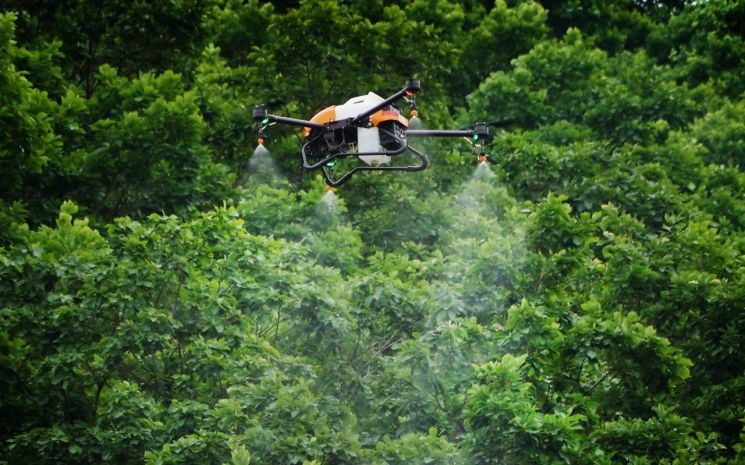
From next year, drones will be deployed for aerial pest control in chestnut orchards. This reflects the intention to fundamentally eliminate the risk of accidents that occur during helicopter-based pest control.
The Korea Forest Service announced on the 8th that it plans to completely switch the pest control method in chestnut cultivation areas from helicopters to drones starting next year.
If pest control is not performed, chestnut production decreases by 59%. Additionally, since most chestnut orchards are established in forested areas, aerial pest control is essential.
For the same reason, the Korea Forest Service has supported aerial pest control in chestnut orchards since 1981. The area supported by aerial pest control by year was 17,540 hectares in 2021, 16,649 hectares in 2022, 15,022 hectares in 2023, and 14,613 hectares this year. Over the past four years, an average of 16,000 hectares of forest (chestnut orchards) have received aerial pest control support annually.
The problem is that the helicopter-based aerial pest control process is exposed to the risk of safety accidents. In fact, the day before, in Hadong-gun, Gyeongnam Province, a French-made small helicopter (AS-350) crashed, injuring one pilot with minor injuries.
The crashed helicopter is estimated to have hit a high-voltage power line at an altitude of 20 meters and then crashed. The Ministry of Land, Infrastructure and Transport’s Aviation and Railway Accident Investigation Board will investigate the cause of the accident and reach a conclusion. The investigation period is expected to take about a year.
Typically, helicopter pest control is conducted at heights of 15 to 20 meters. Since pest control activities are carried out at relatively low altitudes, the risk of accidents is high.
Accordingly, to fundamentally eliminate the risk of accidents, the Korea Forest Service plans to conduct aerial pest control in chestnut orchards using drones instead of helicopters starting next year. With the improved performance of drones, the Korea Forest Service believes that conducting aerial pest control using drones on site will no longer be problematic.
The expected benefits of using drones for aerial pest control are also significant. With the advantage of carrying pesticides on the drone and spraying at close range (within 5 meters), as well as the development of software and radar technologies for obstacle avoidance and terrain tracking, drones can spray pesticides more precisely and in a limited area compared to helicopters, which was fully considered.
Lee Jong-su, Disaster Control Officer at the Korea Forest Service, said, “Deploying drones for aerial pest control in chestnut orchards has been under consideration for some time, and the recent accident only accelerated the timing.” He added, “Once drones are deployed on site, we expect a twofold effect of minimizing safety risks and maximizing pest control effectiveness.”
© The Asia Business Daily(www.asiae.co.kr). All rights reserved.
!["The Woman Who Threw Herself into the Water Clutching a Stolen Dior Bag"...A Grotesque Success Story That Shakes the Korean Psyche [Slate]](https://cwcontent.asiae.co.kr/asiaresize/183/2026021902243444107_1771435474.jpg)
















