Amid the growing repercussions of the electric vehicle fire accident in Cheongna, Incheon, the Ministry of Oceans and Fisheries has established guidelines requiring passenger and cargo ships carrying electric vehicles to maintain battery charge levels at 50% or below.
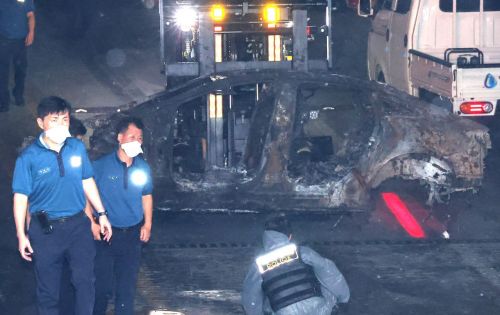
On the 8th, the Ministry of Oceans and Fisheries announced safety measures for the maritime transport of electric vehicle batteries based on this principle. The ministry plans to set a recommended standard in the maritime transport safety guidelines to limit battery charge levels to 50% or less when loading electric vehicles. Until now, the private sector has voluntarily maintained battery charge levels below 50%. According to the National Fire Research Institute, the lower the electric vehicle's charge level, the longer the thermal runaway transition time. When the charge level is 100%, the thermal runaway transition time is only 7 minutes and 50 seconds, whereas at 50%, it extends to about 31 minutes and 59 seconds.
Additionally, to reduce casualties caused by electric vehicle fires, the ministry plans to gradually supply dedicated firefighting equipment to coastal passenger ships by next year. The dedicated firefighting equipment includes devices that spray water upward from beneath the vehicle to prevent thermal runaway transition, as well as smothering fire extinguishing agents and firefighter gear. Initially, about 10 vessels, including passenger ships in Jeju and Ulleung, will be equipped this year, and next year, with secured budget, related equipment will be installed on approximately 150 passenger ships.
Furthermore, the ministry will include in the guidelines a prohibition on charging batteries during the transport of electric vehicles on passenger ships. Electric vehicles with a history of accidents will be restricted from being loaded. However, all these measures are recommendations and not mandatory. There is no obligation to strictly follow these guidelines on site. A Ministry of Oceans and Fisheries official stated, “If these measures were legally enforced, there could be issues with public acceptance among citizens who want to travel with their cars,” and added, “We will consider legislation in the future.”
© The Asia Business Daily(www.asiae.co.kr). All rights reserved.