Honam and Chungcheong Pilgrimage... A Multi-dimensional Perspective
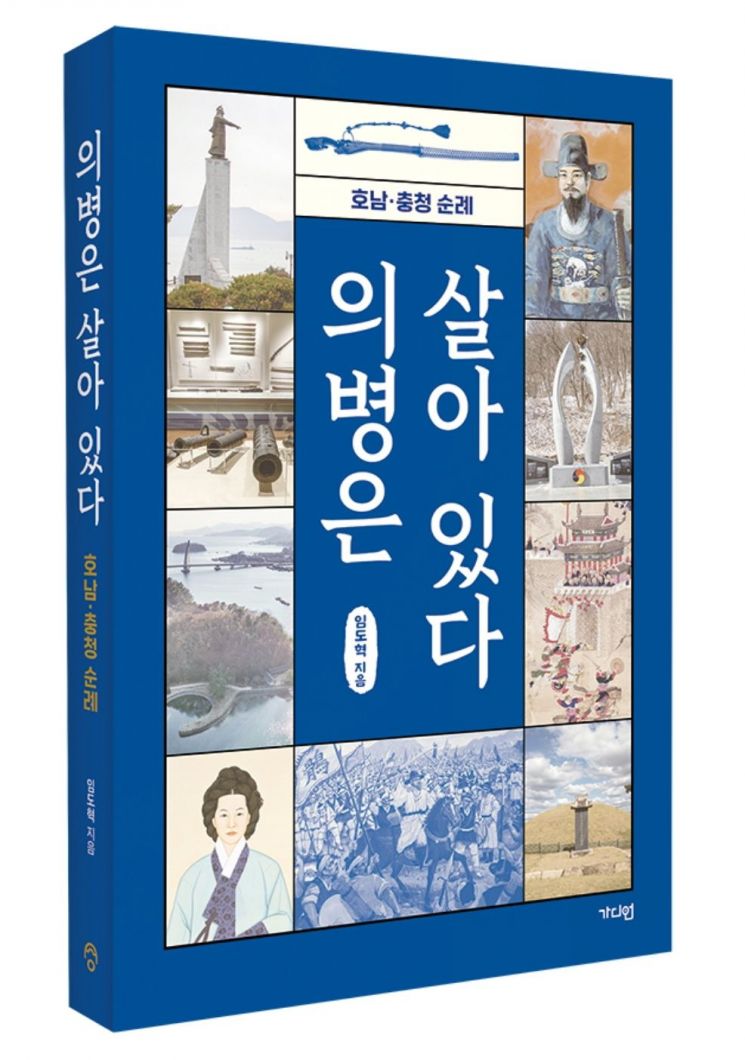
Lim Dohyeok, CEO of Hanbat FM and former reporter for the Chosun Ilbo, has published “Uibyeong Are Still Alive: Pilgrimage to Honam and Chungcheong” (312 pages, Guardian). The book explores the passionate cries and spirit of the Uibyeong (righteous armies) during the Imjin War, which continue to resonate in the hearts of Koreans today, as Lim personally traveled to various historical sites to shed light on their legacy.
The book is divided into four parts. Part 1 covers the roles of the Uibyeong and the navy in changing the course of the Imjin War. Part 2 introduces prominent Uibyeong figures such as Song Jemin, Hwang Jin, Go Gyeongmyeong, Jo Heon, Monk Yeonggyu, and Kim Cheonil. Part 3, focusing on the Jeongyu War, adds accounts of Kim Deokryeong, Hong Gashin, Lee Yeongnam, and Ryu Hyeong, who were active during the brutal devastation of Honam. Part 4 features three wartime diaries, including Gang Hang’s “Ganyangrok.”
The author did not merely rely on literature, historical records, or internet searches to compile the activities of the Uibyeong. Nor did he stop at simply introducing historical sites and sharing his impressions in a flat travelogue. Instead, Lim connected the spatial context of the past with the present and even extended it into the future, striving to present a multidimensional account of the Uibyeong’s activities.
He worked to identify spatial intersections between the Uibyeong and the navy, as well as between the Uibyeong and government forces, and also traced temporal links between the Uibyeong and their descendants, transforming the narrative from “2D” to “3D.” The book also includes future plans such as the sanctification of battle sites and commemorative projects. All of this is the result of the author’s own efforts and exploration on the ground.
The book is filled with gripping and suspenseful stories. In the chapter on Hwang Jin, the hero of the Battle of Ichi, Lim introduces photographs of various anti-Japanese monuments that were destroyed during the Japanese occupation. Seeing the intentionally damaged monuments?such as the statues of General Gwon Yul, Jo Heon, Go Gyeongmyeong, and Monk Samyeong?naturally stirs up anger.
The book also vividly captures the tragedy of the Second Battle of Jinju Fortress and the Battle of Namwon Fortress, the process by which the discourse of “national sweetheart” Nongae was amplified, the contrasting fates of Kim Deokryeong and Hong Gashin, and the story of a scholar who was taken prisoner to Japan, escaped in secret, and returned home via Ming China after more than two years. The reader will feel as if they have boarded a time machine and leapt into the heart of the war.
The author stated, “As you follow the noble footsteps of the Uibyeong, I believe you will gain insights into the past, present, and future,” adding, “We have a duty to discover, honor, and remember their deeds.”
© The Asia Business Daily(www.asiae.co.kr). All rights reserved.
![Clutching a Stolen Dior Bag, Saying "I Hate Being Poor but Real"... The Grotesque Con of a "Human Knockoff" [Slate]](https://cwcontent.asiae.co.kr/asiaresize/183/2026021902243444107_1771435474.jpg)











