Asia Economy Email Inquiry Response
90,000 Domestic Transaction Cancellation Accounts and 630 Billion KRW Scale
"New System Launching at the End of This Month... Communication on Resumption Timing"
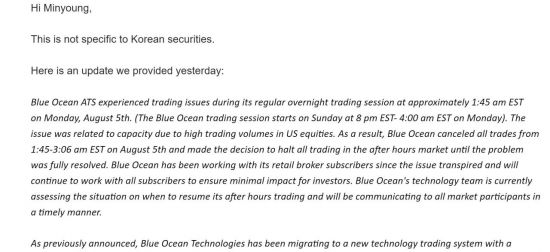 The U.S. Alternative Trading System (ATS) Blue Ocean announced on the 5th that the reason for the cancellation of weekly U.S. stock trades by domestic securities firms was due to system capacity limitations. Email response excerpt. Photo by Cha Min-young
"On the same day, a surge in trading volume in the U.S. stock market caused a capacity shortage in the (system), leading to problems."
Recently, Blue Ocean, a U.S. Alternative Trading System (ATS) that generated cancellations of U.S. stock weekly trading orders amounting to 630 billion KRW in the domestic market, made this statement regarding the recent incident. There are 19 domestic affiliated securities firms, and cancellations occurred in about 90,000 accounts. After the weekly trading ended, the restoration of accounts to their original state by the regular market showed significant discrepancies among securities firms, increasing investor damages.
In an interview with Asia Economy on the 7th, Blue Ocean explained, "This is not an issue exclusive to Korean securities firms," adding, "On the 5th (Eastern Time, U.S.), from 1:45 AM to 3:06 AM, Blue Ocean canceled all trades and decided to suspend all after-hours trading until the problem was completely resolved."
They further stated, "Since this incident, Blue Ocean has been cooperating with securities firm customers and will continue to work with all subscribers to minimize the impact on investors," adding, "Currently, the technical team is considering when to resume after-hours trading and will promptly inform all market participants."
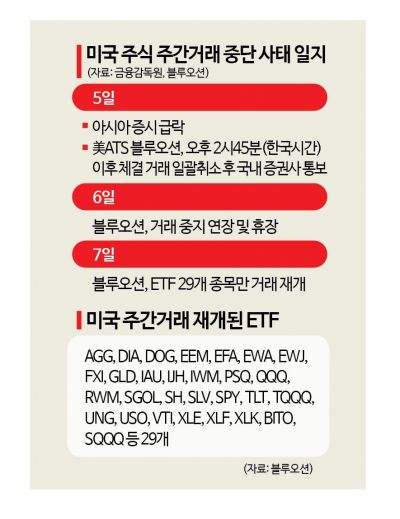
Domestic securities firms have partnered with Blue Ocean, the only provider of local night services in the U.S., to offer U.S. stock day market services. However, on the 5th, Blue Ocean’s trade execution system shut down, unilaterally canceling trades executed after 2:45 PM (Korean time) on the 5th, and the resulting profits and losses were also erased. That day was also the "Black Monday," when all three major U.S. stock indices fell due to the Asian stock market crash. Besides domestic securities firms, the well-known U.S. securities trading platform Robinhood was also reportedly affected. The U.S. media outlet The National Desk (TND) reported, "Robinhood temporarily suspended 24-hour trading early morning on the 5th (local time)."
According to the Financial Supervisory Service, the total amount of canceled trades due to the U.S. stock weekly trading cancellation notification incident is 630 billion KRW. Nineteen securities firms experienced investor damages, with about 90,000 accounts affected. This includes most domestic securities firms, such as NH Investment & Securities, Mirae Asset, Samsung, KB, Kiwoom, and Toss Securities, which had been publicly known.
However, even three days later, Blue Ocean’s system remains incomplete. After the market closure on the 6th, services resumed only for 29 Exchange-Traded Funds (ETFs) as of the 7th. The ETFs currently tradable are products listed on the U.S. market based on major indices or commodities. Among these, semiconductor ETFs preferred by domestic investors, such as "SOXX," "SOXS," and "SOXL," were not included.
Blue Ocean is currently conducting system enhancements. They announced plans to complete the enhancements by the end of this month, but whether additional stocks will resume trading is currently unknown. Blue Ocean emphasized, "As previously announced, Blue Ocean is collaborating with the MEMX exchange to replace the system with a new trading technology system," adding, "The goal is to guarantee a global trading platform that meets the high volatility, growth, and evolution of after-hours trading demand, and this system is scheduled to be operational by the end of this month."
Meanwhile, the likelihood of financial authorities initiating sanctions against securities firms based on this incident is low. Since the outcome was not due to intentional or negligent acts by domestic securities firms, the possibility of firms independently compensating investors is also limited. As of 3 PM on the 7th, 109 complaints had been filed with the Financial Supervisory Service. The FSS stated, "It is difficult to conclude that domestic securities firms are responsible for the unilateral trade cancellations caused by the local alternative trading system’s system error," but added, "We plan to minimize investor dissatisfaction by prioritizing voluntary adjustments between securities firms and investors."
© The Asia Business Daily(www.asiae.co.kr). All rights reserved.
![Clutching a Stolen Dior Bag, Saying "I Hate Being Poor but Real"... The Grotesque Con of a "Human Knockoff" [Slate]](https://cwcontent.asiae.co.kr/asiaresize/183/2026021902243444107_1771435474.jpg)

















