Virtually Includes Most Domestic Securities Firms
Low Possibility of Sanctions... Compensation Likely Difficult
Blue Ocean States "Not Just a Problem for Korean Securities Firms"
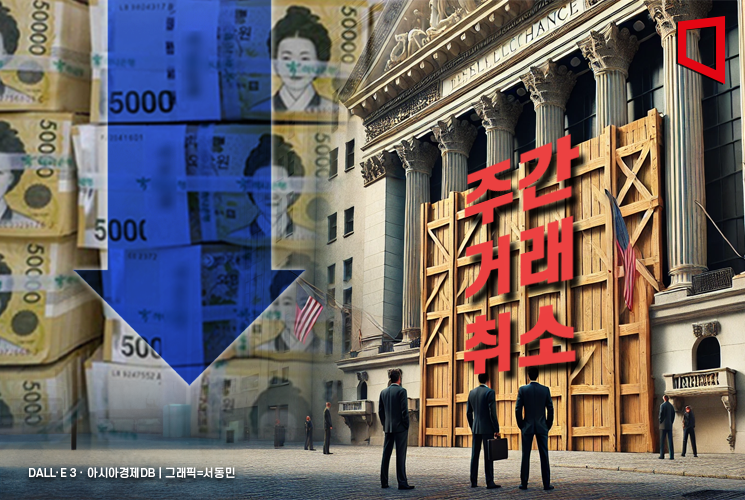
Due to the cancellation notification incident of weekly trading executions for U.S. stocks originating from the U.S. Alternative Trading System (ATS) Blue Ocean, damages amounting to 630 billion KRW occurred across 90,000 domestic accounts. However, since the fundamental cause lies with the overseas exchange rather than domestic securities firms, the authorities are unlikely to impose sanctions. As the damage was not caused by intentional or negligent acts, the possibility of securities firms directly compensating for the losses is limited, and the authorities plan to encourage voluntary resolution between securities firms and investors.
Government Begins Fact-Finding... Assessing Damage Scale
According to the Financial Supervisory Service (FSS) on the 8th, the total amount of canceled trades due to this U.S. stock weekly trading execution cancellation incident is 630 billion KRW. A total of 19 securities firms experienced investor damages, with trades canceled in approximately 90,000 accounts. Almost all domestic securities firms were involved, including NH Investment & Securities, Mirae Asset, Samsung, KB, Kiwoom, and Toss Securities, which had been publicly known.
The FSS stated, "Securities firms, after confirming with local brokers and Blue Ocean, selected the canceled trades and recalculated margin requirements per investor to restore accounts to their original state before resuming order acceptance," adding, "The time required varied by securities firm, so the timing of resuming order acceptance differed."
The FSS further explained the need for restoration: "If weekly trading purchases are not canceled before regular trading sales, short selling may occur, and if weekly trading sales are not canceled before regular trading purchases, unsettled balances may arise."
These securities firms had partnered with Blue Ocean to provide U.S. stock day market services. However, on the 5th (Korean time), Blue Ocean's trade execution system shut down, unilaterally canceling trades executed after 2:45 PM, and the resulting profits and losses were erased. That day was also the "Black Monday," when all three major U.S. New York indices fell due to a plunge in Asian stock markets. Besides domestic securities firms, the well-known U.S. securities trading platform Robinhood was also reportedly affected. The U.S. media outlet The National Desk (TND) reported, "Robinhood temporarily suspended 24-hour trading early morning on the 5th (local time)."
Domestic investors are expressing frustration not only over the trade cancellations on the day but also regarding the securities firms' follow-up measures. Some claim they suffered losses in regular trading due to the aftereffects of previous order execution cancellations, even though the weekly trading had ended and regular trading had begun. On communities such as Blind, investors voiced complaints like, "It was an incomprehensible measure to block accounts even after regular trading started," and "Although the settlement was canceled, the funds were already held as deposits, so order cancellations were impossible, restricting regular trading." Some have begun recruiting affected investors for class-action lawsuits via open chat rooms.
However, the financial authorities are unlikely to initiate sanctions against securities firms based on this incident. As of 3 PM on the 7th, the FSS had received 109 complaints. The FSS stated, "Since the unilateral trade cancellations were caused by a system error in the local alternative trading system, it is difficult to attribute fault to domestic securities firms," but added, "We plan to minimize investor dissatisfaction by prioritizing voluntary resolution between securities firms and investors."
Blue Ocean: "Not a Problem Exclusive to Korean Securities Firms"
The fundamental cause of this incident was a system error on Blue Ocean's side, unable to handle the increased trading volume amid volatile markets. In response to Asia Economy's email inquiry, Blue Ocean explained, "This is not an issue limited to Korean securities firms," and "The problem stems from capacity issues due to a surge in trading volume in the U.S. stock market." They added, "Blue Ocean will continue to cooperate with all subscribers to minimize the impact on investors," and "Our technical team is currently considering when to resume after-hours trading and will promptly inform all market participants."
Even three days later, Blue Ocean's system remains incomplete. After the market closure on the 6th, as of the 7th, services have resumed only for 29 listed Exchange-Traded Funds (ETFs). Blue Ocean notified partnered domestic securities firms that only some ETFs can be traded. The ETFs currently tradable are products based on major indices or commodities listed on the U.S. market. However, popular semiconductor ETFs among domestic investors such as 'SOXX,' 'SOXS,' and 'SOXL' are not included. Blue Ocean is currently working on system improvements. Although they announced plans to complete this by the end of the month, it is currently unknown when additional securities will be available for trading.
A representative from a major securities firm said, "Domestic securities firms inform customers that overseas stock trading may not proceed smoothly due to local liquidity issues," and added, "Since the trade cancellations were not due to intentional or negligent acts, there appears to be no legal basis to provide compensation to the victims."
Meanwhile, the FSS warned that overseas stock trading inherently carries risks of system failures and price information errors depending on the stability of local brokers or exchanges, urging investors to exercise caution. Especially for weekly trading, since all trading volume of our investors is executed through a single alternative trading system, investors need to be particularly careful. The FSS also plans to explore measures to enhance the stability of overseas stock investments.
© The Asia Business Daily(www.asiae.co.kr). All rights reserved.


















