Hankyung Association, Professor Cha Jin-ah of Korea University Presents Research Report
"Legalization of Illegality - Concerns over Infringement of Management and Property Rights"
There has been a claim that the amendment to the Labor Union and Labor Relations Adjustment Act (the Yellow Envelope Act), which passed the National Assembly plenary session, should be thoroughly reconsidered as it could effectively justify illegal activities by labor unions.
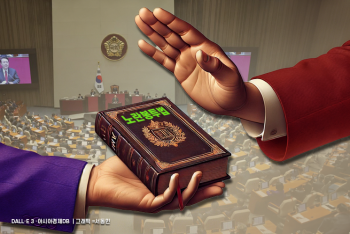
On the 8th, the Korea Employers Federation made this claim through a research report titled "Review of the Unconstitutionality of the Labor Union Act Amendment," commissioned to Professor Cha Jin-ah of Korea University Law School.
First, the amendment expands the concept of the employer, increasing the possibility of violating the principle of legality in criminal law. The principle of legality requires that the elements of a criminal offense and the punishment (result) be clearly defined in the penal code. The amendment broadens the concept of the employer beyond the party to the employment contract to include those who can "substantially and concretely control or determine" the working conditions of employees. The criteria for judging "substantial and concrete control or determination" of working conditions are unclear. This could expand the scope of employers. Multiple employers could be subject to criminal penalties for violations of the Labor Union Act.
Moreover, if the scope of employers is expanded, collective bargaining between the primary employer and subcontractor unions, who do not have a direct employment contract with subcontracted workers, could become possible. The report argued that "the management rights of subcontracting employers would be excessively infringed."
The increase in the scope of labor disputes is also problematic, as strikes related to restructuring and other issues could increase. If the concept of labor disputes is expanded from disputes concerning the "determination of working conditions" to disputes concerning "working conditions" as per the amendment, not only interest disputes (negotiation matters between labor and management) but also rights disputes (subject to judicial remedies) would be included in labor disputes. Simply put, unions could initiate disputes with management not only over wage increases and working hours adjustments but also over existing working conditions. The report warned, "With the expansion of the concept of labor disputes, strikes could occur over matters essential to the employer's management rights, such as restructuring and managerial dismissals," and expressed concerns that "the employer's fundamental rights, such as freedom of occupation and property rights, would be infringed, and social costs would surge."
On the other hand, claims for damages by employers would be restricted. The amendment stipulates that claims for damages by employers are limited not only for legitimate collective bargaining or strike actions but also for "other union activities." The report pointed out that the criteria for judging "other union activities" are ambiguous, violating the constitutional principle of clarity. The principle of clarity requires that the content of legal norms restricting fundamental rights be clearly defined. The scope of limiting employer claims for damages is narrowed, potentially exempting all union activities, including illegal strike actions such as violence, destruction, and political strikes, from liability for damages. The report stated, "This could effectively justify illegal union activities and lose constitutional legitimacy."
There are also criticisms that the amendment contradicts the intent of civil law. The amendment requires that when calculating liability for damages arising from illegal strike actions or other union activities, the responsibility range should be determined by considering the contribution of individual union members to the damage. The reason civil law recognizes joint and several liability for joint illegal acts is to protect victims from joint illegal acts where individual responsibility is unclear. Denying joint liability only for illegal union acts, as in the amendment, contradicts the intent of civil law. It may also infringe on the employer's right to equality. While the amendment recognizes exceptions to joint liability for illegal union acts, it does not consider disadvantages to employers. It is also practically difficult for employers to prove the contribution of individual union members to losses caused by collective union actions such as strikes. Therefore, the employer's right to claim damages is likely to be effectively nullified.
Professor Cha said, "The legislation is tilted in favor of unions, causing an imbalance of power between labor and management and potentially worsening labor-management relations," adding, "Considering the possibility of negative effects such as effectively justifying illegal union acts, worsening labor conflicts, and a surge in social costs, the legislation needs to be thoroughly reconsidered."
© The Asia Business Daily(www.asiae.co.kr). All rights reserved.

















