Hana Tour Faces Double Trouble with T-Mef Incident and Stock Price Drop
Hanon Systems Likely to Renegotiate Contract Terms
SK and Doosan's 'Rebalancing' at Risk if Buyback Requests Surge
Market instability is casting a shadow over the mergers and acquisitions (M&A) market as well. This is because the likelihood of disagreements arising between buyers and sellers over the 'value' of listed company M&A deals has increased. Some discord has already begun to surface.
According to the Korea Exchange on the 8th, Hana Tour's stock price fell 8.55% from 50,300 won to 46,000 won (as of the 7th) this month. The valuation, previously estimated at over 1 trillion won, is likely to be adjusted, presenting an unexpected obstacle. Another listed company on the market, Hanon Systems, which has already signed a memorandum of understanding (MOU), is also showing signs of turbulence due to the stock price decline, and the stock price is expected to be a variable in the SK and Doosan Group's restructuring (rebalancing) efforts.
Hana Tour Faces Double Trouble from the Timef Incident and a Bear Market
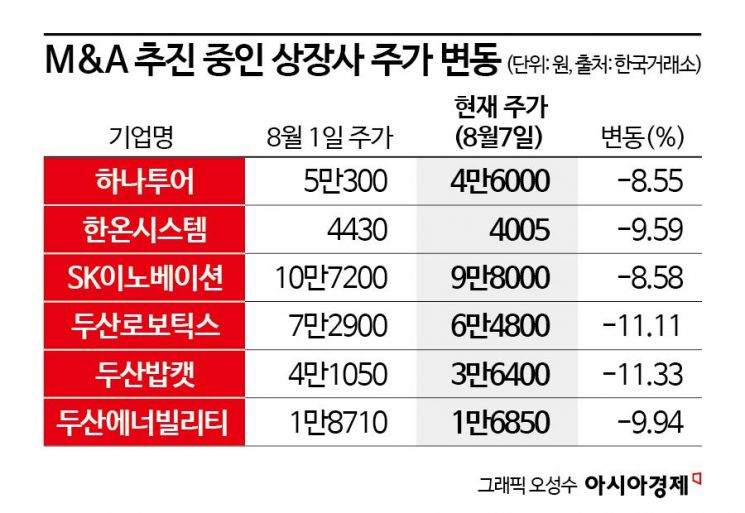
Hana Tour's sale is being led by IMM Private Equity (PE), a private equity fund (PEF) operator. The sale target includes 16.68% of Hana Tour shares held by IMM PE through a special purpose vehicle and a combined 27.7% including shares held by the founder and related parties. IMM PE, which became the largest shareholder in 2019, has embarked on a full-scale investment exit after about five years. Just two months ago, the valuation was over 1 trillion won. At that time, the stock price was 57,000 won (market capitalization of 914.2 billion won), with a 30% premium for management control added. However, the travel industry was hit hard by the delayed settlement incident involving Timef (Timon + Wemakeprice), and combined with the overall bear market, the market capitalization dropped to 737.8 billion won as of the 7th, erasing 176.4 billion won in just two months.
An investment banking (IB) industry insider said, "Even if the stock price is undervalued, the visible market price cannot be ignored," adding, "It will be difficult for sellers to get the value they want at the current stock price." This means the gap between buyers' and sellers' expectations could widen due to the stock price.
Another listed company M&A deal, Hanon Systems, has experienced discord during the sale process. Korean Tire, which signed an MOU with PEF operator Hahn & Company in May, failed to pay the capital increase funds scheduled for the 3rd. The market points to a 'valuation gap' as the cause, with speculation that Korean Tire may be seeking a price adjustment. At the time of the MOU, the acquisition price was 10,250 won per existing share and 5,605 won per new share from the capital increase. However, the stock price has continued to decline, standing at 4,005 won as of the 7th. Nonetheless, since the two companies have a long-standing relationship and the MOU has strong binding power, it is unlikely that the sale will collapse.
Stock Prices Emerge as a Variable Ahead of 'Rebalancing'
SK Group, which is pushing for mergers among its affiliates, has also been affected by the stock price decline. The stock price of SK Innovation, which is scheduled to merge with SK E&S, is 98,000 won, about 12.5% lower than the stock purchase right exercise price (111,943 won). If general shareholders seeking to realize gains flood the exercise of stock purchase rights, it could exceed the limit of 800 billion won. If the limit is exceeded, the merger contract will be canceled. Doosan Group, which is pushing for a merger between Doosan Bobcat and Doosan Robotics, is in a similar situation. Both groups are concerned that the unstable stock market and resulting stock prices could become obstacles to the mergers.
Meanwhile, the still sluggish M&A market is expected to rebound after the U.S. interest rate cuts in September. The biggest cause of the M&A market downturn was the "three highs" (high interest rates, high inflation, and high exchange rates). Jung Kyung-soo, head of the M&A Center at Samil PwC, said, "It will definitely be a positive factor as financing will become easier than now," adding, "I believe the market situation is likely to improve compared to the current state."
© The Asia Business Daily(www.asiae.co.kr). All rights reserved.
![Clutching a Stolen Dior Bag, Saying "I Hate Being Poor but Real"... The Grotesque Con of a "Human Knockoff" [Slate]](https://cwcontent.asiae.co.kr/asiaresize/183/2026021902243444107_1771435474.jpg)
















