Muhammad Yunus, who led the movement for unsecured microloans to the poor and won the Nobel Peace Prize, has been appointed to lead the interim transitional government of Bangladesh.
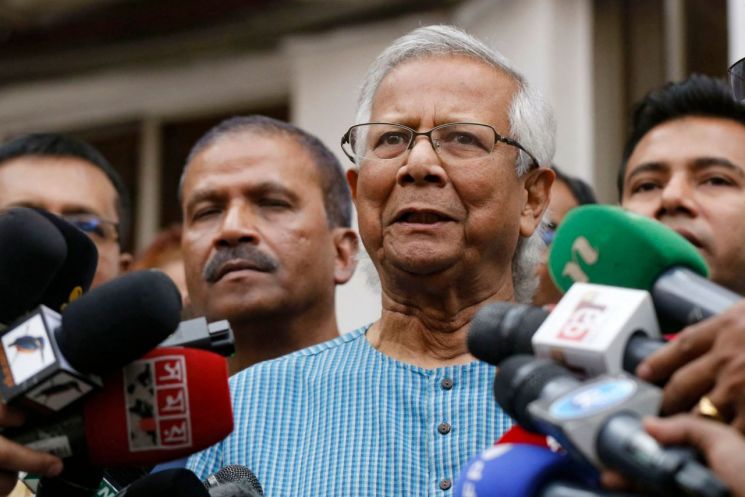
According to Bloomberg News on the 7th, a spokesperson for the President of Bangladesh announced that President Mohamed Shahabuddin met with anti-government student leaders, military officials, business figures, and civil society activists, and after consultations, appointed Yunus as the head of the transitional government. This announcement came just one day after Prime Minister Sheikh Hasina, who had ruled Bangladesh for a long time, fled abroad under pressure from anti-government protesters and resigned from her position.
Accordingly, 84-year-old Yunus will take on the heavy responsibility of stabilizing the chaotic situation in Bangladesh caused by anti-government protests and the prime minister’s resignation. Bangladesh, a parliamentary system, does not grant real power to the president. Bloomberg News evaluated, "Although Yunus has largely stayed out of politics, he is one of the most famous figures in Bangladesh and wields considerable influence among Western elites." This decision was reportedly recommended by the student leadership that led the protests, and the military is also said to have supported him.
As a poverty eradication activist, Yunus is known as the pioneer of so-called ‘microfinancing’ for providing unsecured microloans to the poor who had difficulty obtaining bank loans. He received the Nobel Peace Prize in 2006 for his contributions to helping the poor. At one point, he attempted to call for political reform by founding a new party but gave up after a few weeks. In recent years, he also spent a long time in court facing about 200 charges including money laundering and bribery against himself and his colleagues. Locally, these charges were widely seen as politically motivated, with the Hasina regime feeling threatened by him behind the scenes.
Other members of the interim government are expected to be announced within the next few days. Asif Nazrul, a law professor at Dhaka University who attended the meeting with the president, told The New York Times (NYT), "We are forming a government in an emergency situation," adding, "The term of the government has not been determined."
However, it is expected that normalizing Bangladesh amid the spreading instability will not be an easy task for Yunus. Political unrest is likely to continue for some time even under the transitional government, and Yunus himself has mentioned in media interviews that "politics is very uncomfortable" for him, indicating a lack of relevant experience. Considering Bangladesh’s history of multiple military governments after its independence from Pakistan, it remains to be seen whether the military will limit its role to mediator in establishing the transitional government during this national emergency.
Anti-government protests, mainly led by university students, spread in Bangladesh after the Dhaka High Court decided in June to reinstate the public office quota system for children of independence activists. The situation escalated into the worst violence in Bangladesh’s history, with over 300 deaths, especially after then-Prime Minister Hasina ordered a violent crackdown. Fahmida Katun, research director at the think tank Policy Dialogue Centre, diagnosed, "As you can see, there is no order on the streets, trust in the police is lacking, and significant property damage has occurred," adding that the interim government’s top priority will be restoring peace.
It remains uncertain whether Yunus will fully enter politics or merely fill the gap until an early general election. Bloomberg News reported, "In recent weeks as protests spread, Yunus publicly raised his voice against violence and described Hasina’s violent crackdown as a threat to democracy, but he did not mention any political ambitions." He had said in an interview earlier this year, "I am not a politician."
© The Asia Business Daily(www.asiae.co.kr). All rights reserved.
![Clutching a Stolen Dior Bag, Saying "I Hate Being Poor but Real"... The Grotesque Con of a "Human Knockoff" [Slate]](https://cwcontent.asiae.co.kr/asiaresize/183/2026021902243444107_1771435474.jpg)
















