National Cybersecurity Cooperation Center Relocates to Pangyo Campus
National Intelligence Service to Launch 'Cyber Partners' Next Month
Yoon Oh-jun: "Core Hub for National Cyber Cooperation"
The National Intelligence Service (NIS) has renamed the National Cybersecurity Cooperation Center to the "Pangyo Campus." Since cyberattacks are carried out simultaneously across borders and institutions, the policy is to strengthen cooperation and communication between government agencies and private companies for national-level response.
On the morning of the 7th, Yoon Oh-jun, the 3rd Deputy Director of the NIS, held a press conference at the National Cybersecurity Center Pangyo Campus in Seongnam, Gyeonggi Province, to announce this plan. The NIS opened the National Cybersecurity Cooperation Center at this location in November 2022. It serves as a joint platform for the public, private, and military sectors to share cyber threat information and technology, and to enable rapid and efficient national-level response in case of incidents.
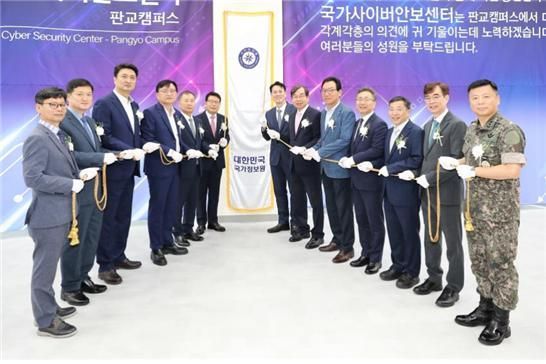 Plaque Unveiling Ceremony at the National Cybersecurity Center Pangyo Campus.
 [Photo by National Intelligence Service]
Deputy Director Yoon said, "We have operated under the title of National Cybersecurity Cooperation Center for about 20 months, and we believe we have achieved some results aligned with our goals of communication, cooperation, and mutual growth." He added, "We considered how to take a step forward with a more progressive approach and decided to change the name to Pangyo Campus." He also stated, "We will do our best to make Pangyo Campus a space that engages with the public and to become a core hub for national cyber cooperation, including communication, education and training, and corporate co-prosperity."
The NIS plans to carry forward and develop the core values of the existing cooperation center, known as the "3C"?Communication, Collaboration, and Co-prosperity?into the "3H" through the newly launched Pangyo Campus. It aims to serve as a "Hub" for communication and cooperation, education and training, and corporate co-prosperity. Currently, more than 60 personnel from 15 national and public institutions and 9 information security companies are stationed at the Pangyo Campus, with 12 related institutions and companies participating as non-residents.
The NIS also plans to launch the nationwide cybersecurity alliance "Cyber Partners" in September and strengthen communication with related industries during the formulation of national cybersecurity policies such as network separation and supply chain security. Cyber Partners will be centered on national and public institutions, information security companies, and companies related to critical national functions such as telecommunications, defense, healthcare, finance, and power. The goal is to create a cooperative body that serves as a focal point for public-private collaboration by timely sharing cyber threat information and preventing the spread of damage.
Additionally, the first international cyber exercise led by South Korea, "APEX (Allied Power EXercise) 2024," is scheduled to be held next month. This policy is based on accumulated experience from participating in NATO's largest cyber defense exercise, "NATO Locked Shields," for four consecutive years and winning first place in this year's UK-hosted DCM exercise.
According to the NIS, the number of public-private information sharing cases, which was about 40,000 in 2020, has significantly increased to 360,000 in 2023 and 420,000 this year since the center's opening. The NIS operates platforms (NCTI and KCTI) that allow national and public institutions and private companies to share cyber threat information. The number of participating institutions and companies has grown from 8 in August 2015 to 630 as of this month.
Meanwhile, the plaque unveiling ceremony held the previous day was attended by Shin Yong-seok, Cybersecurity Secretary of the Presidential Office; Cho Won-hee, Commander of Cyber Operations; Lee Kyung-min, Chief of Security at the Counterintelligence Command; Lee Dong-jung, Director of the National Cyber Crisis Management Group; Hwang Soo-hoon, Director of the National Security Technology Research Institute; Lee Sang-joong, President of the Korea Internet & Security Agency; Kim Cheol-woong, President of the Financial Security Institute; Cho Young-chul, Chairman of the Information Security Industry Association; Lee Ki-joo, President of the Korea CISO Association; Cho Joon-hee, Chairman of the Korea Software Industry Association; Kim Sang-bae, President of the Korea Cybersecurity Society; and Ha Jae-chul, President of the Korea Information Security Association.
© The Asia Business Daily(www.asiae.co.kr). All rights reserved.
![Clutching a Stolen Dior Bag, Saying "I Hate Being Poor but Real"... The Grotesque Con of a "Human Knockoff" [Slate]](https://cwcontent.asiae.co.kr/asiaresize/183/2026021902243444107_1771435474.jpg)

















