Continued Current Account Surplus Due to Increased IT Exports Including Semiconductors
Possibility of Reduced Travel Account Deficit Due to Yen Strength
July Current Account Surplus Expected to Narrow Due to Increased Imports
The current account balance in June recorded the largest surplus in 6 years and 9 months. This was due to the continued strong performance of semiconductor exports and an expanded decrease in imports caused by delayed domestic demand recovery. The surplus for the first half of the year exceeded the initial forecast by about $10 billion, suggesting that the annual forecast will also be revised upward.
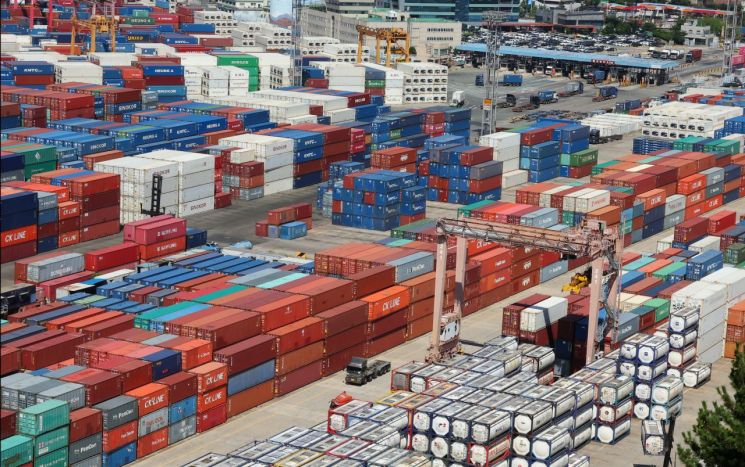
According to the 'June Balance of Payments (provisional)' released by the Bank of Korea on the 7th, the current account balance in June recorded a surplus of $12.26 billion. This marked a positive balance for two consecutive months since May, with the surplus significantly expanding compared to the previous month ($8.92 billion). It is also the largest surplus since September 2017 ($12.34 billion).
The current account surplus for the first half of the year accumulated to $37.73 billion, exceeding the initial forecast by about $10 billion. Earlier, the Bank of Korea had projected a current account surplus of $27.9 billion for this year in its May economic outlook, but exports of IT items such as semiconductors and information and communication devices improved significantly beyond expectations, greatly surpassing the forecast.
Song Jae-chang, head of the Financial Statistics Department at the Bank of Korea's Economic Statistics Bureau, explained the reasons for the large current account surplus: "The continued export boom, including record-high semiconductor exports driven by increased demand in AI-related upstream industries and rising memory prices, combined with an expanded decrease in imports of goods such as semiconductor manufacturing equipment and passenger cars due to delayed domestic demand recovery, contributed to the large surplus."
Accordingly, the annual current account forecast is also expected to be revised upward. Previously, the Bank of Korea forecasted a $60 billion surplus for this year, but the first half of the year has already achieved about 60% of the annual forecast.
Mr. Song stated, "Based on customs clearance data, the trade balance in July narrowed somewhat compared to June, so the current account surplus in July is expected to shrink slightly," but added, "However, considering the continued export boom due to improvements in the global manufacturing economy and the steady inflow of investment income, the surplus trend is expected to continue for the time being in the second half of the year."
He added, "However, there are variables such as the U.S. economic situation, the possibility of a slowdown in AI investment, directions of major countries' monetary policies, the U.S. presidential election, and geopolitical risks in the Middle East."
Goods Balance Records Largest Surplus in 3 Years and 9 Months... Semiconductor Exports Up 50.4%
Looking at the current account balance by category in June, the goods balance (exports minus imports) recorded a surplus of $11.47 billion, the largest since September 2020 ($12.02 billion). The cumulative goods balance for the first half of the year was a surplus of $44.27 billion.
The goods balance surplus was driven by exports of IT items such as semiconductors and information and communication devices. Exports in June reached $58.82 billion, an 8.7% increase compared to the same month last year. Based on customs clearance data, semiconductor exports rose by 50.4%, information and communication devices by 26.0%, petroleum products by 8.5%, and passenger cars by 0.5%. Meanwhile, steel product exports continued to decline by 18.0%. Exports of machinery and precision instruments (-1.4%) and chemical products (-7.5%) also showed weakness.
By region, exports increased to Southeast Asia (27.9%), the United States (14.8%), and China (1.8%) compared to the same month last year, while exports to Japan (-6.8%) and the European Union (EU, -18.3%) continued to decline.
Imports amounted to $47.35 billion, down 5.7% from the same month last year. This was due to delayed domestic demand recovery, deferred investment in semiconductor manufacturing equipment, and delayed aircraft imports in some sectors. Based on customs clearance data, raw materials such as coal decreased by 6.6%, capital goods including semiconductor manufacturing equipment and semiconductors decreased by 4.6%, and consumer goods such as passenger cars and grains decreased by 15.6% compared to the same month last year.
Imports are expected to gradually increase in the second half of the year. Mr. Song explained, "Looking at the trade balance based on customs clearance data for July, goods imports increased in July. Although capital goods and consumer goods imports have had seasonal characteristics, as domestic manufacturers resume facility investments and raw material prices stabilize, the decline in imports is expected to ease in the second half of the year."
The services balance recorded a deficit of $1.62 billion in June, mainly due to travel and other business services. The deficit widened compared to the previous month (-$1.29 billion).
The travel balance deficit reached $900 million. The deficit slightly expanded compared to the previous month (-$860 million) as travel income decreased more than travel payments.
Due to the recent rebound in the yen, the travel balance deficit may decrease in the future. Mr. Song said, "The previous trend of travel balance deficits was influenced by the weak yen, but recently, the Bank of Japan (BOJ) raised interest rates and expectations of a rate cut by the U.S. Federal Reserve (Fed) have led to a stronger yen. As a result, demand for travel to Japan, which had been activated by the weak yen, is expected to weaken somewhat."
The primary income balance recorded a surplus of $2.69 billion, expanding from $1.76 billion in the previous month. The dividend income surplus widened to $2.34 billion from $1.13 billion in April as the effect of quarterly dividend payments in the previous month disappeared. Interest income recorded a surplus of $480 million.
The net financial account, which is capital minus liabilities, increased by $12.24 billion, the largest increase since October 2020 ($18.75 billion). Direct investment saw an increase of $4.89 billion in domestic investors' overseas investments, while foreign investment in the domestic market decreased by $370 million. Securities investment showed an increase of $6.63 billion in domestic investors' overseas investments, mainly in stocks, while foreign investment in the domestic market decreased by $2.39 billion, mainly in bonds.
© The Asia Business Daily(www.asiae.co.kr). All rights reserved.
![Clutching a Stolen Dior Bag, Saying "I Hate Being Poor but Real"... The Grotesque Con of a "Human Knockoff" [Slate]](https://cwcontent.asiae.co.kr/asiaresize/183/2026021902243444107_1771435474.jpg)
















