Persistent Depression and Lethargy for 2 Weeks
'Setting Goals During Work' Helps Recovery
Lee (31), an office worker living in Dongjak-gu, Seoul, has been suffering from severe work stress after recently returning from a 5-night, 6-day trip to Vietnam. Upon finishing his vacation, he found himself overwhelmed with neglected tasks and work-related messages from his team members, leaving him with no time to breathe. Initially, he thought it was just simple work stress, but after nearly two weeks of persistent lethargy, depression, headaches, and dizziness since his return, Lee recently visited a hospital.
Lee said, "I went on vacation to escape daily life, but as the return date approached, I felt depressed and unfocused even while on vacation. On the first day back, seeing the flood of messages made me realize I was back to reality. Now, I don't know what to wait for or endure."
 On the afternoon of the 3rd, when the summer vacation season reached its peak, Haeundae Beach in Haeundae-gu, Busan, was crowded with vacationers cooling off from the heat.
 [Photo by Yonhap News]
As such, more office workers are reporting what is called 'vacance syndrome,' characterized by severe depression and lethargy after summer vacations end. Experts advise that planning the next vacation in advance or setting small goals within work to focus on one task can help ease the transition back to daily life.
According to job search site JobKorea on the 7th, among about 330 male and female office workers surveyed last year, 69% responded that they had experienced burnout syndrome. Burnout syndrome refers to a state of extreme fatigue, as if energy is suddenly drained after focusing intensely on one task. Notably, most office workers reported overcoming burnout through 'vacation.' In the same survey, when asked how they overcame burnout, 47.9% said they took a vacation or leave of absence, which was the highest response. Other responses included 'enjoying hobbies outside of work' (41.5%) and 'changing jobs' (26.7%).
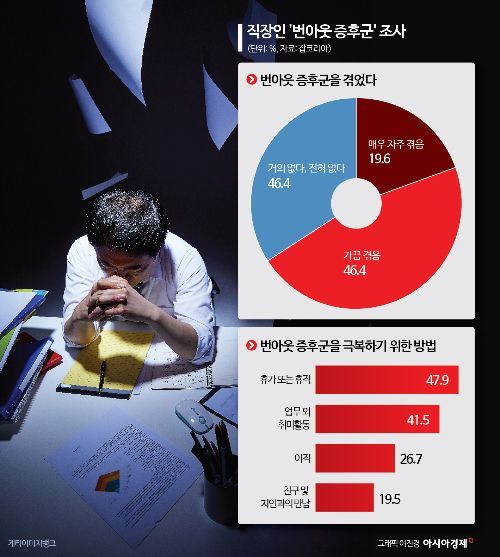
However, quite a few people feel even greater lethargy after their vacation. If symptoms such as lethargy, depression, fatigue, headaches, and nausea persist for two weeks after returning from vacation, it is considered vacance syndrome. Generally, the symptoms worsen with heavier workloads and longer vacation periods.
Experts say that vacance syndrome itself is a natural phenomenon but recommend consulting a professional if it continues for a long time. They also advise that maintaining a regular lifestyle and setting small goals can help with returning to daily life. Professor Baek Jong-woo of Kyung Hee University’s Department of Mental Health Medicine said, "Many office workers work while waiting only for summer vacation as an opportunity for rest and recharge. The end of vacation can mean there is nothing more to look forward to." He added, "First, it is good to maintain a regular lifestyle to recover the disrupted body rhythm caused by the vacation. Planning the next vacation in advance or setting and practicing small goals within work can naturally help recover from the syndrome."
© The Asia Business Daily(www.asiae.co.kr). All rights reserved.
![Clutching a Stolen Dior Bag, Saying "I Hate Being Poor but Real"... The Grotesque Con of a "Human Knockoff" [Slate]](https://cwcontent.asiae.co.kr/asiaresize/183/2026021902243444107_1771435474.jpg)












