Suspicions of Political Pressure Intervention Also
Criticism is pouring in on the Bank of Japan (BOJ) as it is being pointed out that the global stock market crash was triggered by the BOJ's interest rate hike. It is argued that the BOJ raised rates without properly understanding the economic situation. There are also suspicions that political pressure was involved.
On the 6th, Nobuyasu Atago, a senior economist at Rakuten Securities Economic Research Institute and a former BOJ official, told Bloomberg News, "The BOJ should be humble about economic data and the market," adding, "The fact that the BOJ raised interest rates despite poor economic statistics shows that the BOJ did not pay attention to the data."
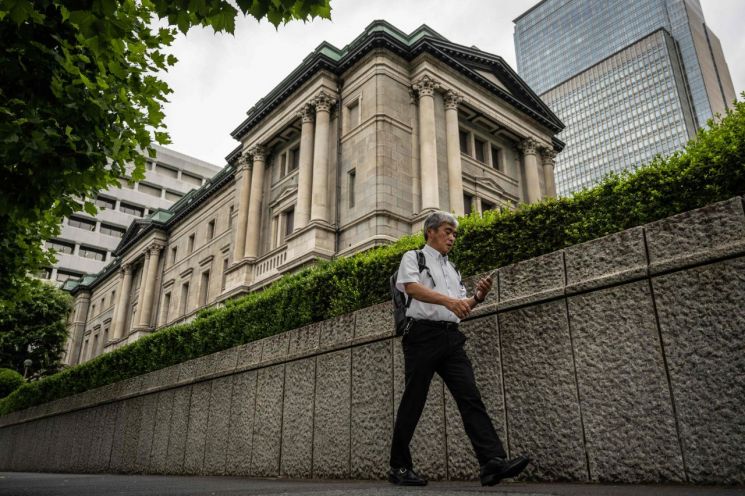
At the time of the rate hike, BOJ Governor Kazuo Ueda repeatedly emphasized that the decision was based on economic and inflation data. However, on the 5th, the Nikkei 225 average closed down 12.4% from the previous trading day. This is the largest drop ever, surpassing the 'Black Monday' on October 20, 1987. As the yen surged, the dollar-yen exchange rate briefly fell to the 141 yen level on the 5th. Bloomberg reported that the yen's sharp rise worsened the profits of export companies and caused the stock market to plummet. This has led to voices saying that the BOJ raised rates too quickly.
Mari Iwashita, chief market economist at Daiwa Securities, described it as "a poorly timed rate hike." She said, "The BOJ can wait to see whether the U.S. economy will enter a recession or achieve a soft landing before taking the next step," adding, "At the very least, rate hikes in September and October are now impossible."
Initially, economists expected the BOJ to raise rates again by the end of the year. According to last week's Bloomberg survey, the market anticipated that Japan's policy rate would reach 0.5% by year-end. However, Bloomberg reported that due to fierce criticism, it seems difficult for the BOJ to raise rates for the time being.
Some speculate that political pressure was behind the BOJ's rate hike. Economist Atago said, "I think political factors were behind the (rate hike) decision," adding, "It can only be interpreted as a signal of communication between politics and the BOJ on how to deal with yen depreciation." He also said that consumption and production data are too weak to justify a rate hike.
In fact, ahead of the rate hike, two heavyweight politicians from the Liberal Democratic Party unusually expressed opinions on BOJ policy. Toshimitsu Motegi, LDP Secretary-General, said the BOJ should more clearly show its policy to normalize financial policy, and Taro Kono, Minister of Digital Affairs, opposed yen depreciation in a Bloomberg interview.
However, there is also an assessment that the BOJ's rate hike decision was correct and that the recent market plunge was due to weak U.S. employment data and the Federal Reserve's (Fed) decision not to cut rates. Jesper Koll, director at Monex Group, said, "Normalizing interest rates is the right thing to do, and the BOJ did not move too quickly."
Kenjaki Jin, chief economist for Japan at Soci?t? G?n?rale, said that as market views on the possibility of a U.S. recession calm down, the BOJ may raise rates again around December. He also noted that the current stock market crash has been more influenced by the U.S.
© The Asia Business Daily(www.asiae.co.kr). All rights reserved.

















