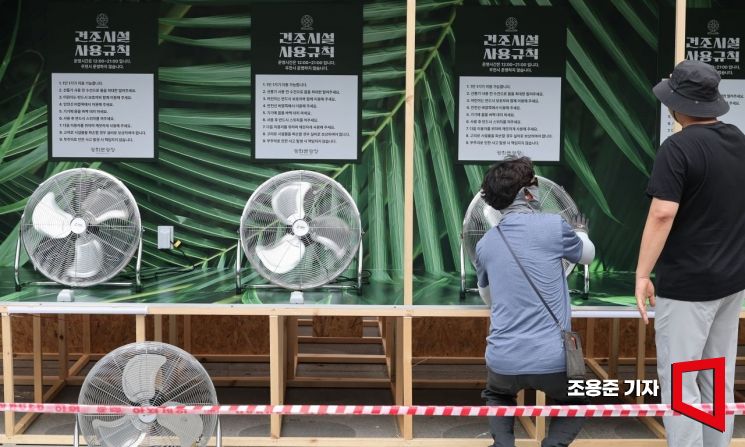
Heat-related illnesses are surging due to prolonged scorching heat. This year, the total number of heat-related illness cases reached 1,690, with 14 reported deaths.
On the 6th, the Central Disaster and Safety Countermeasures Headquarters (CDSCH) of the Ministry of the Interior and Safety announced that as of 11 p.m. the previous day, two additional deaths caused by the heatwave were confirmed, bringing the cumulative death toll to 14. The number of heat-related illness cases increased by 112.
On the morning of the 4th at 9:44 a.m., a 71-year-old woman collapsed due to the heatwave in Jungnang-gu, Seoul. She was found by a caregiver and transported to a hospital but passed away. On the same day at 2 p.m., a 78-year-old woman collapsed and died while working in a field in Goheung-gun, Jeollanam-do. In Miryang, Gyeongsangnam-do, a Vietnamese man in his 60s who had collapsed from heatstroke on the 2nd also died.
Damage to livestock and aquaculture due to the heatwave is also continuing. From June 11 to the 5th of this month, 303,000 livestock animals died, including 26,000 pigs and 277,000 poultry. Aquaculture losses amounted to 10,767 fish, including flatfish.
The nationwide heatwave is expected to continue for the time being. Currently, the upper atmosphere over the Korean Peninsula is dominated by the Tibetan High, while the middle and lower layers are influenced by the North Pacific High. This means that hot air is covering the entire atmosphere in a double layer. The Korea Meteorological Administration (KMA) has determined that there are no factors to suppress the heat on the peninsula until the 11th, and the heatwave with temperatures exceeding 36 degrees Celsius is expected to persist.
Concerns have also been raised that the worst-ever heatwave in 2018 may be repeated. At that time, the Tibetan High and North Pacific High simultaneously settled over the Korean Peninsula, causing temperatures to soar up to 41 degrees Celsius in some areas. Afterward, temperatures exceeding 40 degrees were not observed until a high temperature of 40 degrees was recorded on the 4th in Jeomdong-myeon, Yeoju, Gyeonggi-do, for the first time in six years.
The KMA forecasted that on this day, the highest perceived temperatures would remain around 35 degrees Celsius in most regions nationwide, with tropical nights continuing. Currently, heatwave advisories have been issued for 17 areas including Incheon, Gangwon, and Ulsan, while heatwave warnings are in effect for 165 areas including Seoul and Busan.
© The Asia Business Daily(www.asiae.co.kr). All rights reserved.

















