US Employment Data Shocks Market
Daily: "Labor Market Slows... Interest Rate Cut Next Quarter"
Goolsby: "Not a Recession"
Amid a global stock market plunge triggered by concerns of a recession originating in the United States, Federal Reserve (Fed) officials have stepped in to calm the markets. However, there are some differences in their current assessments of the market.
On the 5th (local time), according to Bloomberg and Yahoo Finance, Mary Daly, President of the San Francisco Federal Reserve Bank, said at an event held in Hawaii, "It is clear that inflation is approaching the target," adding, "We have confirmed that the labor market is slowing down, and it is very important to ensure it does not slow too much and lead to a recession." She also stated, "Policy adjustments will be necessary in the next quarter."
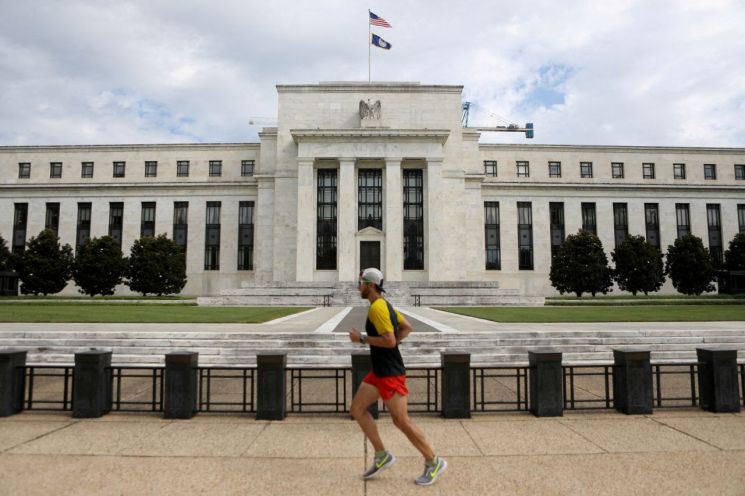
Regarding the timing and magnitude of Fed's interest rate cuts, she did not specify details but said, "It will vary significantly depending on incoming information."
The U.S. Department of Labor reported on the 2nd that the July unemployment rate surged to 4.3%, the highest level since October 2021. Meanwhile, nonfarm payroll employment increased by 114,000, falling far short of market expectations. The unexpected cooling of the labor market has raised concerns that the economy may enter a recession faster than anticipated, leading to criticism that the Fed missed the timing for rate cuts and increasing pressure for the Fed to lower interest rates.
In response, President Daly acknowledged the slowdown but cautioned against premature conclusions, saying, "It is still too early to say whether the labor market is slowing at a sustainable pace that allows the economy to continue growing or if there is a real weakness." She reassured the market by stating, "We have a fairly robust labor market."
Austan Goolsbee, President of the Chicago Federal Reserve Bank, also sought to ease market fears in an interview with CNBC on the same day. He said, "What the Fed does is simple: maximize employment, stabilize prices, and maintain financial stability," adding, "If economic conditions come in collectively indicating that any one of these is deteriorating, we will fix the problem."
Although the July employment data showed warning signs, it is interpreted as not signaling a crisis for the entire U.S. economy. Overall, the U.S. economy is described as continuing to grow at a stable level.
President Goolsbee holds a more optimistic view on the economic outlook. He drew a line, saying it is not yet a recession and believes the market is overreacting to the July employment data. He said, "Although the July employment data came in weaker than expected, it does not yet look like a recession."
However, concerns about a recession persist in the market. There have even been calls for the Fed to implement emergency rate cuts. On the same day, Jeremy Siegel, a professor at the University of Pennsylvania's Wharton School, said in an interview with CNBC that an emergency rate cut of 0.75 percentage points is necessary. Steven Brown, Deputy Chief North America Economist at Capital Economics, said, "A soft landing is still the most likely outcome," but added, "The risk of a hard landing has increased, and if disorderly market reactions continue, the Fed may ease policy faster than expected."
© The Asia Business Daily(www.asiae.co.kr). All rights reserved.

















