Sharp Decline Amid US July Employment Shock
Chicago Fed President Says "Not Seeing a Recession" to Calm Fears
Oil Prices Weaken More Due to 'R Fear' Than Middle East Tensions
Following the panic selling triggered by the fear of an 'R (Recession) shock' originating from the US, Asia's stock markets were hit hard, and the three major indices on the New York Stock Exchange (NYSE) plunged sharply in early trading on the 5th (local time). Investors were gripped by Black Monday fears as recession concerns spread across the market due to the shock from the July employment report. Amid this, Austan Goolsbee, President of the Federal Reserve Bank of Chicago, cautioned against the market's overreaction, stating that the July employment report does not indicate signs of a recession.
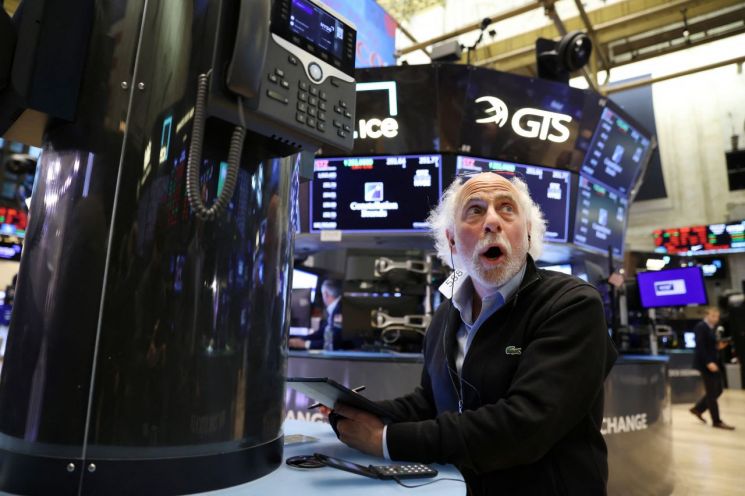
As of 9:40 a.m. at the NYSE on the day, the Dow Jones Industrial Average was down 2.67% from the previous close, standing at 38,676.54. The large-cap focused S&P 500 index fell 3.4% to 5,164.88, while the tech-heavy Nasdaq index plunged 4.49% to 16,022.33.
The July employment report released on the 2nd by the US Department of Labor showed sharp signs of cooling in the labor market, leading to a sell-off. According to the report, nonfarm payrolls increased by 114,000 last month, significantly below the forecast of 176,000 and the revised previous month's figure of 179,000. This is the lowest since the COVID-19 pandemic. The unemployment rate rose 0.2 percentage points from 4.1% in the previous month to 4.3%, marking the highest level since October 2021. According to the 'Rule of Three,' if the average unemployment rate over the past three months is more than 0.5 percentage points higher than the lowest rate in the past 12 months, it can be considered that the economy has entered a recession. The July unemployment rate was found to be 0.53 percentage points higher than the lowest rate in the previous year, spreading recession fears.
Two days before the July employment report, concerns grew that the Federal Reserve's decision to keep interest rates at 5.25-5.5% was a misjudgment, accelerating recession fears. Wall Street criticized the Fed for missing the timing to respond to the recession, and expectations grew that the Fed would cut rates significantly in September. There are also forecasts that the Fed will implement consecutive 'big cuts' of 0.5 percentage points in both September and November. JP Morgan and Citigroup expect the Fed to cut rates by 0.5 percentage points twice in September and November and by 0.25 percentage points in December, totaling a 1.25 percentage point reduction this year. Previously, JP Morgan expected a 0.5 percentage point cut and Citigroup a 0.75 percentage point cut, but both have significantly raised their forecasts.
Investors are also betting on big cuts in September and November. According to the Chicago Mercantile Exchange (CME) FedWatch tool, the federal funds futures market fully prices in a 100% probability that the Fed will cut rates by more than 0.5 percentage points in September. The probability of an additional rate cut of more than 0.5 percentage points in November is 91.7%. The likelihood of another 0.25 percentage point cut in December is priced in at 95%.
As demand for safe-haven assets surged amid recession fears, US Treasury yields also plunged. The yield on the US 2-year Treasury note, sensitive to monetary policy, fell 19 basis points (1 bp = 0.01 percentage points) from the previous trading day to 3.67%, while the US 10-year Treasury yield, the global benchmark for bond yields, dropped 9 basis points to around 3.69%.
However, Goolsbee expressed in an interview with CNBC that although the July employment figures were weaker than expected, they do not indicate a recession. He emphasized, "While the employment numbers came in weaker than expected, it does not yet look like a recession," adding, "There are some indicators to watch, such as rising household delinquency rates, but economic growth remains at a fairly stable level." He pointed out that the market's fear is exaggerated. Goolsbee also reassured the market by stating, "The Fed's mission is to maximize employment, stabilize prices, and maintain financial stability. If the situation worsens, we will fix it."
Among individual stocks, AI leader Nvidia plunged 11.51%. Apple fell 5.17% after news that Berkshire Hathaway, led by investment guru Warren Buffett, halved its stake in Apple. Tesla dropped 7.83%, while Broadcom and Super Micro Computer fell 6.49% and 9.73%, respectively.
The market is focusing on economic indicators and Fed officials' remarks scheduled for release this week. On the morning of the day, the ISM July Non-Manufacturing Purchasing Managers' Index (PMI) will be released. The market expects the July Non-Manufacturing PMI to rise to 51.4 from 48.8 in the previous month, indicating an expansion phase. On the 6th, trade balance data will be announced, and on the 8th, new unemployment claims are scheduled. Additionally, speeches by Mary Daly, President of the San Francisco Fed, and Thomas Barkin, President of the Richmond Fed, are expected.
Concerns about Middle East conflict are also rising as Iran is expected to retaliate against Israel, which is believed to be behind the assassination of Hamas leader, as early as the 5th.
International oil prices are weak as concerns about a US recession dominate investor sentiment more than geopolitical instability in the Middle East. West Texas Intermediate (WTI) crude oil is trading at $72.63 per barrel, down $0.89 (1.21%) from the previous trading day, while Brent crude, the global benchmark, is down $0.91 (1.18%) at $75.90 per barrel.
© The Asia Business Daily(www.asiae.co.kr). All rights reserved.
![A Woman Who Jumps Holding a Stolen Dior Bag... The Mind-Shaking, Bizarre Con of a "Human Knockoff" [Slate]](https://cwcontent.asiae.co.kr/asiaresize/183/2026021902243444107_1771435474.jpg)
















