No Legal Basis for 'Electric Vehicle Ban'
Interest Grows After Cheongna Apartment Fire Incident
Potential Infringement on Owner Usage Rights
"Alternative Measures Needed, Such as Fire Prevention Zones"
Some apartments have started banning electric vehicles from entering underground parking lots following an electric car fire in an underground parking garage of an apartment complex in Cheongna-dong, Seo-gu, Incheon.
According to fire authorities, around 6:15 a.m. on the 1st, smoke and flames broke out on a parked Mercedes-Benz vehicle in the underground parking lot of an apartment in Cheongna-dong, Seo-gu, Incheon, quickly spreading to nearby vehicles. As a result, 40 surrounding vehicles were completely destroyed by fire, and 100 vehicles were damaged. Power was cut off to five apartment buildings, and 122 residents evacuated to temporary housing facilities.
Experts analyzed that the damage was exacerbated by the combination of the difficulty in extinguishing electric vehicle fires and the enclosed structural characteristics of underground parking lots. Extinguishing electric vehicle fires requires large water tank facilities, but underground parking lots are structurally difficult for such equipment to access, and the discharge of toxic gases is not smooth, resulting in greater damage compared to fires involving conventional vehicles.
Gong Ha-seong, a professor in the Department of Fire and Disaster Prevention at Woosuk University, said, "The most effective way to extinguish electric vehicle fires is through large prefabricated water tanks, but underground parking lots have low ceiling heights, making access difficult. The discharge of toxic gases is also not smooth, which can increase the damage."
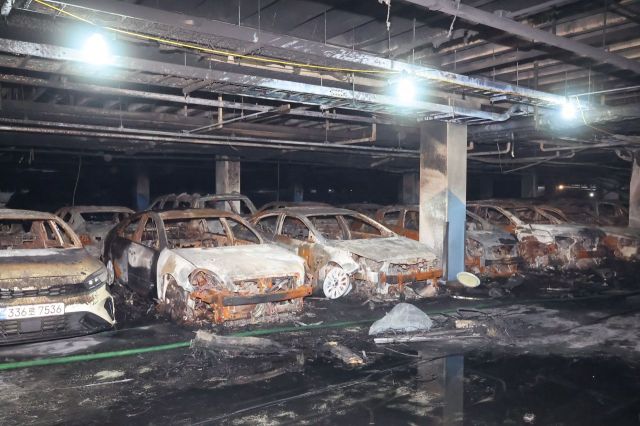 On the morning of the 2nd, vehicles were completely burned in the underground parking lot of an apartment in Cheongna, Seo-gu, Incheon. [Photo by Yonhap News]
Following a series of electric vehicle fires, some apartments are prohibiting electric vehicles from parking underground through resident votes and relocating charging and parking facilities to above ground. According to the Act on the Promotion of Environmentally Friendly Automobiles, newly constructed apartments with 100 or more households must secure charging facilities and dedicated parking spaces for at least 5% of total parking spaces by January next year, and existing apartments must secure at least 2%, but there are no separate regulations for above-ground and underground parking.
In March, an apartment in Anyang, Gyeonggi Province, held a resident vote and banned electric vehicles from entering the underground parking lot, sparking controversy. One resident said, "After the Cheongna fire incident, there has been discussion among residents about banning electric vehicles from underground parking," adding, "When they encouraged us to buy electric vehicles, where are electric vehicle owners supposed to park now?"
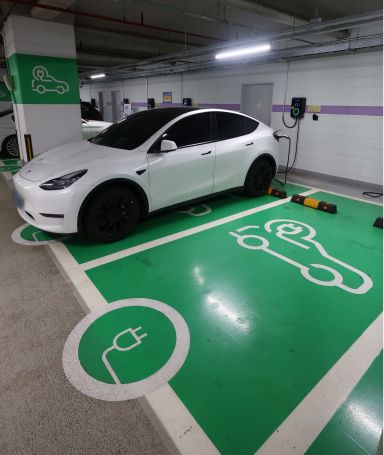
Experts advise that there is no legal basis to ban electric vehicles from underground parking lots and suggest finding other alternatives, such as establishing fire zones within underground parking lots.
Electric vehicles are not particularly more dangerous compared to internal combustion engine vehicles, and many newly built apartments do not have above-ground parking lots at all, so banning underground parking could infringe on owners' rights to use common property. In fact, the electric vehicle fire incidence rate last year was 0.013%, similar to or slightly lower than that of internal combustion vehicles (0.016%).
Attorney Kim Ki-yoon of Kim Ki-yoon Law Office said, "If it were explosives or really dangerous materials, the story would be different, but electric vehicles are not particularly more dangerous or prone to explosion compared to internal combustion vehicles," adding, "Banning electric vehicles from underground parking lots can be seen as infringing on owners' rights to use the 'common areas' of parking lots." He further stated, "Even if such a measure is approved through a resident vote, it has no legal effect and can be nullified."
Professor Gong also said, "It is not desirable to completely ban electric vehicles from underground parking lots," advising, "Measures should be taken to minimize damage, such as installing concrete partitions on both sides of electric vehicle-only parking spaces to prevent flames from spreading to surrounding vehicles in case of an explosion."
© The Asia Business Daily(www.asiae.co.kr). All rights reserved.
![Clutching a Stolen Dior Bag, Saying "I Hate Being Poor but Real"... The Grotesque Con of a "Human Knockoff" [Slate]](https://cwcontent.asiae.co.kr/asiaresize/183/2026021902243444107_1771435474.jpg)












