The Largest Since 'Black Monday' in October 1987
The Nikkei 225, a representative stock index of the Japanese stock market, recorded its largest-ever drop, falling more than 12% on the 5th. This was a result of spreading recession concerns following weaker-than-expected U.S. July employment data and a rise in the unemployment rate.
On that day, the Nikkei index closed at 31,458.42, plunging 4,451.28 yen (12.40%) from the previous session. This surpassed the previous record drop of 3,836 points on October 20, 1987, known as "Black Monday," marking the largest decline in history. During the session, the drop exceeded 4,600 yen. The TOPIX index, which tracks first-section Tokyo Stock Exchange-listed companies, also fell 12.23%.
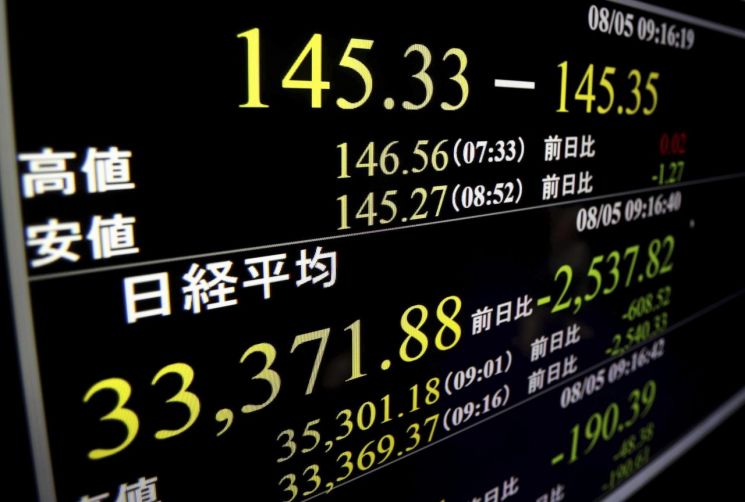
This plunge is interpreted as being influenced by recession fears spreading due to not only the weaker-than-expected U.S. economic indicators for July but also the worsening unemployment rate. The previously released July Manufacturing PMI (Purchasing Managers' Index) remained below 50, indicating economic contraction, and weekly initial jobless claims reached their highest level in a year, reinforcing contraction signals. The unemployment rate rose to 4.3%, up 0.2 percentage points from the previous month (4.1%), marking the highest level since October 2021. As a result, the three major New York stock indices closed lower for two consecutive days. The Nikkei index expanded its losses on the day following a nearly 6% plunge on the 2nd.
The decline was particularly notable in financial stocks. Shares of Mitsui Sumitomo Financial Group, Mitsubishi UFJ Financial Group, and Mizuho Financial Group, which had recently been on an upward trend, fell more than 15%, 17%, and 19%, respectively. Semiconductor stocks such as Tokyo Electron, Advantest, and SoftBank Group, which led last week's decline in the Tokyo stock market, also plunged nearly 15-18%.
Market analyst Hidetaro Yasuda of Tokai Tokyo Intelligence Lab said, "Many overseas investors purchased stocks during the early phase of Abenomics when the Bank of Japan (BOJ) avoided easing monetary policy," adding, "As the BOJ shifted its policy direction by raising interest rates, it seems to have triggered these investors to take selling positions." Previously, the BOJ raised its short-term policy rate to 0.25% on the 31st of last month.
The rise in the yen's value, which increased concerns about the earnings of Japanese export companies, was also cited as a cause of the stock price decline. At the beginning of this month, the dollar-yen exchange rate was in the 160 yen range per dollar, but it is currently trading in the 142 yen range. This is a result of the BOJ's rate hike combined with the Federal Reserve's (Fed) announcement of a rate cut in September, narrowing the interest rate gap between the U.S. and Japan. A decline in the dollar-yen exchange rate means a rise in the yen's value.
Regarding the future outlook for the Tokyo stock market, both optimistic and pessimistic views coexist. Senior strategist Ichii Kitano of Phillip Securities upgraded his short-term investment judgment on the Japanese stock market from "neutral" to "buy," diagnosing that "even considering the narrowing U.S.-Japan interest rate gap, Japanese stocks are entering an oversold territory." Senior trader Yusuke Sakai of T&D Asset Management noted, "Currently, there is no visible downside," adding, "The recent positive factors such as strong earnings from a few days ago have been forgotten amid the selling pressure."
© The Asia Business Daily(www.asiae.co.kr). All rights reserved.
![Clutching a Stolen Dior Bag, Saying "I Hate Being Poor but Real"... The Grotesque Con of a "Human Knockoff" [Slate]](https://cwcontent.asiae.co.kr/asiaresize/183/2026021902243444107_1771435474.jpg)
















