Fire Prevention Charger Support Unit Price Increased to 400,000 KRW
Test Reports Received, Separate Specifications Also Established
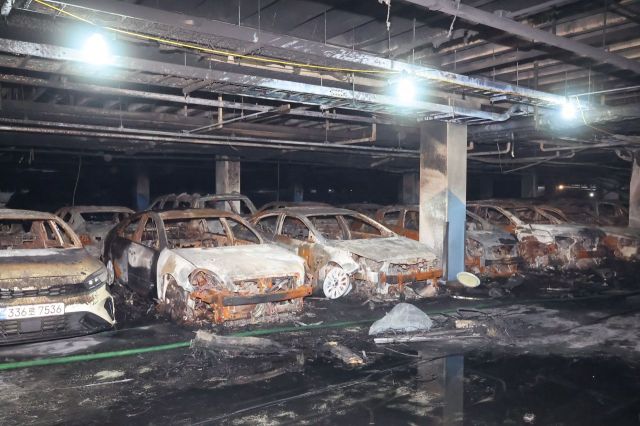 Vehicles that were completely burned are lined up in the underground parking lot of an apartment complex in Cheongna, Seo-gu, Incheon.
 [Image source=Yonhap News]
The Ministry of Environment has stepped up regulations on electric vehicle (EV) safety management. This comes as EV fires have been increasing, causing numerous casualties and property damage. Following a recent EV fire incident at an apartment complex in Cheongna, Incheon, signs of reluctance to use electric vehicles have even emerged. The Ministry of Environment is concerned that this trend could hinder the spread of eco-friendly vehicles.
According to the Ministry of Environment on the 5th, the government recently revised the 'Electric Vehicle Charging Facility Subsidy Guidelines' and decided to increase the support price for 'fire-prevention type slow chargers' by up to 400,000 KRW. Based on a 7 kW charger, the subsidy for a standard charger is 1.4 million KRW, but it will rise to 1.8 million KRW for the fire-prevention type. Considering that the market price of the power line communication (PLC) modem required for the fire-prevention charger is around 400,000 KRW, operators can install fire-prevention devices without additional cost. The total budget for the additional subsidy support is 80 billion KRW.
The fire-prevention type slow charging facility is a device that receives battery status information to prevent overcharging and utilizes data transmitted from the charger for fire prevention. The Ministry of Environment decided to distribute fire-prevention type slow chargers starting this year, following concerns that slow chargers pose a higher fire risk than fast chargers. Fast chargers typically stop charging at about 80% battery capacity, but slow chargers charge up to 100%, increasing the risk of overcharging.
Related regulations have also been revised. Operators of fire-prevention type slow charging facilities must submit test reports to verify that the devices are functioning properly. When registering products, compliance with separately stipulated product, communication, and certification standards is also required.
The Ministry of Environment’s move to establish an EV safety management system is driven by the phenomenon of 'electric vehicle phobia.' As EV fires occur more frequently, consumers concerned about safety may hesitate to purchase electric vehicles. A Ministry of Environment official stated, "It is true that negative perceptions among consumers increase whenever an EV fire occurs," adding, "This is an issue that must be resolved because it could disrupt the transition to eco-friendly vehicle adoption."
Fear of electric vehicles has grown even stronger following the fire incident in the Cheongna area of Incheon. On the 1st, a fire broke out in a Mercedes-Benz electric vehicle charging on the first basement floor of an apartment in Cheongna, damaging about 140 vehicles and cutting electricity to approximately 480 households across five apartment buildings. Subsequently, residents in other apartments held meetings to discuss measures such as forcing EVs to be parked only above ground or relocating underground EV charging zones to above ground.
According to the National Fire Agency, as the number of electric vehicles has increased, the number of fires has also risen annually: 24 cases in 2021, 43 in 2022, and 72 last year. Property damage over the past three years has amounted to 3.25543 billion KRW. Although there have been no fatalities from EV fires yet, 13 people have been injured over the past three years.
© The Asia Business Daily(www.asiae.co.kr). All rights reserved.

















