Regarding the corporate value-up program promoted by the government, a claim has emerged that “a strategy to increase the growth rate of profits along with shareholder returns is necessary to maximize corporate value.” In a low-growth phase, it is suggested that strategic measures such as mergers and acquisitions (M&A) or restructuring should be utilized to improve return on equity (ROE) rapidly and find new growth opportunities. Like Japan, which succeeded in value-up, consistent policies and efforts by companies to continuously communicate shareholder value enhancement plans to the market are also required.
Samil PwC announced on the 5th that it published a report titled ‘Value 業 (Up)! The Catalyst to Resolve Korea Discount, Success Factors of the Corporate Value-Up Program.’ This report was prepared to examine the causes of the ‘Korea Discount,’ an undervaluation phenomenon in the domestic stock market, review the main contents of the government’s corporate value-up program, and provide strategic directions for enhancing corporate value.
Earlier, the government announced support measures for corporate value-up in February and released detailed guidelines in May. Last month, it announced key tax support plans. The core of the corporate value-up program is to emphasize efforts by listed companies themselves to raise corporate value and to provide various institutional incentives to encourage this.
The report identified low capital efficiency and insufficient shareholder returns as causes of the Korea Discount. ROE, a profitability indicator that measures how much net profit is generated using equity over one year, averages 8% over 10 years in Korea, which is lower than major countries such as the U.S. (14.9%), Japan (8.3%), and China (9.3%). Korea’s dividend payout ratio is also passive, averaging 26% over 10 years compared to 49.5% in advanced countries.
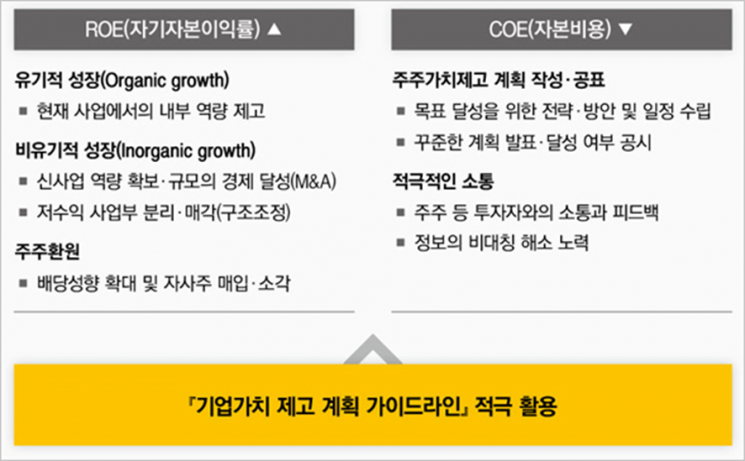
The report proposed two strategies to enhance corporate value: ▲ rapid growth strategy and ▲ active communication policy. For rapid growth, improving ROE through profit growth as well as expanding shareholder returns is necessary. Increasing the shareholder return ratio helps enhance corporate value in the short term, but if rapid profit growth does not support it, the upward momentum may weaken. To this end, organic growth by strengthening existing business capabilities and inorganic growth through M&A and restructuring were suggested.
Yoon Chang-beom, head of Samil PwC’s Value-Up Support Center, said, “Companies need to view value-up disclosures not as a burden but as a catalyst for growth and make efforts to establish and implement strategies that can increase corporate value,” adding, “Proactive restructuring and M&A ahead of market trends can become new growth engines by changing the business portfolio.”
The report introduced considerations when disclosing corporate value enhancement plans using government guidelines. It analyzed that it is efficient to use ROE as a key indicator when establishing corporate value enhancement plans, and the more specific the strategies such as acquisitions and sales, business unit reorganization, and investment attraction are, the more trust they gain from the market.
Kim Yong-beom, co-head of the center, said, “Many companies often set fragmented goals like ‘achieving a certain sales amount’ without a big direction when establishing corporate value enhancement plans,” adding, “For companies making disclosures, it is important to set and establish a concrete story line with short- and mid-to-long-term goals and execution plans to achieve them.”
Finally, the report introduced the case of Japan’s value-up policy. It stated, “Japan began efforts to enhance corporate value through the ‘Japan Revitalization Strategy’ under the Abe administration from 2013, which included two directions: corporate governance reform and the stewardship code,” and “Thanks to policies consistently pursued over a long period, value-up was able to achieve results.” Detailed information can be found on the Samil PwC website.
© The Asia Business Daily(www.asiae.co.kr). All rights reserved.
![Clutching a Stolen Dior Bag, Saying "I Hate Being Poor but Real"... The Grotesque Con of a "Human Knockoff" [Slate]](https://cwcontent.asiae.co.kr/asiaresize/183/2026021902243444107_1771435474.jpg)
















