Checking Trends in Domestic and International Financial Markets
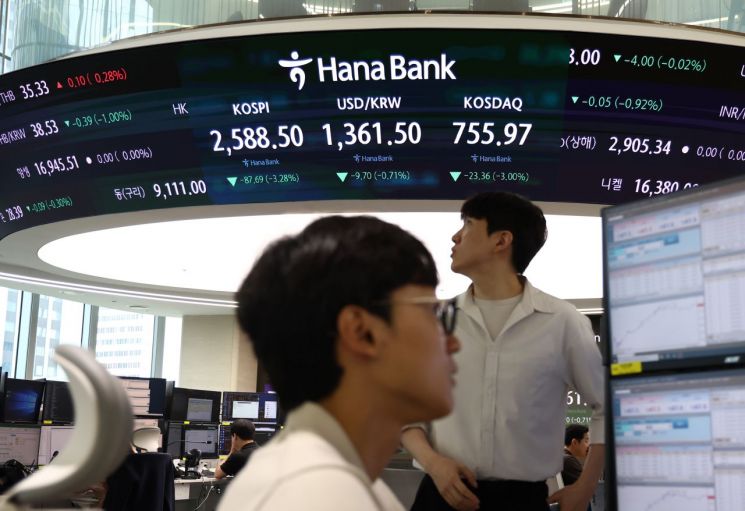 The KOSPI reflected fears of a U.S. economic recession, starting with a decline of more than 2% for two consecutive trading days, breaking below the 2,600 level. On the 5th, employees were working in the dealing room of Hana Bank in Jung-gu, Seoul.
 [Image source=Yonhap News]
The government has decided to maintain a joint 24-hour monitoring system with relevant agencies, maintaining a high level of vigilance in response to the increasing volatility in global financial markets. If necessary, contingency plans will be activated according to the situation.
On the 5th, the Ministry of Economy and Finance held a joint conference call with relevant agencies, chaired by Deputy Minister Yoon In-dae, to review recent domestic and international financial market trends and discuss future response directions.
The meeting was attended by the Deputy Minister and Director of Economic Policy Bureau of the Ministry of Economy and Finance, the Deputy Governor of the Bank of Korea, the Director of Financial Policy Bureau of the Financial Services Commission, and the Deputy Governor of the Financial Supervisory Service.
Last week, global stock markets plunged significantly amid amplified anxiety caused by fears of an economic recession triggered by the U.S. employment shock in the latter half of the week, and deteriorating earnings of big tech companies centered around the Magnificent Seven that have been leading the U.S. stock market.
The New York stock market saw the Nasdaq plunge 2.4% on the 2nd due to heightened recession concerns following worsening employment data. The ISM Manufacturing PMI released a few days earlier also fell far below expectations, deepening market concerns about an economic downturn. Reflecting these U.S.-originated negative factors, the Korean stock market experienced historic drops with the KOSPI down 3.6% and the KOSDAQ down 4.2%. The Japanese Nikkei index also fell 5.8%, and the Hong Kong Hang Seng index recorded a decline in the 2% range.
As fears of a U.S.-originated recession spread, the government moved to stabilize market sentiment ahead of the stock market opening. The government stated, "Amid increased volatility in global financial markets and persistent uncertainties such as the resurgence of geopolitical instability in the Middle East, the government and the Bank of Korea will maintain a joint 24-hour monitoring system with relevant agencies with high vigilance over domestic and international financial markets." Furthermore, if necessary, relevant agencies will closely cooperate and respond according to the contingency plan.
The government added, "We will continue efforts to strengthen the resilience of our capital and foreign exchange markets and expand external safety nets by steadily implementing programs such as corporate value-up programs, advancement of foreign exchange and bond markets, and expansion of supply chains."
© The Asia Business Daily(www.asiae.co.kr). All rights reserved.
![Clutching a Stolen Dior Bag, Saying "I Hate Being Poor but Real"... The Grotesque Con of a "Human Knockoff" [Slate]](https://cwcontent.asiae.co.kr/asiaresize/183/2026021902243444107_1771435474.jpg)
















