GS, Probability of Recession Rises from 10% to 25% Amid Unemployment Shock
Consecutive Big Rate Cuts Expected in September and November
"Too Early to Judge Recession," Calls for Caution
Concerns are growing on Wall Street that the U.S. may have entered a recession phase due to the shock from the July employment report. As the U.S. Federal Reserve (Fed) held interest rates steady at 5.25?5.5% in July, there are criticisms that it missed the opportunity to respond to the recession. Meanwhile, some investment banks (IBs) predict that the Fed will implement consecutive 'big cuts' by lowering rates by 0.5 percentage points at both the September and upcoming November Federal Open Market Committee (FOMC) meetings. However, given that the U.S. achieved a surprise growth in Q2 and economic indicators have been highly volatile, some caution that it is premature to judge a recession based solely on the rise in unemployment in July.
Goldman Sachs Raises U.S. Recession Risk

On the 4th (local time), Goldman Sachs raised the probability of a U.S. recession next year from 15% to 25%. While Goldman Sachs views the recession risk as limited, it increased the likelihood of a recession by 10 percentage points just two days after the July employment report was released.
Jan Hatzius, Chief Economist at Goldman Sachs, stated, "Our expectation is that job growth will recover in August," but added, "If we are wrong and the August employment report is as weak as July's, there is a high possibility of a 50 basis point (1bp = 0.01 percentage points) rate cut in September."
The reason Goldman Sachs raised the recession probability is the poor employment data last month. According to the U.S. Department of Labor's July employment report released on the 2nd, nonfarm payrolls increased by 114,000, significantly below the forecast of 176,000 and the previous month's figure of 179,000. This is the lowest level since the COVID-19 pandemic. The unemployment rate rose 0.2 percentage points from 4.1% in the previous month to 4.3%, the highest since October 2021. According to the "Rule of Three," if the three-month average unemployment rate is at least 0.5 percentage points higher than the lowest rate in the past 12 months, it can be considered that the economy has entered a recession. The July unemployment rate was found to be 0.53 percentage points higher, spreading recession fears. The manufacturing business index released on the 1st also added fuel to the fire. As recession fears grew, the U.S. Treasury yield on the 10-year bond plunged to the 3% range for the first time in six months since February, and the New York Stock Exchange plummeted.
Wall Street Predicts Consecutive Big Cuts in September and November... Caution That It Is Too Early to Judge a Recession
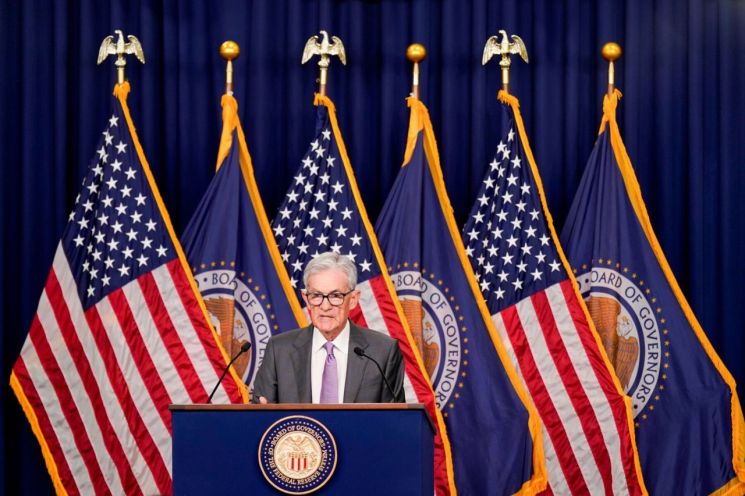
As the 'fear of R (Recession)' sweeps across financial markets worldwide, including the U.S., the narrative criticizing the Fed's delayed response in July has shifted to expectations of a 'big cut in September.' JP Morgan and Citigroup have issued aggressive forecasts that the Fed will cut rates by 0.5 percentage points consecutively in September and November, followed by a 0.25 percentage point cut in December, totaling a 1.25 percentage point reduction within the year.
JP Morgan analyzed, "The July employment report shows a slowdown in job growth mainly in the service sector and a rise in the unemployment rate," adding, "The employment diffusion index also fell to 49.6%, the second-lowest below 50% outside of recessions." They further stated, "Even if labor market conditions somewhat recover, the Fed is likely to cut rates by more than 100 basis points this year, expecting a total of 125 basis points in three cuts within the year." Previously, they had forecasted two 0.25 percentage point cuts in September and November, totaling 0.5 percentage points, but have significantly revised their outlook. Citigroup also changed its forecast from a total 0.75 percentage point cut to 1.25 percentage points.
However, there is considerable caution that it is premature to judge a recession as the U.S. economy remains resilient. The preliminary estimate of the U.S. real gross domestic product (GDP) growth rate for Q2 was 2.8% annualized quarter-over-quarter, nearly double the previous quarter's 1.5%. This also significantly exceeded experts' expectations of 2.1%, driven by expanded consumer spending. The market analysis suggests that the pace of the Fed's rate cuts depends on the August employment report, which will be available before the September FOMC meeting.
© The Asia Business Daily(www.asiae.co.kr). All rights reserved.
![Clutching a Stolen Dior Bag, Saying "I Hate Being Poor but Real"... The Grotesque Con of a "Human Knockoff" [Slate]](https://cwcontent.asiae.co.kr/asiaresize/183/2026021902243444107_1771435474.jpg)

















