'Double High Pressure' Covers Korean Peninsula
Yesterday Yangsan, Today Yeoju Hits 39 Degrees
As temperatures in some areas approach 40 degrees Celsius, the current heatwave is expected to continue for at least ten more days.
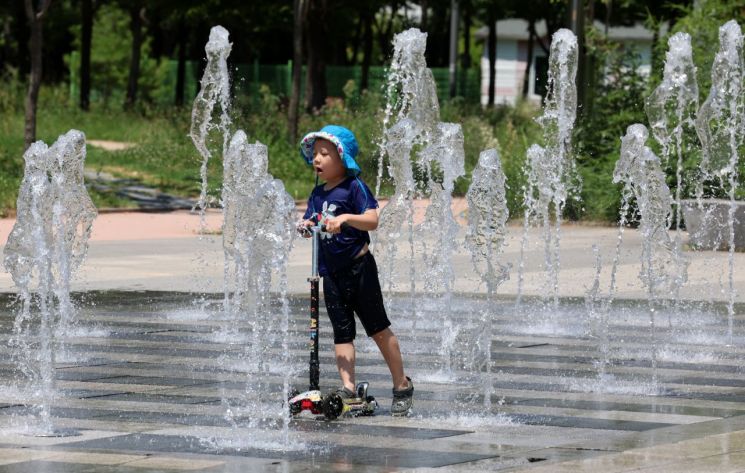 A child is playing in the water at the ground fountain in Sinyong Neighborhood Park, Buk-gu, Gwangju.
 [Image source=Yonhap News]
According to the Korea Meteorological Administration on the 4th, the mid-term forecast predicts that from the 7th to the 14th, morning temperatures will range from 23 to 27 degrees Celsius, and daytime temperatures will be between 30 and 36 degrees Celsius, exceeding average temperatures and maintaining similar levels to now. Nationwide, the highest perceived temperature is expected to reach up to 35 degrees Celsius, with tropical nights continuing every night. Following a record high of 39.3 degrees Celsius in Yangsan, Gyeongnam the previous day, the temperature in Jeomdong-myeon, Yeoju, Gyeonggi Province rose to 39 degrees Celsius at 1:49 p.m. on the same day.
Currently, the Tibetan High and the North Pacific High are covering the area around the Korean Peninsula. The upper atmosphere dominated by the Tibetan High experiences adiabatic warming in the high-pressure zone, while the middle and lower layers receive hot and humid air from the North Pacific High. The air is heated by direct sunlight, causing temperatures to rise. Adiabatic warming refers to the phenomenon where the temperature increases as the volume of air contracts under adiabatic conditions. The entire atmosphere, from the lower to the upper layers, is filled with hot air.
In 1994 and 2018, similarly strong dual high-pressure systems developed, resulting in the worst heatwaves on record. On August 1, 2018, the temperature in Hongcheon, Gangwon Province soared to 41 degrees Celsius, a 'first-ever recorded value' that prompted meteorological officials to verify the measurement on site. There have been a total of seven instances where temperatures exceeded 40 degrees Celsius, all except one occurring in 2018, with the exception being August 1, 1942, in Daegu.
It is possible that the current period is not the 'peak' of the Tibetan High and North Pacific High. When these two high-pressure systems are at their strongest, the heatwave also reaches its peak, but it is uncommon for the peak of these systems to occur in early August. Predictions suggest that even more severe heatwaves may occur in the future.
© The Asia Business Daily(www.asiae.co.kr). All rights reserved.

















