Vacation Forfeiture, Increase in Non-Regular Workers, Companies with Fewer Than 5 Employees, and Low Wages
More than half of office workers have either given up or postponed their summer vacation. The highest rate of giving up summer vacation was reported among non-regular workers, who cited 'financial burden' as the main reason.
The civic group Workplace Bullying 119 announced the results of a survey on ‘2024 Summer Vacation Plans’ containing these findings on the 4th.

The survey was conducted by Workplace Bullying 119 through the professional polling agency ‘Global Research’ from May 31 to June 10, targeting 1,000 office workers nationwide aged 19 and older, based on the employment population ratio from the Economically Active Population Survey. The confidence level is 95%, with a sampling error of ±3.1 percentage points (p).
Summer vacation is considered a contractual leave rather than a statutory leave under the Labor Standards Act. For this reason, if there is no provision in employment rules or collective agreements to grant summer vacation separately from annual leave, employees use their personal annual leave for summer vacation.
The survey results showed that the rate of giving up summer vacation was relatively high among non-regular workers (30%), non-office workers (28.8%), workplaces with fewer than 5 employees (28.9%), regular employees (29.5%), those earning less than 1.5 million KRW (30.1%), and non-union members (21.2%).
When respondents who had no summer vacation plans or had not yet decided were asked for reasons, ‘financial burden of vacation costs’ was the highest at 56.5%. Other reasons included ‘lack or insufficiency of paid annual leave’ at 12.2%, ‘burden of backlog of work after vacation’ at 10.9%, and ‘feeling pressured or scrutinized when taking vacation’ at 7.8%.
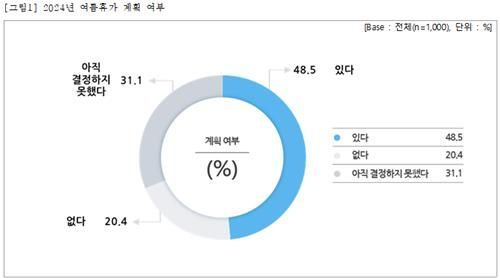
By respondent characteristics, the proportion citing ‘financial burden’ was higher among non-regular workers (61.9%) than regular workers (51.8%), and among regular employees (61.2%) compared to senior managers (50%).
The response ‘unable to plan vacation due to lack or insufficiency of paid annual leave’ was higher among non-regular workers (17.2%), non-union members (12.9%), non-office workers (16.3%), workplaces with fewer than 5 employees (17.3%), and regular employees (18.1%).
The response ‘unable to plan vacation due to burden of backlog of work after vacation’ was relatively higher among regular workers (15.2%), office workers (16.4%), and senior managers (33.3%). The response ‘unable to plan vacation because taking vacation itself feels pressured or scrutinized’ was notably higher in public institutions (15.7%). This is about four times higher than workplaces with 300 or more employees (3.8%) and about 2.5 times higher than workplaces with fewer than 5 employees (6.4%).
Among respondents who had summer vacation plans, when asked about the planned vacation period including weekends, ‘3 to 5 days’ was the highest at 60.6%, followed by ‘6 to 7 days’ at 24.3%. However, among non-regular workers (14.9%) and workplaces with fewer than 5 employees (15.7%), the response for ‘only 1 to 2 days’ including weekends was higher than that of regular workers (3.4%) and workplaces with 300 or more employees (5.5%).
According to the survey by Workplace Bullying 119, there were numerous cases where employees who used their personal annual leave were refused without any reason or were forced to work during their vacation due to heavy workloads.
This exploits the fact that workers currently employed find it difficult to report to the Labor Office easily, and involves the employer’s abuse of the right to change the timing of annual leave even when it does not significantly disrupt business operations. It was also pointed out that every summer vacation season, there are repeated incidents of forcing employees to use their annual leave according to the employer’s summer vacation schedule.
Workplace Bullying 119 stated, "There is a need for both raising awareness about guaranteeing workers’ right to rest and legislative supplementation for workers who fall into the blind spots of labor laws."
© The Asia Business Daily(www.asiae.co.kr). All rights reserved.


















