Ministry of Education-Designated Medical School Evaluation and Accreditation Bodies
Annual 'Major Change Assessment' Announced for 30 Schools with Increased Quotas
"Will Non-Accreditation Restrict New Students' National Exams?" Confusion Ensues
"It is not about failing a specific medical school. The main goal is to provide students with a proper educational environment and proper education so that graduates are fully competent as doctors." (Ahn Deok-seon, President of the Korea Institute of Medical Education and Evaluation)
The Korea Institute of Medical Education and Evaluation (KIMEE) has become the center of attention regarding the evaluation and accreditation of medical education for medical schools with increased admission quotas for the 2025 academic year. When KIMEE announced that it would conduct special evaluations annually for six years targeting medical schools with increased quotas, some medical schools expressed concerns that they might fail to meet standards such as expanding educational facilities or securing full-time faculty, resulting in loss of accreditation. If a medical school fails KIMEE’s evaluation and loses accreditation, students admitted afterward cannot take the national medical licensing examination (KMLE) upon graduation, causing confusion among prospective medical school applicants as well.
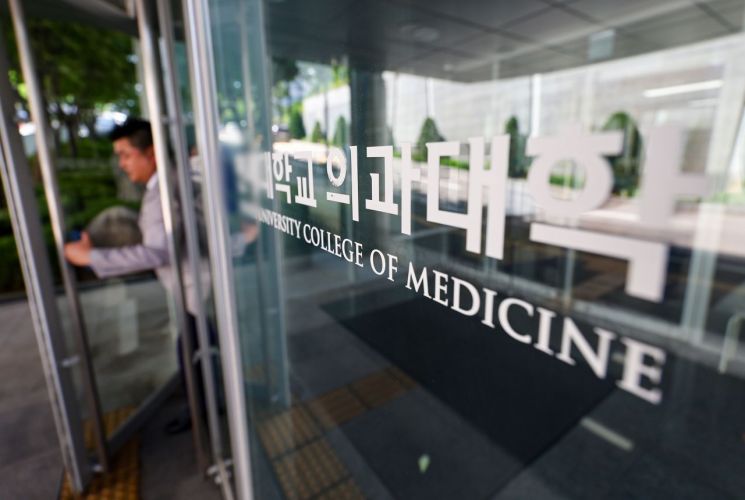
What kind of institution is KIMEE?
Discussions on medical school evaluation systems in Korea began in the 1990s. KIMEE, originally established as the Korea Medical School Accreditation Committee, was organized privately rather than under the Ministry of Health and Welfare or the Ministry of Education. It started preliminary evaluations of newly established medical schools in 1999 and began assessing medical education sites. It officially launched as a non-profit foundation in 2003.
In 2007, the government amended the Higher Education Act to expand autonomy in higher education, promote autonomous quality management, and strengthen accountability by designating external university evaluation and accreditation agencies as recognized institutions. Along with KIMEE, the Korea Nursing Education Evaluation Institute, Korea Dental Education Evaluation Institute, and Korea Oriental Medicine Education Evaluation Institute are all recognized agencies delegated by the Ministry of Education. Since 2014, KIMEE has been designated as the recognized agency responsible for medical school evaluation and accreditation through Ministry of Education reviews every five years.
In February 2012, the Ministry of Health and Welfare amended the Medical Service Act to specify that graduates from medical schools without KIMEE accreditation after 2017 cannot take the national medical licensing examination. In June 2016, the Ministry of Education revised the Enforcement Decree of the Higher Education Act to mandate evaluation and accreditation for all medical schools.
KIMEE gained significant attention during the closure of Seonam University Medical School in 2018. Seonam University failed KIMEE’s accreditation evaluation in 2013 and again in an additional evaluation in 2016, which ultimately led to students dispersing to other schools and the university shutting down.
How is the evaluation and accreditation conducted?
KIMEE’s main task is to conduct evaluation and accreditation for 40 medical schools nationwide. The evaluations are broadly categorized into 'regular evaluation,' 'interim evaluation,' and 'major change evaluation.'
Regular evaluations are periodic assessments conducted every 2, 4, or 6 years. This year, eight medical schools?Catholic University, Catholic Kwandong University, Kyung Hee University, Dongguk University, Pusan National University, Seoul National University, Sungkyunkwan University, and Hanyang University?are subject to evaluation. KIMEE reviews 92 criteria across nine evaluation areas including educational resources and faculty to determine accreditation status and grants accreditation for 2 to 6 years until the next evaluation.
Regular evaluations typically take place during the year before accreditation expires. Medical schools submit a regular evaluation application to KIMEE at the beginning of the year and form an evaluation committee consisting of medical school professors and administrative staff. They investigate the university’s operational system, basic medical education curriculum, students, faculty, facilities, and post-graduate education to prepare an accreditation evaluation report. This includes verifying classrooms and laboratories used for student education, as well as convenience facilities such as student cafeterias and lounges. Information on tuition fees, faculty salaries, and plans for expanding teaching hospitals is also required. After multiple rounds of revisions and reviews, the self-evaluation research report and student report are submitted to KIMEE by the end of July. Then, KIMEE’s on-site evaluation team reviews the documents and visits the university in the fall for further verification. A medical school official who underwent last year’s regular evaluation revealed, "The self-evaluation report alone was about 600 pages, and the interim evaluation required 300 pages of documentation, mobilizing all administrative resources within the medical school. Professors on the committee complained about workload overload."
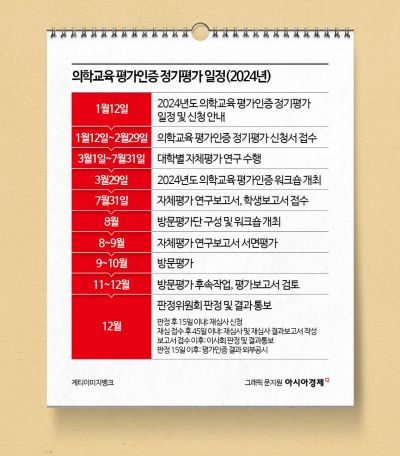
KIMEE maintains a pool of about 300 medical school professors to evaluate and accredit an average of 10, and sometimes dozens, of schools annually. Since professors are busy with outpatient care, conferences, and research, schedules are coordinated carefully, and evaluation teams are formed by selecting professors who have no conflicts of interest with the medical schools being evaluated. The evaluation team prepares a final evaluation report based on submitted documents and on-site assessments. At the end of the year, a judgment committee composed of up to 15 members, including KIMEE’s accreditation director and chairs of specialized committees, reviews the evaluation results and opinions before making the final decision on accreditation status and duration for each university.
Interim evaluations are conducted every two years for medical schools that have already received accreditation to maintain their accreditation status. This year, 15 medical schools are subject to interim evaluation.
When significant changes are expected in medical education, a separate major change evaluation is conducted. This evaluation is carried out to assess the impact on basic medical education and determine whether accreditation can be maintained when an accredited medical school undergoes major changes such as changing teaching hospitals, relocating or splitting campuses, ownership changes, or changes in student numbers. The medical school submits a 'major change plan,' which KIMEE evaluates. In the past, some universities were permitted to establish regional medical schools on the condition of approval but conducted student education and training in unauthorized locations in Seoul, causing controversy. In such cases, corrective actions were taken following a major change evaluation.
What is the major change evaluation applied to medical schools with increased quotas?
KIMEE plans to require medical schools with an increase of 10% or more in their admission quotas next year to submit major change plans by November for review. Among the 40 medical schools, 30 are subject to this, excluding eight located in Seoul and two with increases below 10% (Inje University and Yonsei University Wonju Campus). Starting with an evaluation briefing session held on August 30, document submissions will take place in September, followed by full-scale reviews in December. On-site visits will be conducted by January next year to check faculty recruitment, facility expansion, and financial support plans. Ahn Deok-seon, KIMEE president, stated, "If the university’s submitted support plan is judged insufficient to guarantee educational quality, the remaining accreditation period may be revoked. For medical schools with admission quotas increasing two to three times, we will thoroughly examine classroom space, practical training environments, and affiliated hospital conditions."
The major change evaluation, introduced in 2012, applies the 'ASK 2019' standards based on the international basic medical education standards set by the World Federation for Medical Education (WFME), similar to regular and interim evaluations. Among the 92 basic criteria, 51 criteria expected to be affected by major changes are selected for evaluation, effectively maintaining the same accreditation standards.
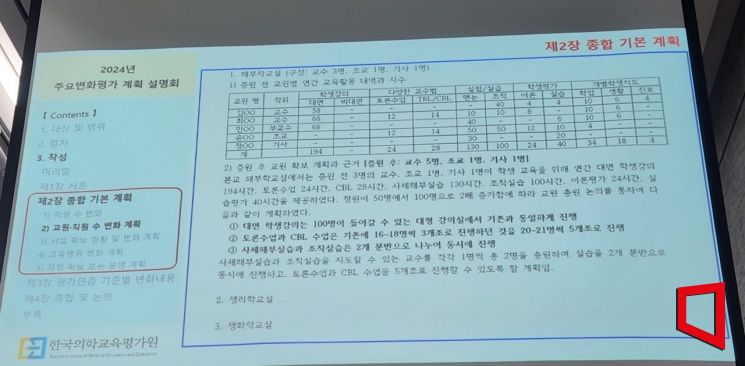 The Korea Institute of Medical Education and Evaluation held a "Major Change Evaluation Plan Briefing" on the 30th of last month and announced that it will evaluate major changes annually for the next six years in medical schools where the admission quota increases by more than 10% next year.
However, KIMEE explains that differences may exist depending on the type of major change. Changes such as switching major teaching hospitals or relocating campuses have effects limited to the current year, so the major change evaluation is conducted once. In contrast, for quota increases, since the basic medical education curriculum differs each year until the admitted students graduate, KIMEE believes it is necessary to monitor and evaluate the university’s preparedness annually.
The major change evaluation is also conducted by a visiting evaluation team of three members who conduct a 2-day on-site visit. The evaluation results are categorized as accreditation or non-accreditation. However, non-accreditation decisions can be deferred for one year. KIMEE regulations specify, "Universities granted a deferral for non-accreditation must undergo re-evaluation within one year, during which the accreditation status is maintained."
Failing to meet specific evaluation criteria does not necessarily result in non-accreditation. The judgment committee comprehensively assesses educational conditions and may require re-evaluation after one year. If the university invests more in medical education or improves deficiencies during that period, it can receive accreditation in the next evaluation. Also, if a medical school admits students for the 2025 academic year and receives a non-accreditation decision in the major change evaluation early next year, these students can still take the national medical licensing examination six years later through the deferral system.
 Anduk Seon, President of the Korea Institute of Medical Education and Evaluation, is speaking at the 'Major Change Evaluation Plan Briefing' held on the 30th of last month at the Bankers Hall in Jung-gu, Seoul. / Photo by Taewon Choi peaceful1@
Strengthening qualitative evaluation over quantitative indicators
KIMEE’s evaluation and accreditation primarily rely on qualitative assessments based on expert judgment. Since each university has different campuses and various environments and conditions, qualitative evaluation is emphasized over uniform quantitative indicators to encourage continuous quality management of medical education at each university.
Yu Seung-min, Dean of Eulji University College of Medicine, who has experience both receiving KIMEE accreditation and participating as an evaluator, said, "I believe it is very risky to evaluate the quality of medical education quantitatively by setting numerical values." He pointed out, "Rather, negotiation and persuasion between KIMEE and medical schools are essential." Dean Yu explained, "Until now, medical school evaluations were based on evidence of past achievements to assess authenticity. In contrast, the current major change evaluation assesses future plans, which limits what can be demonstrated. For example, if a school plans to build a new building, they can only show the site and budget plans, and faculty recruitment plans will be limited to presenting and confirming a master plan."
A KIMEE official emphasized, "It is not easy for an already accredited medical school to receive a non-accreditation decision through a major change evaluation unless the educational environment is utterly incapable of supporting student education. KIMEE is making various efforts to ensure professionalism, independence, and reliability as an evaluation agency."
© The Asia Business Daily(www.asiae.co.kr). All rights reserved.



















