Illegal to store personal belongings in common corridors
Fines up to 3 million KRW under Fire Safety Act
"Insufficient storage space also causes increase in stored items"
On the 3rd, I visited an officetel in Gwanak-gu, Seoul. Looking down the corridors on each floor, various personal items such as bottled water, trash, and boxes were placed. The space between the large luggage blocking the door was so narrow that only one adult could pass through. A paper with the phrase "Please move the items stored inside your unit" was attached to the door.
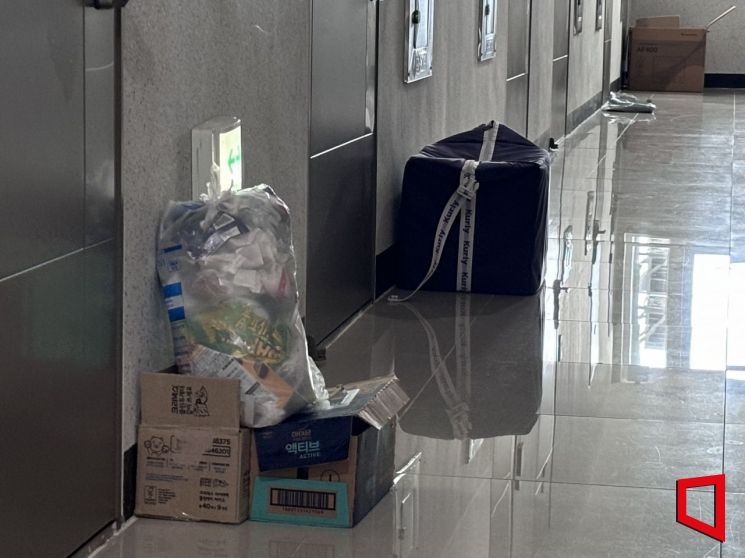 Trash and boxes are piled up in the hallway of an officetel in Gwanak-gu, Seoul.
 [Photo by Yeom Dayeon]
The youth safety housing located in Mapo-gu, Seoul, was in a similar situation. Shim (25), whom I met that day, said, "I recently heard for the second time that even the fire department came out because of the items piled up in the building corridor here," adding, "The management office keeps issuing notices, but the situation is not improving, so it is inconvenient." The management office also complained, "We keep receiving complaints, and when we visit the unit to ask them to organize their belongings, sometimes they do not respond at all," adding, "It is difficult to enforce from the management side, so it is really awkward."
Recently, complaints and inconveniences caused by piled-up items in corridors of apartments or officetels have been increasing. Especially in cases where there is insufficient storage space inside one-room units, corridors are often used as storage spaces. A fire official said, "Reports related to corridor clutter in officetels and similar buildings are continuously increasing," adding, "We usually resolve complaints through on-site guidance, but if multiple warnings are issued, fines may be imposed according to the Fire Services Act."
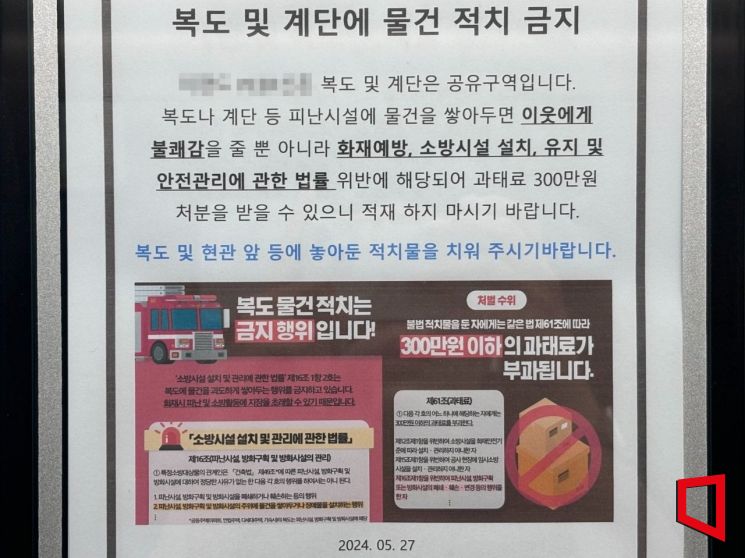 A notice stating "No storage of items in hallways and staircases" is posted at a youth safety housing in Mapo-gu, Seoul.
 [Photo by Yeom Da-yeon]
In fact, storing items in common corridors is illegal. Article 16 of the Act on Installation and Management of Fire-Fighting Facilities prohibits "stacking items or installing obstacles around evacuation facilities, fire compartments, and fire prevention facilities." Violators may be fined up to 3 million KRW.
However, exceptions to fines apply if the corridor or passageway width allows evacuation of two or more people or if the items are temporarily stored and can be moved immediately. Although fines may not be imposed, the act of stacking items itself is illegal.
In another apartment, it was not difficult to find stored items such as bicycles or trash. Kang (61), who lives in a corridor-style apartment in Dongjak-gu, Seoul, said, "There is a designated trash collection day every week, but in summer, if trash is left at home for a week, many people inevitably put it outside because of the smell and insects."
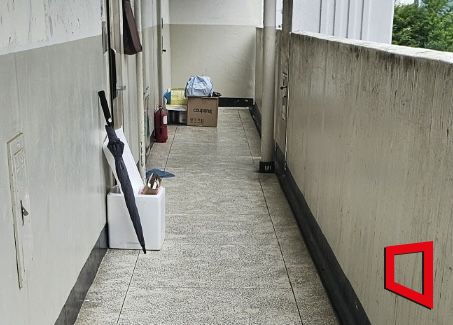 Personal belongings are piled up in the hallway of an apartment in Dongjak-gu, Seoul.
 [Photo by Yeom Dayeon]
Experts warn that clutter in corridors can not only obstruct emergency situations but also act as another risk factor. Lee Young-joo, a professor in the Department of Fire and Disaster Prevention at Kyungil University, said, "Clutter obstructs the entry of firefighters and the evacuation of residents, so it is naturally a problem that needs to be resolved," emphasizing, "Especially in cases of fire, the clutter itself can become combustible material that worsens the fire or blocks the evacuation routes, creating dangerous situations."
Professor Lee added, "Although fire inspections are conducted, the most important thing is for residents themselves to recognize the risks and sufficiently prepare and prevent them."
Meanwhile, some voices point out that the fundamental cause of the problem is the lack of storage space in apartments or officetels. A (29), who lives in youth safety housing, said, "Since the one-room is less than 5 pyeong (approximately 16.5 square meters), there is nowhere to put even essential items," adding, "I often leave water or bulky items in the corridor and bring them in when needed."
Lee Yong-jae, a professor in the Department of Fire Safety Management at Kyungmin University, explained, "Citizens are generally aware that they should not leave items in corridors or stairways, but as homes are getting smaller, it has become an unavoidable situation." He said, "The fundamental solution to the problem is to increase storage space in homes," adding, "Policies or efforts to secure storage space in residential areas are needed even now."
© The Asia Business Daily(www.asiae.co.kr). All rights reserved.



















