Early August Red Leaf Lettuce Retail Price Up 96% MoM
Cabbage, Cucumber, Perilla Leaves Also See Large Increases
Food Ingredients and Daily Necessities Prices Continue to Rise
At a home-style meal restaurant in Jung-gu, Seoul, the lettuce and other leafy vegetables that were previously provided as a standard side with the spicy pork stir-fry menu will not be offered for the time being. This is due to vegetable prices having roughly doubled compared to a month ago. The situation is not much different for pork belly specialty restaurants or eateries that include vegetables as a basic component. They are either reducing the amount of lettuce or perilla leaves provided or excluding them altogether, asking customers for their understanding.
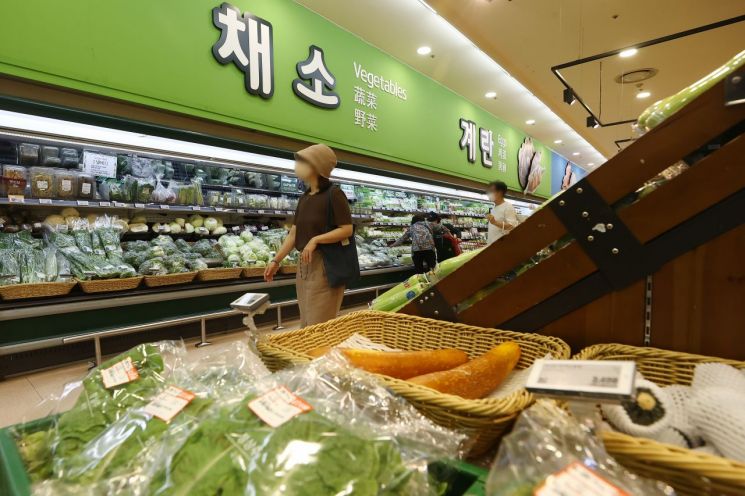
The early onset of the heatwave and prolonged rainy season have caused vegetable prices to surge significantly within a month, impacting both the food service industry and household meal costs. In particular, the prices of leafy vegetables used for wraps have been soaring.
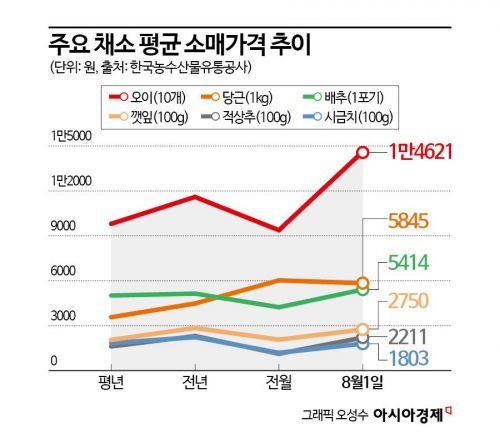
According to the agricultural product distribution information from the Korea Agro-Fisheries & Food Trade Corporation (aT) on the 2nd, the retail price per 100g of red leaf lettuce (standard grade) was 2,211 won as of the previous day, marking a 96% increase compared to a month ago (1,128 won). Although this is a 4.4% decrease compared to the same period last year, it is 36.4% higher than the average price.
During the same period, the price of a whole napa cabbage was 5,414 won, up 27.8% from the previous month and 7.9% compared to the average. Additionally, the price of spinach per 100g rose from 1,193 won on the 1st of last month to 1,803 won a month later, a 51.13% increase. Prices of cucumbers (14,621 won) and perilla leaves (2,750 won) also rose by 55.9% and 32.9%, respectively, compared to the previous month.
The sharp rise in major vegetable prices over the past month is due to the repeated effects of the rainy season, heavy rains, and heatwaves, which have impacted production and shipment in farming areas. This summer's rainy season lasted 39 days in Jeju Island, 36 days in the southern region, and 29 days in the central region. Compared to the average of 31 to 32 days, Jeju and the southern region experienced longer periods, while the central region had a slightly shorter duration.
Record-breaking heavy rains fell in major vegetable-producing areas such as Chungnam and Jeonbuk, causing crop damage. A farmer in Chungnam said, "Due to damage from fatigue and the heatwave, greenhouse operations have been difficult, leading to a shortage of supply." He added, "Quality has also been affected, resulting in lower profitability for farmers and higher prices for consumers, so the situation is not favorable."
The upward trend in prices for some vegetables is expected to continue through this month. According to the Agricultural Outlook Center of the Korea Rural Economic Institute, the production volume of napa cabbage this summer is estimated at 340,000 tons, down 7.2% and 9.1% compared to last year and the average, respectively. Due to frequent rain and uneven growth, the harvest volume of napa cabbage this month is also expected to decrease by 5.4% compared to last year and 6.0% compared to the average.
Accordingly, the wholesale price of napa cabbage per 10kg is expected to rise to 16,000 won this month, an increase of 19.3% from last year and 29.5% from the average. The Ministry of Agriculture, Food and Rural Affairs plans to secure a supply volume of 23,000 tons this year to stabilize the supply and will flexibly distribute it to the market in response to the supply instability of summer napa cabbage.
Meanwhile, prices of processed foods have also continued to rise along with vegetables. An analysis by the Price Monitoring Center of the Korea Consumer Agency on 37 essential goods in the second quarter of this year showed that 24 items increased by an average of 4.5% compared to the same period last year. Among food-related items, sugar had the highest price increase rate at 17.8%, followed by gochujang (red chili paste) at 10.2%, seasoned laver at 7.1%, and beer at 5.8%. Among the top 10 items with the highest price increases, four were fermented sauce products.
The Consumer Agency pointed out, "While the prices of gochujang and doenjang (soybean paste) remain high, the significant rise in soy sauce prices this year is expected to negatively affect the stability of both household meal costs and dining-out expenses."
© The Asia Business Daily(www.asiae.co.kr). All rights reserved.
![Clutching a Stolen Dior Bag, Saying "I Hate Being Poor but Real"... The Grotesque Con of a "Human Knockoff" [Slate]](https://cwcontent.asiae.co.kr/asiaresize/183/2026021902243444107_1771435474.jpg)

















