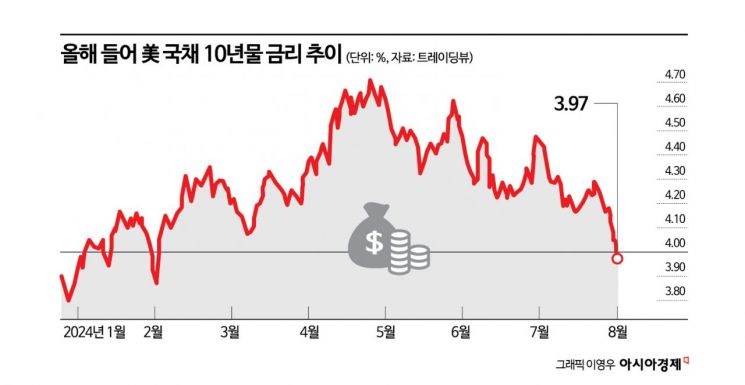
On the day after the U.S. Federal Reserve (Fed) signaled a September pivot (policy shift), the yield on the 10-year U.S. Treasury note fell into the 3% range for the first time in six months. This was due to worsening manufacturing and employment indicators amid ongoing expectations for rate cuts, sharply increasing recession concerns. The market has also seen growing criticism that the Fed should have cut rates last month. The fear of recession weighed heavily on the New York stock market as well.
Rising Recession Fears Trigger Sharp Drop in Treasury Yields and Stock Market
In the New York bond market on the 1st (local time), the benchmark global bond yield?the 10-year U.S. Treasury yield?moved around 3.97%, down 12 basis points (1bp=0.01 percentage point) from the previous session. This is the first time in six months that the 10-year yield has fallen below 4%, since February. The 2-year yield, which is sensitive to monetary policy, also dropped to 4.19%, marking its lowest level in half a year.
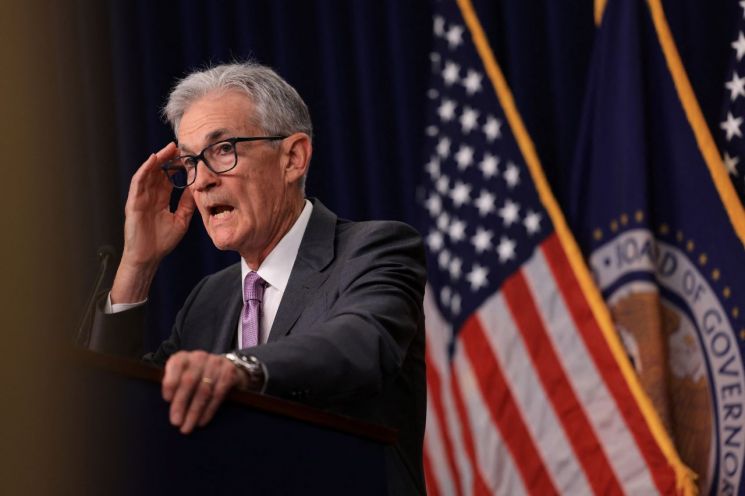
This sharp decline in Treasury yields was driven by Fed Chair Jerome Powell’s indication of a possible rate cut in September, coupled with weak economic data released that day. The market was overwhelmed by concerns that a recession could hit before the Fed lowers rates.
The economic indicators released that day all reinforced signals of economic contraction. The U.S. manufacturing Purchasing Managers' Index (PMI) for July, published by S&P Global, fell to 49.6, marking a shift to contraction territory after one month. The Institute for Supply Management (ISM) also reported a July manufacturing PMI of 46.8, down from 48.5 the previous month, indicating an accelerated contraction. A PMI below 50 signals economic contraction, while above 50 indicates expansion. Additionally, weakening signals appeared in the labor market. According to the U.S. Department of Labor, initial jobless claims for the week of July 21?27 reached 249,000, the highest in about a year.
Adam Crisafulli, strategist at Vital Knowledge, said, "The lower-than-expected PMI is another sign that domestic economic growth conditions are cooling." Chris Rupkey, chief economist at FWD Bonds, diagnosed that "the winds of recession are blowing strongly." The New York stock market fell sharply across the board. The S&P 500 index, focused on large-cap stocks, dropped 1.37%, while the tech-heavy Nasdaq index slid 2.3%. The Chicago Board Options Exchange (CBOE) Volatility Index (VIX), known as Wall Street’s fear gauge, surged to its highest level in three months during the session.
Missed the Timing for Rate Cuts... Attention Turns to Today’s Employment Report
Some argue that amid growing recession fears, the Fed missed the opportunity to cut rates at the July Federal Open Market Committee (FOMC) meeting held until the previous day. Capital Economics analyzed, "Manufacturing contraction could slow third-quarter economic growth more than expected," adding, "With the labor market also weakening, concerns are spreading that the Fed’s monetary policy shift is too late."
Accordingly, there is speculation that the Fed may implement a ‘big cut’?a 0.5 percentage point reduction instead of the usual 0.25 percentage point?at one of the remaining FOMC meetings this year in September, November, or December. According to the Chicago Mercantile Exchange (CME) FedWatch tool, the federal funds futures market fully prices in a rate cut of at least 0.75 percentage points by year-end. The probability of a cut exceeding 1 percentage point within the year stands at about 26.1%, indicating that the market is betting on at least one big cut in the remaining meetings this year.
The Wall Street Journal (WSJ) reported, "The Fed may regret not igniting the rate cut fire in July," explaining, "This is why the rate futures market is pricing in a 0.5 percentage point cut at one of the remaining meetings this year."
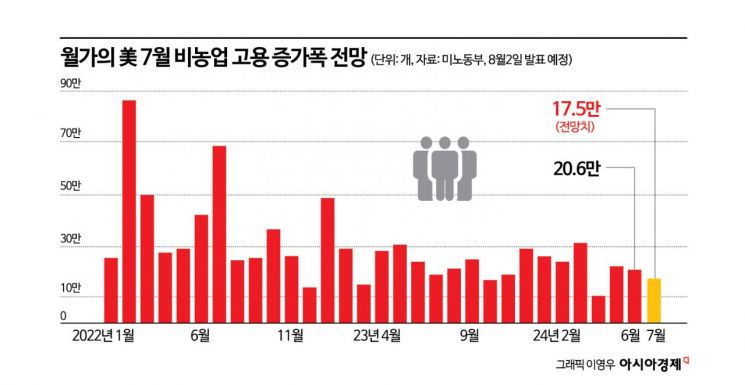
Now, market attention is focused on the July nonfarm payroll report from the U.S. Department of Labor, scheduled for release on the morning of the 2nd. This is a key indicator to confirm further cooling signals in the labor market. Currently, Wall Street expects nonfarm payrolls to have increased by 177,000, a significant slowdown from the previous month’s 206,000. The unemployment rate is forecast to remain steady at 4.1%.
The critical question is whether this slowdown in job growth is part of a ‘labor market normalization’ or an ‘early sign of a broad recession.’ If the unemployment rate comes in higher than expected, recession concerns based on the Sahm Rule could intensify. The Sahm Rule identifies a sudden recession risk when the three-month moving average of the unemployment rate rises by 0.5 percentage points above its lowest point in the past 12 months. This rule has been validated in all past recessions since the 1970s, including the global financial crisis. As of June, the Sahm Rule indicator stood at 0.43 percentage points, close to the threshold.
Dr. Claudia Sahm, who devised the Sahm Rule, warned on the first day of the FOMC, "Cut rates. The time has come," adding, "Waiting any longer will make gradual cuts difficult and could create unwarranted urgency."
© The Asia Business Daily(www.asiae.co.kr). All rights reserved.
![Clutching a Stolen Dior Bag, Saying "I Hate Being Poor but Real"... The Grotesque Con of a "Human Knockoff" [Slate]](https://cwcontent.asiae.co.kr/asiaresize/183/2026021902243444107_1771435474.jpg)


















