[Timeff Rehabilitation Application Part 2]
Shortened Settlement Cycle and Segregated Deposit Regulations Intensify
Criticism of Gu Young-bae's Management Responsibility for 'Excessive Acquisition'
Concerns Over Industry Ecosystem Contraction Due to Regulatory Focus

The 'Timf (Timon·Wemakeprice) incident' has triggered increased regulatory movements on e-commerce platforms. The two main regulatory proposals are ① separation of payment management and ② shortening of settlement cycles. As a measure to strengthen payment management, the application of an 'escrow' system is expected. Escrow is a system where a trusted third party, such as a bank, holds the payment and releases the funds to the seller only after the delivery of goods is completed. It involves placing transaction funds in a separate account. This is a safeguard to prevent platform operators from using sellers' settlement funds as petty cash. Following the 'Timf incident,' the introduction of escrow may become mandatory for all online commerce platform operators.
Shortening the settlement cycle is also under consideration. Under the current 'Large-scale Distribution Industry Act,' settlement of sales proceeds is mandated within 40 to 60 days from the end of the month in which the goods were sold. However, this law has only been applied to large marts and department stores. In the future, it may be applied to all small and medium-sized platform operators. Timon has paid proceeds 40 days after the last day of the month in which the transaction occurred, while Wemakeprice has paid on the 7th of the second month after the transaction.
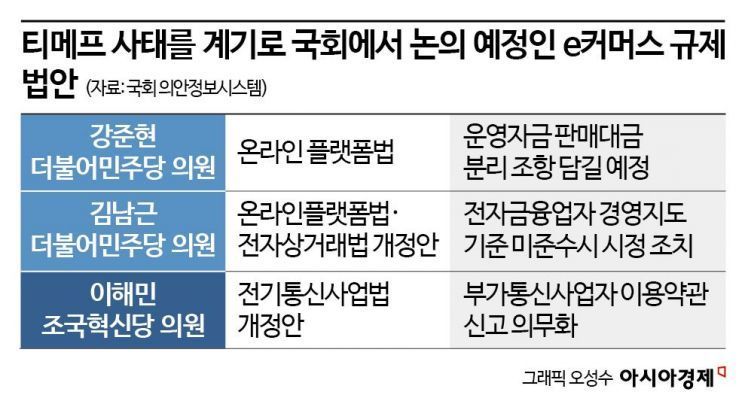
Legislative proposals are also being introduced one after another. Kang Jun-hyun, a member of the Democratic Party of Korea, is preparing an 'Amendment to the Act on Fairness in Online Platform Brokerage Transactions.' It is expected to include provisions to separate operating funds and sales proceeds in e-commerce companies' accounting. The main goal is to make it difficult to use sales proceeds for other purposes. Lee Hae-min of the Justice Innovation Party also proposed an 'Amendment to the Telecommunications Business Act' to require value-added telecommunications service providers to report their terms of use.
Personal Misconduct of Koo Young-bae... Expansion of Regulation May Stifle Domestic Startups
The industry expresses concerns about excessive regulation. The root cause of this incident is the personal misconduct and poor management of Koo Young-bae, CEO of Qoo10, and there is a view that imposing regulations on the entire online platform market could stifle the overall market. The premise is that the case involves fraud, embezzlement, and breach of trust charges arising from Koo's aggressive acquisition of Timon·Wemakeprice and his efforts to raise funds for a Nasdaq listing. The problem originated from the poor management of Qoo10, a Singapore-based e-commerce company, but if regulatory bills are implemented one after another, it is pointed out that only the entry barriers for innocent domestic operators will increase.
In fact, domestic companies like Naver Pay and 11st have relatively smooth cash flow and liquidity for tenant companies due to their fast settlement cycles. In the case of 11st, settlements are completed within one business day after purchase confirmation and return completion. Naver Pay settles the full amount within about three days after payment. Additionally, Naver Pay, Kakao Pay, and Toss Pay have implemented pre-refund measures for payment transactions on both sides of Timf.
Jeon Sung-min, a professor of business administration at Gachon University, said, "The settlement chaos in e-commerce platforms is a rare case both domestically and internationally," adding, "It happened because CEO Koo, who was trying to list Qoo10, pushed ahead recklessly despite weak capital conditions." An industry insider in the domestic e-commerce sector said, "The problems of Timon·Wemakeprice are limited to Qoo10's management responsibility."
Repetition of the Merge Point Incident... Rubber-band Settlement Cycles and Non-segregated Deposits Are Structural Problems
However, many point out that the 'rubber-band settlement cycles' and 'non-segregated deposits of sales and operating funds' exposed by the Timf incident are bad practices that must be corrected this time. The structure makes it easy for platform operators to divert funds payable to tenant sellers and to use funds interest-free, making it easy to cause a 'settlement crisis' like this. The similarity of the Timf incident to the 2021 Merge Point crisis also supports the argument that this is a 'structural problem.' At that time, Merge Point gained popularity by selling points called 'Merge Merge' at a 20% discount. However, after it was revealed that the business was conducted without registration as an electronic financial business operator, sales were suspended, usage locations were reduced, and refund requests followed.
The actual damage to Merge Money purchasers at that time amounted to 75.1 billion KRW, and the damage to Merge Point affiliates was 25.3 billion KRW. As a result of investigations and trials, Kwon Nam-hee, CEO of Merge Plus who operated Merge Point, and his brother Kwon Bo-gun, Chief Strategy Officer (CSO), were sentenced to four and eight years in prison, respectively. They were charged with violations of the Electronic Financial Transactions Act and fraud. Despite accumulating deficits that made normal business operations difficult, they sold 252.1 billion KRW worth of Merge Money without notifying 570,000 victims, thereby defrauding them.
Lee Yong-woo, a former Democratic Party member of the 21st National Assembly who focused on raising these issues and demanding institutional improvements, said, "Where there is innovation, there are always blind spots and risks, and the Timf incident is such a case," emphasizing, "Just as the Fair Trade Act stipulates that the principal contractor must not delay payment to subcontractors, regulations should be established to require large e-commerce companies to complete settlement payments within a specific period."
© The Asia Business Daily(www.asiae.co.kr). All rights reserved.


















