Manufacturing and Employment Indicators Slow Down Amid Powell's September Rate Cut Forecast
Criticism Arises Over Missed July Rate Cut Opportunity
0.5%P Cut Expected at One of This Year's Meetings
Following Federal Reserve (Fed) Chair Jerome Powell's indication of a possible rate cut in September, coupled with rising concerns over a U.S. economic recession, the 10-year U.S. Treasury yield fell into the 3% range for the first time in six months. While the outlook for a soft landing of the U.S. economy remains dominant, worries about a potential recession are emerging as signals of cooling in the manufacturing sector and labor market continue to surface. Some analysts suggest that if the U.S. economy cools rapidly, the Fed might execute a 'big cut' of 0.5 percentage points in one of the remaining three meetings this year, having missed the opportunity to cut rates in July.
On the 1st (local time), the 10-year U.S. Treasury yield, a global bond rate benchmark, traded at 3.97%, down 12 basis points (bp; 1bp = 0.01 percentage points) from the previous trading day. This marks the first time in six months since February that the 10-year Treasury yield has fallen into the 3% range. The 2-year Treasury yield, which is sensitive to monetary policy, also dropped 14bp to 4.19%, reaching its lowest level in half a year.
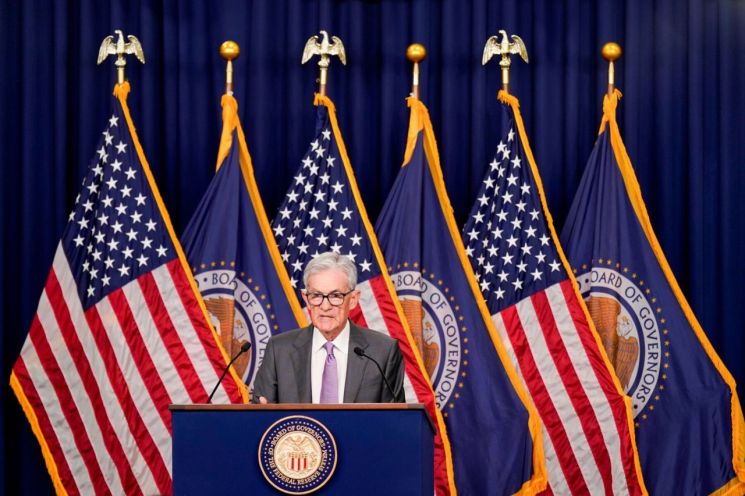
The sharp decline in U.S. Treasury yields is a result of Powell's announcement of a possible rate cut in September and the release of indicators showing a slowdown in the U.S. economy. After the Federal Open Market Committee (FOMC) regular meeting the previous day, Powell mentioned 'employment risks' and signaled a potential rate cut in September. He stated, "With the labor market cooling, the risk of inflation rebound has decreased, while the risk of employment slowdown is now substantial," adding, "A policy rate cut could be discussed at the next meeting in September." As expected, the Fed kept the benchmark interest rate unchanged at 5.25-5.5% for the eighth consecutive time.
Moreover, the release of economic indicators showing a slowdown in the U.S. economy the day after the FOMC meeting accelerated the decline in Treasury yields. The S&P Global U.S. Manufacturing Purchasing Managers' Index (PMI) for July was reported at 49.6. A PMI below 50 indicates contraction, while above 50 indicates expansion; this figure fell below the previous month's 51.6, signaling a shift to contraction after one month. The Institute for Supply Management (ISM) also reported a July U.S. Manufacturing PMI of 46.8, down from 48.5 in the previous month, indicating an accelerated contraction.
Additional signs of weakening employment emerged. According to the U.S. Department of Labor, initial jobless claims for the week of July 21-27 reached 249,000, the highest in about a year. Furthermore, continuing claims for unemployment benefits, which count those claiming benefits for at least two weeks, totaled 1,877,000 for the week of July 14-20, the highest in two years and eight months since November 2021. Both figures exceeded market expectations and the previous week's revised numbers. The July employment report to be released by the U.S. Department of Labor the following day is expected to heighten concerns about labor market cooling. Experts anticipate that nonfarm payrolls increased by 177,000 last month, a significant slowdown from 206,000 in the previous month.
Although the prevailing view is that the U.S. economy can achieve a soft landing with steady growth and declining inflation, the worsening economic indicators have intensified recession fears. Chris Lukki, Chief Economist at FWD Bonds, diagnosed, "The economic indicators released this morning show that the economy is either in recession or moving toward one," adding, "The winds of recession are blowing strongly."
Some voices criticize the Fed for missing the opportunity to cut rates at the July FOMC meeting amid growing recession concerns.
The Wall Street Journal (WSJ) analyzed, "As signs of economic slowdown increase, concerns are spreading that the Fed is reacting too slowly," and warned, "Waiting until September to start cutting rates could further limit the Fed's room to maneuver."
Accordingly, while the interest rate futures market is betting on three rate cuts within the year, there is speculation that the Fed might lower rates by 0.5 percentage points at one of the remaining FOMC meetings in September, November, or December. According to the Chicago Mercantile Exchange (CME) FedWatch tool, the federal funds futures market fully prices in a rate cut of at least 0.75 percentage points by year-end. The probability of a rate cut exceeding 1 percentage point within the year is priced at 26.1%, indicating bets on a single 'big cut' at one of the remaining meetings.
WSJ reported, "The Fed may regret not igniting the spark for a rate cut in July," explaining, "This is why the rate futures market is pricing in a 0.5 percentage point cut at one of the remaining meetings this year."
Meanwhile, concerns over recession turned the New York stock market bearish. After opening higher in the morning, the three major indices were all down as of 2:27 p.m. Eastern Time. The Dow Jones Industrial Average fell 1.73% from the previous close, while the S&P 500 and Nasdaq indices dropped 1.88% and 2.86%, respectively.
© The Asia Business Daily(www.asiae.co.kr). All rights reserved.
![Clutching a Stolen Dior Bag, Saying "I Hate Being Poor but Real"... The Grotesque Con of a "Human Knockoff" [Slate]](https://cwcontent.asiae.co.kr/asiaresize/183/2026021902243444107_1771435474.jpg)
















