After Taking Appetite Suppressants, Vehicle Collisions Occur
Residual Drug Effects Cause Traffic Accidents
Australia Bans Driving for 12 Hours After Medication
Last August, a man in his 20s, Shin Mo (28), driving a Rolls-Royce near Apgujeong Station in Gangnam-gu, Seoul, crashed onto the sidewalk, injuring a woman in her 20s. Investigations revealed that Shin had taken psychotropic drugs, including the sedative 'Midazolam,' at a plastic surgery clinic before driving. Midazolam belongs to the hypnotic sedative category of medical narcotics designated by the Ministry of Food and Drug Safety.
Recently, cases of traffic accidents caused by driving under the influence of medical narcotics have been increasing. Since the current Road Traffic Act does not specify how many hours driving should be restricted after taking medical narcotics, there are urgent calls for establishing clear guidelines.
According to the office of Democratic Party lawmaker Seo Young-kyo on the 2nd, a total of 386 licenses were revoked due to drug-impaired driving over the past five years. The number of revocations, which was only 57 in 2019, increased to 83 in 2021 and reached 113 last year.
The current Road Traffic Act prohibits driving when under the influence of psychotropic drugs or other substances that impair driving ability. However, there are no clear regulations on how many hours driving should be prohibited after drug administration.
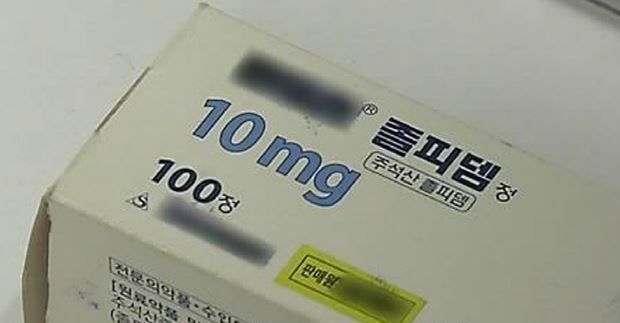
Due to the lack of specific standards, there have been cases where drivers operate vehicles before the drug's effects have worn off, resulting in traffic accidents. For example, in 2022 in Buk-gu, Gwangju, a man in his 30s, Mr. A, who had taken one pill of a sleeping pill containing the psychotropic drug Zolpidem, collided with an oncoming vehicle while driving in the first lane. Although Mr. A was unable to maintain his balance immediately after the accident, he later claimed in court that he was capable of normal driving despite having taken the sleeping pill.
Additionally, in March last year in Seogwipo, Jeju Island, a woman in her 20s, Ms. B, who had overdosed on an appetite suppressant psychotropic drug known as 'Nabi-yak,' caused a collision involving six vehicles while driving her private car.
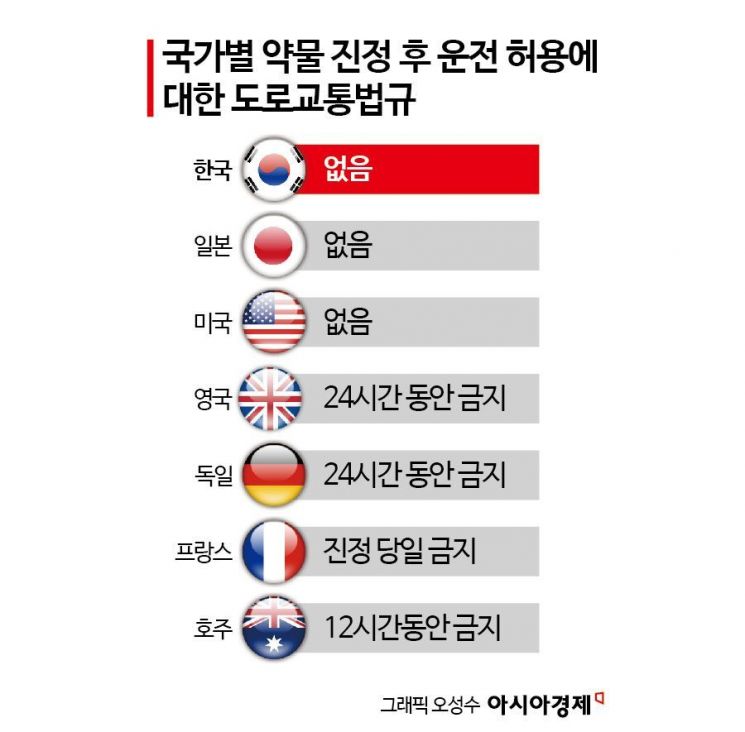
In other countries, concerns over such incidents have led to road traffic laws specifying the time period during which driving is prohibited after taking psychotropic drugs. It is recognized that residual drug effects in the body can critically impair road driving. For instance, the UK and Germany prohibit driving for 24 hours after drug administration. Australia bans driving for 12 hours post-drug intake, and France prohibits driving on the day of drug administration.
Experts emphasize the need for discussions on drug concentration standards and residual effect durations to determine the appropriate level of driving prohibition after drug use.
Lee Beom-jin, director of the Drug Eradication Research Institute, said, "Legally prescribed medical narcotics pose challenges in punishing drivers solely for driving after administration, unlike illegal drugs," adding, "There is a need for driving regulations focused specifically on medical narcotics."
He continued, "Because drug effects vary greatly between individuals, it is difficult to apply uniform regulations to all drugs," explaining, "A forum is needed to discuss how to differentiate punishment levels based on certain drug concentration thresholds and to decide the appropriate duration of driving prohibition."
© The Asia Business Daily(www.asiae.co.kr). All rights reserved.


















