This Year, 626 Village Bus Drivers Shortage
COVID-19 Passenger Drop Causes Operational Difficulties and Workforce Attrition
Low Wages and 43% Aged 65 or Older
"Raise Financial Support Criteria or Implement Semi-Public Operation System"
Seoul’s village buses have fallen into financial difficulties after COVID-19, leading to driver attrition, aging, and a double burden. To prevent a vicious cycle that harms citizens, there are calls for measures such as adjusting the financial support benchmark to reflect reality.
According to Seoul city and industry sources on the 1st, village buses have been facing operational and manpower difficulties due to a sharp decline in passengers amid the prolonged COVID-19 pandemic. As of March this year, there were 2,815 village bus drivers in Seoul, which is 626 fewer than the appropriate number of transport workers. The shortage of transport workers increased significantly from 209 in 2020, when COVID-19 first broke out, to 517 in 2021.
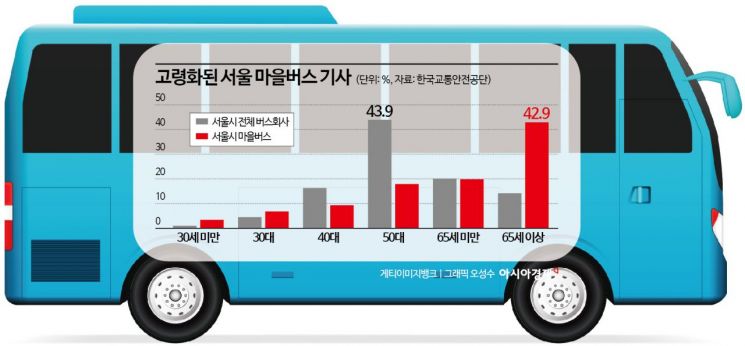
It is analyzed that village bus drivers have left for better-paying jobs such as city buses, parcel delivery, and food delivery. Comparing the monthly salaries including base pay, bonuses, and allowances as of last year, city bus drivers earn about 4.6 million KRW, while village bus drivers earn about 3.2 million KRW, roughly 70% of city bus drivers’ pay. The aging of village bus drivers is also at a serious level due to the turnover of younger drivers. Among all bus companies in Seoul, workers in their 50s make up the highest proportion at 43.9%, and those aged 65 and over account for only 14.2%. However, when limited to Seoul’s village buses, those aged 65 and over account for 42.9%.
Accordingly, voices calling for strengthened support for village buses have gained momentum. The downturn in the village bus industry leads to increased intervals between buses and suspension of bus operations, which ultimately harms citizens. The Seoul Metropolitan Council passed an ordinance in June to improve the treatment of village bus drivers.
There are also claims that Seoul city needs to strengthen its financial support for village buses. Seoul city sets the “financial support benchmark” based on the standard transportation cost, which is the cost of operating one village bus for a day, and provides subsidies accordingly. This year’s benchmark was raised from 457,040 KRW last year to 486,098 KRW, resulting in an additional support of about 551 million KRW as of June. However, the benchmark set this year is still lower than the amount requested by the village bus association (about 520,000 KRW).
There are also criticisms that subsidies have decreased because the payment criteria changed from “registered number of vehicles” to “actual operating number of vehicles.” Until now, the city provided subsidies proportional to the “registered vehicles,” but from early this year, it decided to base support on “actual operating vehicles.” Due to this change, financial support decreased by 16%, from 3.447 billion KRW in February to 2.893 billion KRW in March. Min-gyu Choi, a member of the Seoul Metropolitan Council, said, “More than 60% of the companies receiving subsidies have seen their support reduced,” and added, “The financial support benchmark should be raised to normalize village bus operations, or a quasi-public operation system should be introduced.”
Seoul city plans to maintain the change to “actual operating number of vehicles” as the standard to improve the operation rate of village buses. A city official explained, “From the company’s perspective, using the registered number of vehicles as the basis would mean receiving more subsidies, which might be preferable. However, this could lead to parking vehicles in garages and reducing operation frequency. From the citizens’ perspective, the support criteria should be changed to the actual number of operating vehicles.”
© The Asia Business Daily(www.asiae.co.kr). All rights reserved.

















