NIS Arrests Leaders of Two Voice Phishing Organizations
Supports Police with Real-Time Crime Information
"Will Focus Capabilities on Striking Overseas Origins"
Intelligence authorities have apprehended the masterminds of voice phishing organizations that impersonated government agencies and institutions to extort money from Korean citizens. This achievement was made possible by monitoring the criminal activities of these China-based organizations in real time and providing information to the prosecution and police.
On the 31st, the National Intelligence Service (NIS) announced that it provided information on two voice phishing organizations based in China, including a man in his 30s named Lee (Chinese) and a man in his 30s named Choi (Korean), to the prosecution and police, successfully arresting all suspects entering the country.

According to the NIS, these organizations impersonated entities such as the prosecution, the Financial Supervisory Service, and banks, threatening victims by claiming they were involved in crimes or deceiving them into switching to low-interest loans to extort money. The confirmed amount of damages so far amounts to 1.4 billion KRW.
In March last year, the NIS succeeded in establishing conditions that allowed them to identify phishing victims and monitor the process of actually receiving money. During the tracking process, they even confirmed the actual fraud attempts by the organization's members, known as the "that guy's voice." They secured videos and audio recordings of calls between the members and victims, crime scenarios, and forged arrest warrants manipulated to threaten victims.
Materials obtained by the NIS show that these organizations operated with systematic methods comparable to those of regular businesses. Members acting as "consultants" meticulously recorded victims' ▲identity ▲employment duration and salary ▲loan status and credit card issuance year ▲mobile phone model, among other details, using self-produced "phishing document templates." These records served as performance criteria for remuneration.
'Hotline' Information Support... Crime Prevented Within One Hour
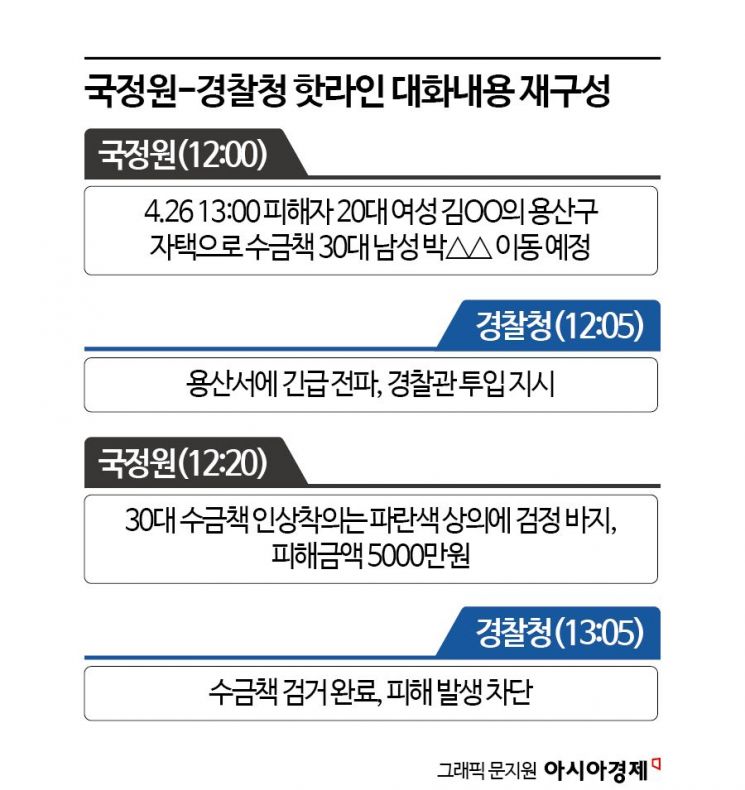
During the process of apprehending the masterminds, the NIS established a "hotline" between the NIS and the National Police Agency. This was to secure the golden time to prevent damage, considering the nature of the crime, which occurs in a short time. The structure allows the NIS to immediately provide the police with information on the voice phishing organization's criminal attempts as soon as it is obtained. The NIS supported the police in real time with information such as the crime location and time.
According to the reconstructed hotline communication process, when the NIS notifies the police of the collector's movements and victim information, the police urgently relay this to the relevant police station, and officers are deployed within five minutes. Subsequently, the NIS provides additional information to the police, such as the collector's age group, appearance, and estimated amount of damage, leading to the collector's arrest by the police within just one hour from the initial information transmission.
From March last year to June this year, this effort prevented damages worth approximately 930 million KRW targeting 28 individuals, including large corporation employees, military personnel, and job seekers.
An NIS official stated, "We plan to strengthen tracking activities against voice phishing organizations operating overseas," adding, "We will focus our capabilities on striking the overseas origins that lead the crimes rather than merely arresting simple collectors operating domestically."
Meanwhile, although the damage from voice phishing crimes has gradually decreased as investigative agencies have established response systems, the scale still amounts to several hundred billion KRW annually. According to the National Police Agency, the damage from voice phishing crimes peaked at 774.4 billion KRW in 2021, then decreased to 543.8 billion KRW in 2022 and 447.2 billion KRW in 2023. However, this year, damages reached 256.3 billion KRW by May, a 50% increase compared to the same period last year.
Below is data related to voice phishing crimes
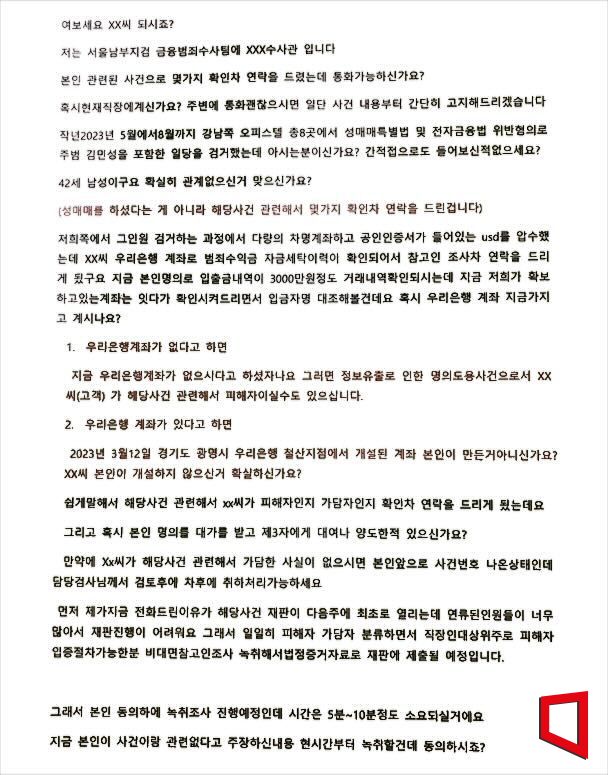
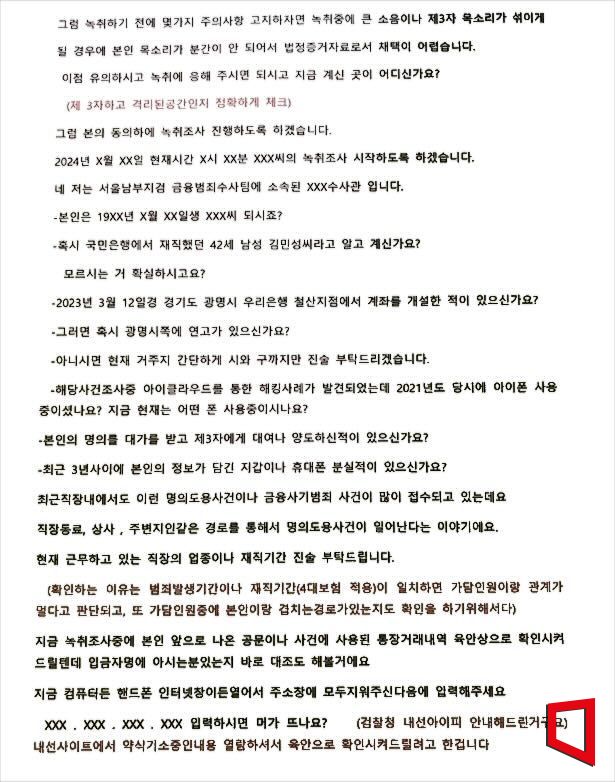
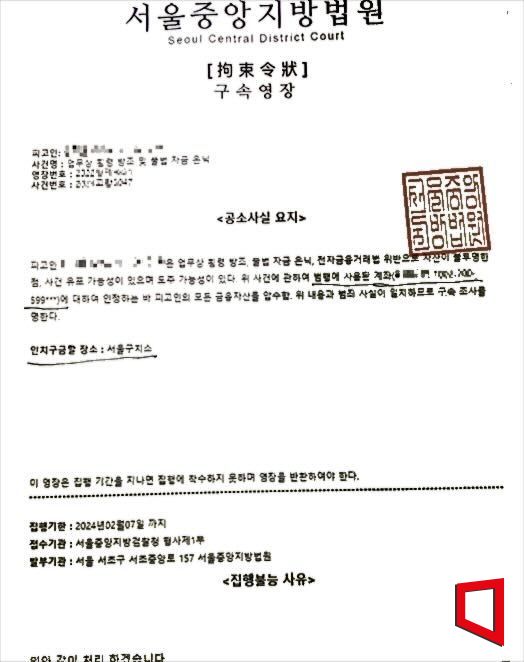
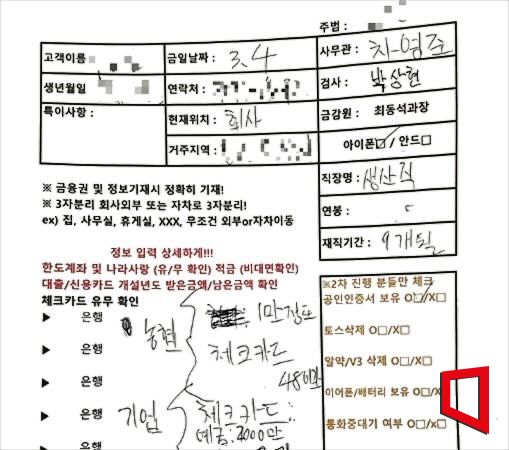 Document form for entering victim information during a voice phishing process
 [Photo by National Intelligence Service]
© The Asia Business Daily(www.asiae.co.kr). All rights reserved.

![Clutching a Stolen Dior Bag, Saying "I Hate Being Poor but Real"... The Grotesque Con of a "Human Knockoff" [Slate]](https://cwcontent.asiae.co.kr/asiaresize/183/2026021902243444107_1771435474.jpg)

















