Medical Reform Special Committee to Announce Three Times Over the Next Year
Public Hearings with Medical Community and Patient Groups Also Planned
Medical School Quotas for 2026 Must Be Discussed with Medical Community Participation
The government will unveil the '1st Reform Plan' this August. Over the next year, it will announce essential medical fee increases, innovations in resident training environments, reforms on essential and regional medical issues, and specific financial investment plans in three phases. Public hearings will also be held to communicate with the medical community and patient groups.
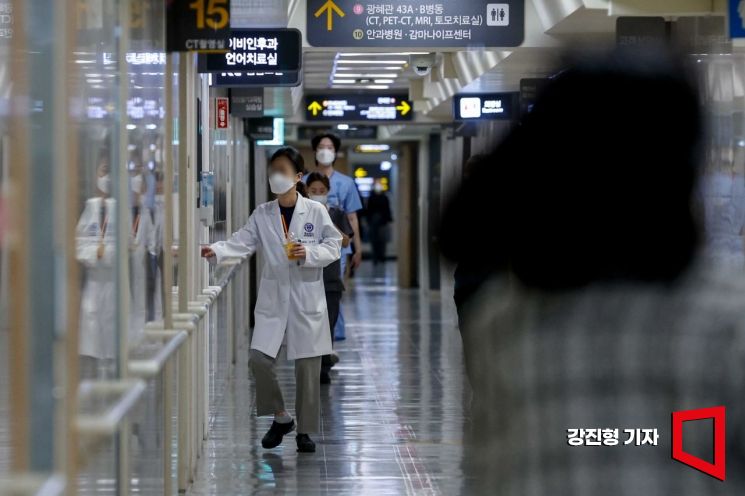
Jeong Gyeong-sil, head of the Medical Reform Promotion Team at the Ministry of Health and Welfare, stated at a press briefing on the progress of medical reform on the 31st, "Along with the situation of resident doctors leaving, long-standing policy (reform) demands regarding the medical delivery system and utilization system are emerging all at once," adding, "We are preparing a broad reform plan, but since it takes a long time to include everything, we will first announce the 1st plan by the end of next month."
The 1st reform plan will primarily include ▲innovation in resident training and strengthening of national support ▲structural transformation of tertiary general hospitals (large hospitals) ▲focused increase in fees for severe and essential medical services ▲strengthening compensation for unavoidable medical accidents. The aim is to first address urgent issues related to essential and regional medical care. Additionally, a public hearing involving the medical community and consumers will be held next month on topics such as the structural transformation of tertiary general hospitals. Kang Jun, head of the Medical Reform General Division at the Ministry of Health and Welfare, explained, "Since the government budget will be submitted to the National Assembly in September, the financial investment plan will also be specified by the end of August."
The 2nd reform plan, scheduled to be announced in December this year, will include ▲innovation in resident training ▲strengthening management of non-reimbursable medical services ▲restructuring of indemnity insurance ▲measures related to the Special Act on Medical Accident Handling. The 3rd reform plan, to be released next year, will include ▲systems to prepare for a super-aged society such as home healthcare ▲strengthening compensation for essential and regional medical care ▲management plans for cosmetic medical services.
Efforts will also be made to establish a system for future medical workforce supply and demand. Jeong emphasized, "Although the Medical Reform Special Committee broadly includes experts from the medical community, health and medical organizations, and consumer groups, the Korean Medical Association and the Korean Intern Resident Association have not participated," adding, "The sooner the medical community participates, the higher the possibility of discussing quotas for the 2026 academic year and beyond."
She also mentioned that necessary improvements will be made during the medical reform process of the special committee. Regarding concerns that promoting specialist-centered hospitals might lead to the absorption of local medical personnel into the metropolitan area, she said, "The direction of medical reform is to reduce areas with high medical utilization while making hospitals less dependent on residents," and added, "We will adjust to prevent non-metropolitan medical personnel from being absorbed into the metropolitan area."
Regarding the legalization of physician assistant (PA) nurses needed for the structural transformation of tertiary general hospitals, Jeong said, "The standing committee recently began discussing the Nursing Act," and added, "Although there are slight differences in opinions between the ruling and opposition parties, they share the same stance on institutionalization, so progress can be made quickly."
© The Asia Business Daily(www.asiae.co.kr). All rights reserved.

















