Transportation-Disadvantaged Area Gangbuk-gu
Shin Gangbuk Line Absolutely Necessary
9.73km Section with 9 Stations, 7 Transfer Stations on 7 Lines
Promoted as a Key Project for 'Wellness Tourism Development'
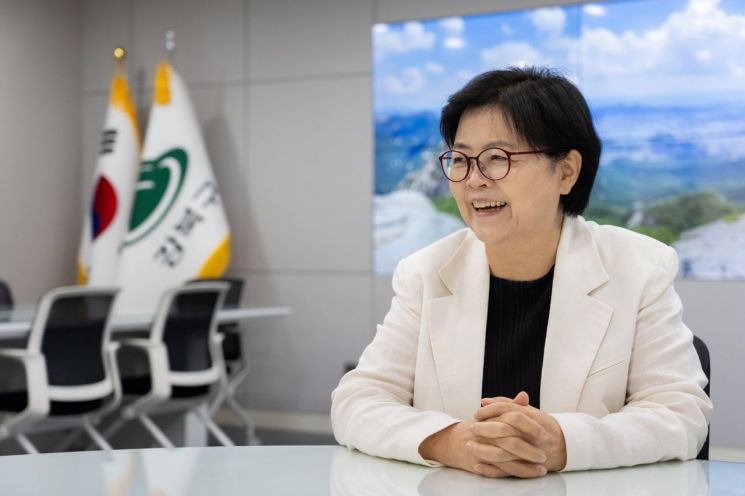 Gangbuk-gu Mayor Lee Soon-hee stated in an interview with this publication, "Residents of Gangbuk-gu face inconvenient transportation conditions, forcing them to take longer routes even for nearby destinations," adding, "The new Gangbuk Line is absolutely necessary." Provided by Gangbuk-gu.
Residents of Gangbuk-gu, Seoul, cite transportation issues as their biggest inconvenience. Bukhansan Mountain occupies about 50% of the total area in the northwest of Gangbuk-gu. In the eastern Beon 2 and 3 neighborhoods, there is the 123-meter-high Opaesan Mountain and Buk Seoul Dream Forest, resulting in a residential terrain in Gangbuk-gu that is long in the north-south direction. The main transportation networks, including Subway Line 4 and the light rail Uisinseol Line, also extend only in the north-south direction.
Even if residents want to go to the adjacent eastern Nowon-gu or the southeastern Jangwi-dong in Seongbuk-gu, or towards Jungnang-gu, there are no suitable transportation options. Since Bukhansan Mountain blocks the west, transportation to the west is naturally poor. To get to Yeouido or Seocho, one must pass through the city center. Even when trying to go to areas with many jobs like Gangnam COEX or Jamsil, one has to transfer between buses and subways three or four times via the city center, taking at least an hour and a half.
Lee Soon-hee, the mayor of Gangbuk-gu, understands these inconveniences better than anyone. He is a semi-native who has lived in Gangbuk-gu for 34 years since 1991. Therefore, as soon as he became mayor, he rolled up his sleeves and pushed forward the ‘New Gangbuk Line’ project. When we met Mayor Lee at Gangbuk-gu Office on the 26th of last month, he said, "Gangbuk-gu is the most neglected area in Seoul in terms of transportation," adding, "It is the only autonomous district in Seoul without a transfer station, and people have to take a roundabout route even for short distances."
The New Gangbuk Line is a light rail line connecting a total distance of 9.73 km from the 4.19 Democracy Cemetery station on the Uisinseol Line to Sangbong Station on Line 7. Starting from the northern Uisinseol Line in Gangbuk-gu, it sequentially connects nine stations across seven lines, including Line 4, Dongbuk Line, Line 1, Gyeongui-Jungang Line, the Metropolitan Express Railway (GTX)-B Line, and Line 7, making it a truly ‘transfer-optimized transportation network.’
The route’s characteristics are clear. It aims to traverse Gangbuk-gu, which has inconvenient public transportation, from east to west, connect the eastern part of Seongbuk-gu and northern Dongdaemun-gu, improve accessibility towards Gangnam, and open a transportation shortcut to avoid detours.
The mayor cited four reasons why the New Gangbuk Line is essential. He said, "Convenient transportation attracts people, and a large population leads to urban development, but the Gangbuk area faces limits in regional economic growth due to a lack of transportation infrastructure."
Considering the changing social realities, improving transportation infrastructure is urgent. He emphasized that large-scale redevelopment projects involving more than 40,000 households in areas such as Suyu-dong and Beon-dong in Gangbuk-gu, Jangwi New Town in Seongbuk-gu, and Imun-dong in Dongdaemun-gu have significantly increased population and transportation demand. He also asked for attention to the fact that out of the 10 million annual visitors to Bukhansan National Park, 7 million climb the mountain through Gangbuk-gu. Balancing development between Gangnam and Gangbuk and resolving transportation disparities are rational issues that must also be addressed from the perspective of equality rights. Mayor Lee said, "Even without comparing the dense subway network in Gangnam with Gangbuk, anyone who knows the situation understands and agrees with this."
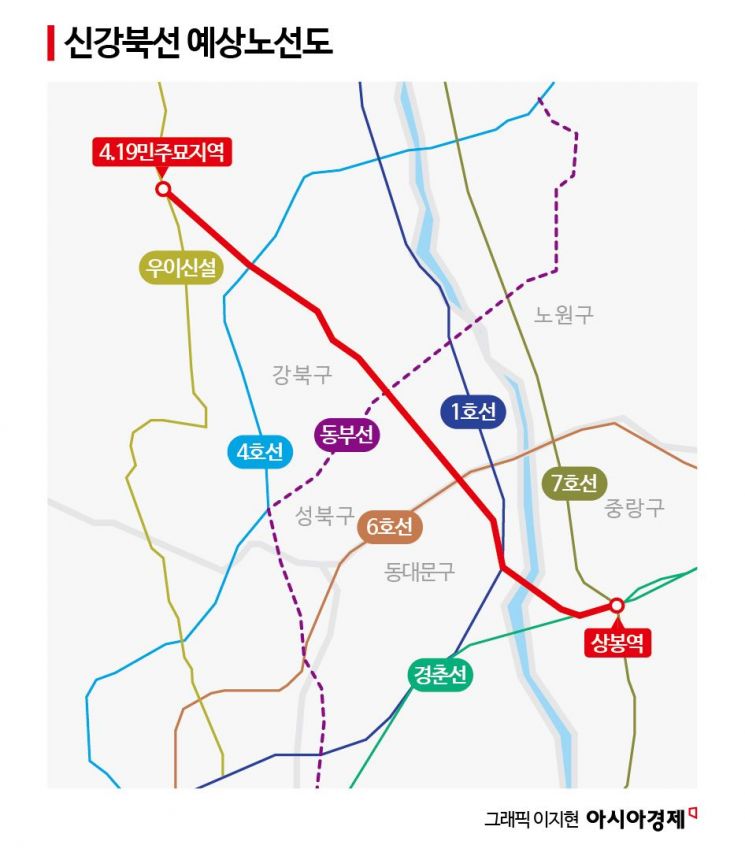
Last November, Gangbuk-gu submitted a ‘(tentative name) New Gangbuk Line Urban Railway Route Review Request’ to the Seoul Metropolitan Government. For now, the decision lies with Mayor Oh Se-hoon of Seoul. If the Seoul city government reviews the related content by the end of this year and reflects the New Gangbuk Line promotion plan in the second revised plan for the Seoul urban railway network, the New Gangbuk Line will be able to enter the ‘main game’ of undergoing a preliminary feasibility study by the Ministry of Economy and Finance. Mayor Lee said, "Our district’s own economic analysis already meets the criteria," but emphasized, "Urban railway networks should be considered not only from an economic perspective but also from the viewpoints of balanced development between Gangnam and Gangbuk and transportation welfare."
In the latter half of his term, Mayor Lee is also focusing on promoting ‘wellness tourism.’ Thanks to Seoul City’s relaxation of the ‘Bukhansan altitude restriction development regulation’ last June, development conditions in the area have improved. Among these, in areas with low competitiveness for redevelopment projects, plans for commercialization such as healing forests, monthly stays, and townhouse construction have become possible.
Mayor Lee said, "Bukhansan National Park, Buk Seoul Dream Forest, and Uicheon Stream are unique natural conditions rarely found in urban areas," adding, "Developing these into tourism resources through visitation, stay, and settlement will not only revitalize the local economy but also greatly help enhance Seoul’s competitiveness."
© The Asia Business Daily(www.asiae.co.kr). All rights reserved.


















