Five counties in Gyeongnam Province have been selected as the second round pilot areas for the Ministry of Education's Education Development Special Zone.
On the 30th, Gyeongnam Province announced this news at the provincial government press center, stating, "Through local study programs, we will respond to the issue of regional extinction and create an opportunity to brighten the future of Gyeongnam."
According to the province, the Education Development Special Zone was introduced to foster cooperation among local governments, education offices, universities, and local industries for the advancement of public education, nurturing outstanding talent, and securing a foundation for settlement in the region.
The application categories are: Type 1 for basic local governments, Type 2 for metropolitan local governments, and Type 3 for basic local governments designated by metropolitan local governments. Namhae-gun was selected for Type 1, while Uiryeong, Changnyeong, Hamyang, and Geochang counties were chosen for Type 3.
With this, following the eight cities and counties including Changwon-si selected in the first round in February, 15 out of 18 cities and counties in the province have now been designated as Education Development Special Zones.
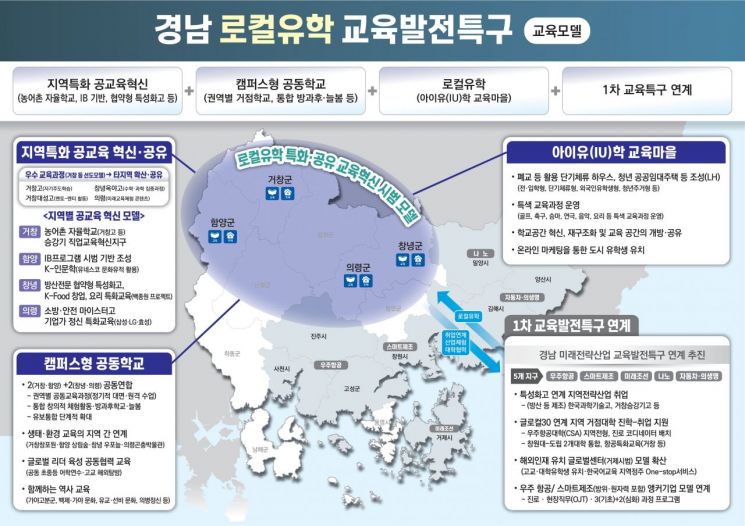
Gyeongnam Province explained that, to address population decline and regional extinction, it collaborated with the Gyeongnam Office of Education to design the "Gyeongnam-type Local Study Education Development Special Zone (draft)" and submitted it for the public contest at the end of June, becoming the only leading region among all metropolitan cities and provinces nationwide.
It was explained that after operating the project for three years, the area will be officially designated as a special zone following an evaluation by the Ministry of Education.
Through this leading designation, the province plans to: ▲ innovate public education by utilizing regionally specialized educational resources ▲ establish campus-type joint schools where students from small schools with low student numbers can study together ▲ create local study education villages to attract urban students to rural areas by providing distinctive education and attractive living conditions ▲ link with the first special zone model focused on future strategic industries.
Plans include achieving differentiated public education innovation by leveraging local specialties such as Geochang's rural autonomous schools and elevator vocational education innovation district, Hamyang's K-Humanities based on world cultural heritage, Changnyeong's defense industry specialized high school and Baek Jongwon's food project, and Uiryeong's firefighting safety meister high school.
In Uiryeong, which faces the highest risk of population extinction in the province, the Gyeongnam Office of Education has been piloting a campus-type joint school since this year, where joint curricula, after-school programs, and experiential activities are offered.
Based on this, the province plans to operate joint schools in a 2+2 format by grouping Hamyang and Geochang, and Uiryeong and Changnyeong together.
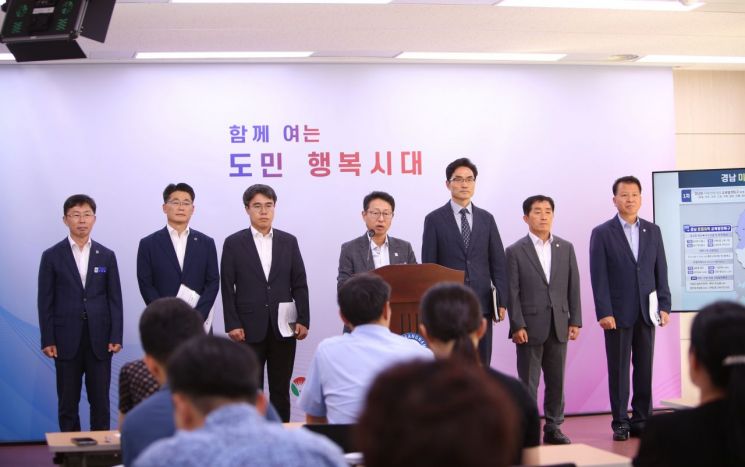 Yoon In-guk, Director of Youth Education at Gyeongnam Provincial Office of Education, is announcing the selection news of the Ministry of Education's second pilot project for educational development special zones.
 [Photo by Lee Seryeong]
In addition, by utilizing the educational resources unique to small rural areas and schools, the province will encourage urban students to study in the countryside and establish short-term experiential share houses, creating a convenient living environment to promote rural study as an alternative to private academies.
Considering the characteristics of the five newly selected areas, which have relatively weak local industrial bases and insufficient university connections, the province will also expand programs related to employment and career experience in regional strategic industries such as aerospace, smart manufacturing, future shipbuilding, nano, automotive, and biomedical, which are the focus of the first Education Development Special Zone.
Additionally, efforts will be made to support university admissions in the region, expand the education system for employment-first and learning-later, and attract international students.
The province also plans to link projects with areas not designated as special zones, such as Tongyeong, Haman, Hadong, Sancheong, and Hapcheon, to create synergistic effects.
Yoon In-guk, Director of the Education and Youth Bureau, said, "Through this local study Education Development Special Zone, we will work closely with the Office of Education, cities and counties, local industries, and universities to make Gyeongnam a place where the dreams of youth and students come true."
© The Asia Business Daily(www.asiae.co.kr). All rights reserved.


















