Ministry of Environment Announces 14 Domestic Dam Construction Sites
Capable of Handling 220mm Heavy Rainfall at Once
Newly Supplied Water to Total 250 Million Tons Annually
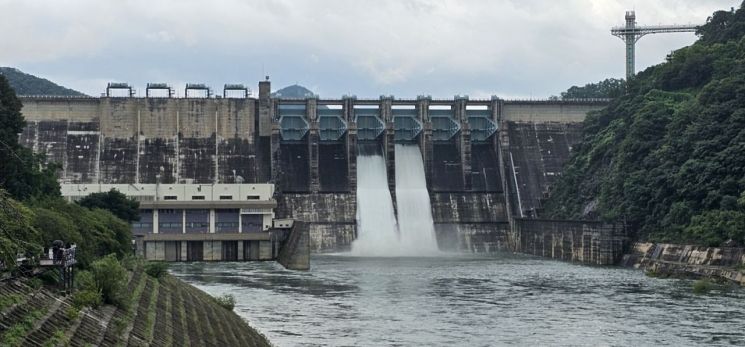
The government announced a new dam construction plan for the first time in 14 years to respond to extreme floods and droughts caused by climate change. There are 14 candidate dam sites nationwide.
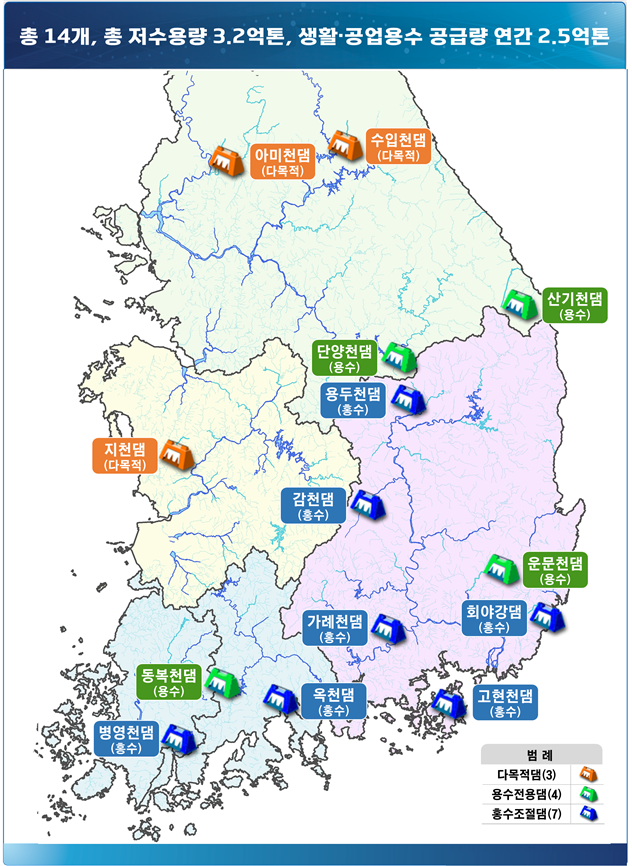
On the 30th, the Ministry of Environment announced 14 candidate sites for climate response dams at the Government Seoul Office. The dams include 3 multipurpose dams, 7 flood control dams, and 4 water supply-only dams. By watershed, there are 4 sites in the Han River basin, 6 in the Nakdong River basin, 1 in the Geum River basin, and 3 in the Yeongsan River and Seomjin River basins.
The government explained that once the climate response dams are built, they will secure flood defense capabilities capable of accommodating rainfall of 80 to 220 mm at once. For example, last year in Yecheon-gun, Gyeongbuk, floods caused 3 casualties and property damage worth 11.7 billion KRW. If the Yongducheon Dam is constructed as planned, it will be able to safely protect downstream areas from floods even during heavy rains with a 200-year return period.
The water newly supplied through the climate response dams will reach 250 million tons annually. This amount is sufficient for 2.2 million citizens. The Ministry of Environment plans to actively respond to new water demands such as extreme droughts and national strategic industries with the additionally secured water. The Ministry also believes that last year’s drought in Gwangju and Jeonnam could have been mitigated without reaching a critical stage if the Dongbokcheon Dam in Hwasun-gun had been in place.
Dam construction has not been pursued at any site for 14 years since the construction of Bohyeonsan Multipurpose Dam began in 2010. As a result, it was difficult to prevent water damage from typhoons such as Hinnamnor in 2022, and future water demand was insufficiently met. In the metropolitan area, 94% of the capacity of Soyanggang Dam and Chungju Dam, the main sources of water supply, has already been used, so if an extreme drought occurs, normal domestic water supply will be disrupted.
When preparing the candidate sites for climate response dams this time, the Ministry of Environment ensured that additional water source regulations due to dam construction would not be added or minimized even in cases where absolutely necessary, and that the number of households displaced by flooding would also be minimized. For example, in the case of the largest-scale Suipcheon Multipurpose Dam (Yanggu, Gangwon), no private houses will be submerged, and there will be no regulations such as water source protection zones caused by dam construction.
The Ministry of Environment plans to actively explain and communicate with residents about their questions and concerns through local briefings and public hearings starting in August, and will also go through sufficient consultation processes with related agencies.
Minister Kim Wan-seop emphasized, “Since dam construction takes about 10 years even if started now, considering the recent climate crisis, there is no room to delay dam construction any longer,” and added, “We plan to significantly increase the budget for supporting areas around dams, such as roads and water supply and sewage systems, so that dams also help improve the lives of local residents and revitalize the regional economy.”
© The Asia Business Daily(www.asiae.co.kr). All rights reserved.
![Clutching a Stolen Dior Bag, Saying "I Hate Being Poor but Real"... The Grotesque Con of a "Human Knockoff" [Slate]](https://cwcontent.asiae.co.kr/asiaresize/183/2026021902243444107_1771435474.jpg)

















