"Ruling Party Only Said Not to Table It, Had No Alternatives"
"Neutrality Is Not Worthless... Must Uphold the People's Will"
Speaker Woo Won-shik of the National Assembly, immediately after the amendment to the Korea Educational Broadcasting System Act (EBS Act) passed the plenary session of the National Assembly, stated, "I earnestly request the President to exercise the veto power with caution regarding matters decided by the legislative branch of the Republic of Korea through long discussions."
Before adjourning the plenary session on the morning of the 30th, Speaker Woo said, "We held the plenary session for 5 nights and 6 days and passed four amended bills after unlimited debate," emphasizing, "The four amended bills are decisions of the National Assembly following the procedures prescribed by law at this point." He continued, "I hope the government takes this seriously," and pointed out, "If the Presidential Office even rejects the (mediation proposal) from the head of the legislative branch, where else can conflicts be mediated?"
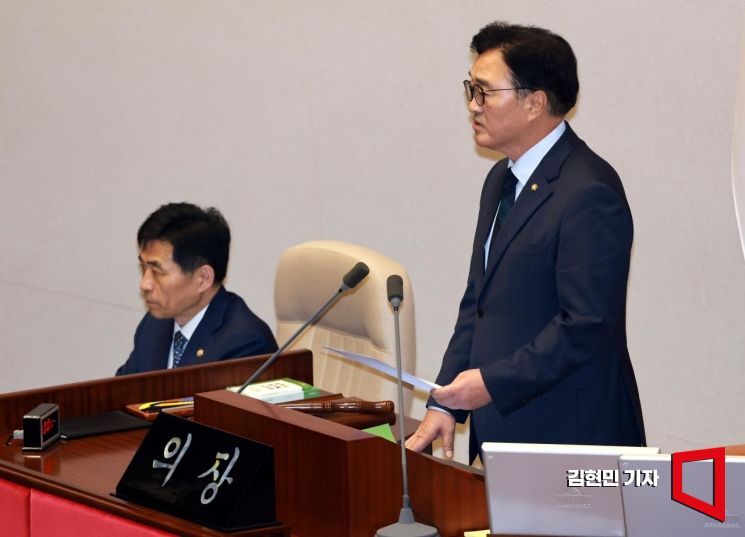 Woo Won-shik, Speaker of the National Assembly, is speaking at the plenary session held at the National Assembly on the 30th. Photo by Hyunmin Kim kimhyun81@
On the same day, the National Assembly passed the amendment to the EBS Act with 189 votes in favor out of 189 members present, despite the ruling party members walking out in the morning. With this, the so-called 'Broadcasting 4 Acts,' including amendments to the Korea Communications Commission Act, the Broadcasting Act, and the Korea Broadcasting Culture Promotion Foundation Act, all passed the National Assembly. Earlier, Speaker Woo proposed forming a 'National Consultative Body for the Broadcasting 4 Acts' to reach a consensus with the ruling party, which opposed the bill's submission, but it was aborted due to the ruling party's opposition. Regarding this, Speaker Woo said, "The ruling party only repeatedly demanded not to submit the bill and had no alternative."
Speaker Woo stated, "In the presidential system with separation of powers, authority is concentrated in the President, but if the side with greater authority does not allow room, the space for dialogue and compromise closes," and added, "The President must actively engage in dialogue with the opposition party." He also said, "No politics can overcome public sentiment," and "To follow public sentiment, we must listen to the voices of the people through the National Assembly chosen by the people. I ask for courage and determination."
He emphasized, "Neutrality is not worthless, and the Speaker of the National Assembly is not just a simple moderator." He also added, "The Speaker of the National Assembly is not on the side of the ruling party or the opposition party but solely on the side of the people," and "I will fulfill the role of the National Assembly based on the will of the people who formed the 22nd National Assembly."
© The Asia Business Daily(www.asiae.co.kr). All rights reserved.
![Clutching a Stolen Dior Bag, Saying "I Hate Being Poor but Real"... The Grotesque Con of a "Human Knockoff" [Slate]](https://cwcontent.asiae.co.kr/asiaresize/183/2026021902243444107_1771435474.jpg)
















