'Second Adolescence' Experienced in Late 20s
Psychiatric Treatment Costs Up 91% in 5 Years
Number of Patients Increased to 427,762
Experts Call for National-Level Solutions Discussion
#1. A, a 26-year-old office worker living in Mapo-gu, Seoul, has been visiting a psychiatric clinic since last year. Due to panic disorder that came along with job hunting, daily life became difficult, leading him to seek medical help. Although he seemed to improve after successfully getting a job this year, he still feels mentally suffocated and depressed. He confessed, "When I pass through crowded places, I feel dizzy and experience intense fear," adding, "I keep going to the hospital and endure by taking the prescribed medication."
#2. Lim, a 28-year-old office worker living in Siheung-si, Gyeonggi-do, is in his third year at a company he wanted to join. However, recently, he has been questioning whether this is the life he truly wants, feeling a lack of motivation in everything and experiencing a suffocating sensation. Lim said, "The stress is so bad that I can't fall asleep at night without having a drink alone," and added, "I read about 'Isipchungi' on the internet, and I could relate to it a lot as if it was my own story."
Recently, the term "Isipchungi" has spread like a trend, with more young people empathizing with it. Isipchungi refers to a second puberty experienced in the mid to late twenties, describing a state involving worries about career paths and self-identity, anxiety, and depression. This term is frequently used on social networking services (SNS) and communities among people aged 25 to 29 and is recognized not as an individual concern but as a common issue faced by this generation.
Their concerns can also be confirmed through actual psychiatric treatment statistics. According to data from the National Health Insurance Service, from 2018 to 2022, the total medical expenses and number of patients in their twenties visiting psychiatric clinics have sharply increased over five years. In 2022, the total psychiatric medical expenses for people in their twenties amounted to 353.36551 billion KRW, a 91% surge compared to 184.87929 billion KRW in 2018. The number of patients also rose by 54%, reaching 427,762 in 2022 from 253,313 in 2018.
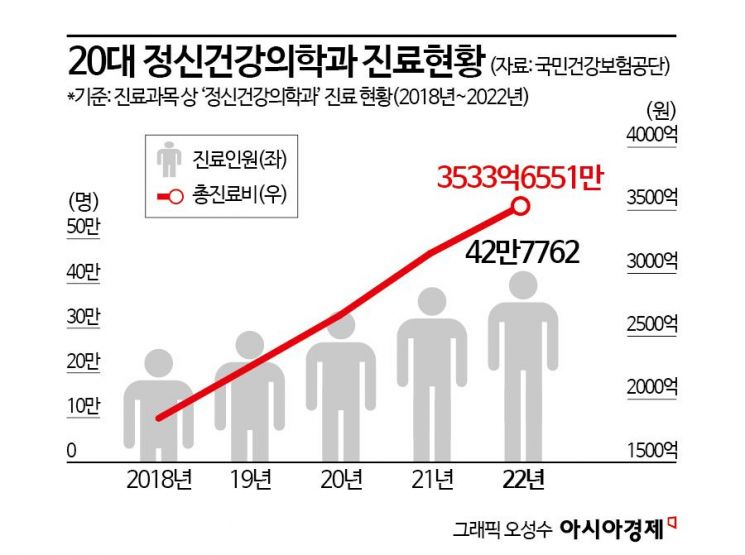
In particular, the most recent data from 2022 shows that people in their twenties spent the highest amount among all age groups. This contrasts with five years ago in 2018, when psychiatric medical expenses ranked sixth after those in their fifties, sixties, forties, seventies, and thirties.
Experts expect that many more people wish to receive psychiatric treatment but are not included in the statistics. Professor Kwak Geum-ju from the Department of Psychology at Seoul National University emphasized, "Currently, people in their twenties are paying for psychiatric costs privately, but only a few can afford it," adding, "Considering those who want to visit hospitals but cannot due to their circumstances and thus are not reflected in treatment statistics, the actual scale is likely very large."
Kim, a 27-year-old job seeker living in Dongjak-gu, Seoul, said, "I have been preparing to become a flight attendant for two years while working part-time, but the future is uncertain and I feel anxious," adding, "My depression is severe, and I am considering visiting a psychiatric clinic, but after looking into it, the cost seems high, so I hesitate to go."
Experts point out that the "Isipchungi" experienced by people in their mid to late twenties is recognized as a problem shared by most of a generation rather than an individual issue, calling for national-level measures. Professor Kwak said, "In the past, people in their late twenties would have a stable situation, but now that period is delayed, making instability the default reality," adding, "Recently, as more diverse lifestyles emerge and the range of comparisons with others widens, conflicts and wandering inevitably intensify."
She continued, "There are too many people across society complaining about mental health issues to simply dismiss this as individual problems," emphasizing, "Support and measures for mental health should be devised just like for physical health."
© The Asia Business Daily(www.asiae.co.kr). All rights reserved.

















