Gangwon Taebaek Located in High Mountain Area
A City Built at the Core of the Taebaek Mountain Range
Comfortable Even Without Air Conditioning or Mosquito Nets
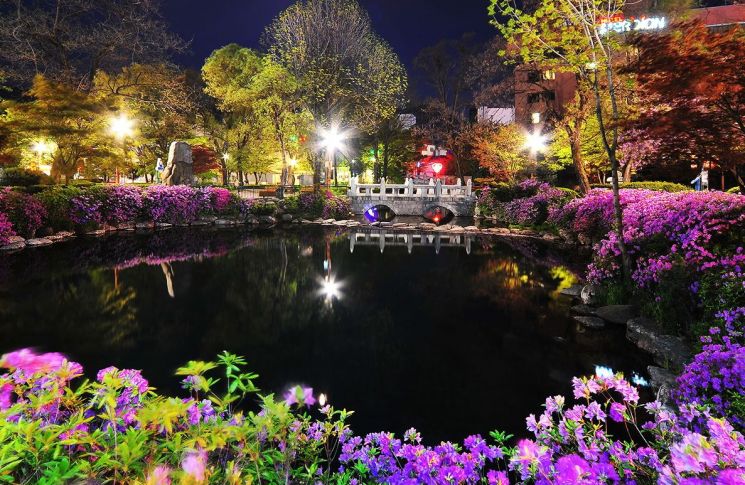
As the Korean Peninsula enters a full-fledged "scorching heat" after the monsoon season, there is one place that uniquely escapes nationwide heatwave warnings. That place is Taebaek, Gangwon Province. Taebaek is known as the only region in Korea where one can enjoy cool temperatures throughout the summer.
"I heard you can live without air conditioning"... Taebaek, the place that avoids heatwave warnings
According to the nationwide weather warning status released by the Korea Meteorological Administration on the morning of the 29th, heatwave warnings or advisories have been issued across the country. However, only one area remains a blank white spot. That place is Taebaek.
The Korea Meteorological Administration issues heatwave warnings when the daytime perceived temperature exceeds 33 degrees Celsius and the nighttime minimum temperature stays above 25 degrees Celsius. Currently, most regions in Korea are experiencing daytime heatwaves ranging from 33 to 35 degrees Celsius and tropical nights around 25 degrees Celsius.
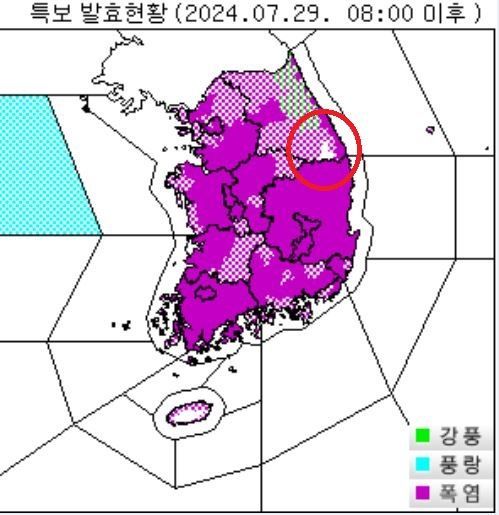 Only Taebaek City has a heatwave advisory, with no warnings issued elsewhere [Image source=Korea Meteorological Administration capture]
But Taebaek is different. On this day, Taebaek’s highest daytime temperature is expected to be around 29 degrees Celsius, and the nighttime temperature is forecasted to drop to 23 degrees Celsius. Depending on wind volume and sunlight, the perceived temperature could be even lower.
Netizens who learned about Taebaek’s temperature status expressed envy, saying things like "I should go to Taebaek for summer vacation," "I heard a heatwave advisory has never been issued even once," "I heard you can live without air conditioning and have to sleep under a winter blanket at night," and "There are no mosquitoes in Taebaek."
The air itself is different from other parts of Korea... The secret is '1,200 meters above sea level'
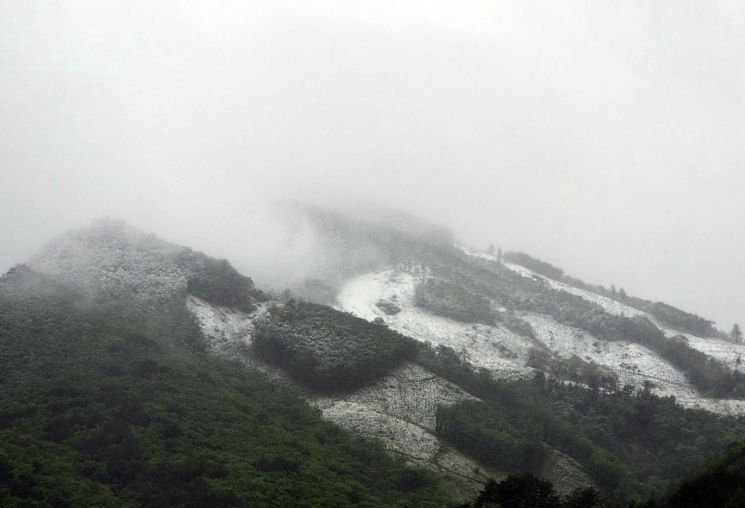
In fact, Taebaek is considered the only "heatwave-free zone" in Korea. It is not completely immune to heatwaves. On July 29 last year, the Gangwon Regional Meteorological Administration issued a heatwave advisory for Taebaek around 10 a.m. However, heatwave warnings in Taebaek are extremely rare, and even then, strong winds and rain quickly cool down the temperature.
So why can Taebaek maintain cool temperatures throughout the summer? The answer lies in its geography. Taebaek is located at the heart of the Taebaek Mountain Range, which runs north to south across the Korean Peninsula. Taebaeksan, the main mountain of the range, reaches 1,567 meters above sea level, and the city of Taebaek itself is situated at 1,225 meters above sea level, making it the highest city in Korea. In other words, the entire area belongs to a high-altitude climate zone.
Because of this, Taebaek’s temperature, humidity, and so-called "air quality" are known to be distinctly different from other regions in Korea. The higher the altitude, the lower the temperature. Generally, the temperature drops by about 5 to 6 degrees Celsius for every 1 km increase in elevation. Thanks to this, while other Korean cities suffer from heatwaves between 33 and 35 degrees Celsius, Taebaek enjoys a relatively cool climate.
The city of Taebaek promotes itself as a "three no's city" in summer: no tropical nights, no air conditioning, and no mosquitoes. The "Cool Festival," which fully leverages the advantages of the high-altitude climate, is held annually in July and August.
© The Asia Business Daily(www.asiae.co.kr). All rights reserved.
![Clutching a Stolen Dior Bag, Saying "I Hate Being Poor but Real"... The Grotesque Con of a "Human Knockoff" [Slate]](https://cwcontent.asiae.co.kr/asiaresize/183/2026021902243444107_1771435474.jpg)


















