Opening Ceremony of the Korean-style ARPA-H Project Promotion Team
"Supporting High-Risk, High-Impact Research"
No Disadvantages if Diligent Despite Failure
Three Projects Announced... Up to 10 Projects Expected Within the Year
"The Korean-style ARPA-H project, although highly likely to fail, is challengingly conducted on high-risk, high-reward research with significant ripple effects to solve social problems, presenting both challenges and opportunities for innovation in Korean healthcare." (Cha Sun-do, President of Korea Health Industry Development Institute)
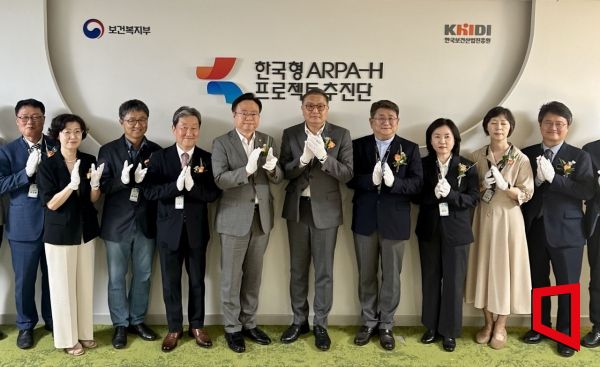 Cha Sun-do, President of the Korea Health Industry Development Institute, Cho Kyu-hong, Minister of Health and Welfare, Park Sang-wook, Senior Secretary for Science and Technology to the President, Seon Gyeong, Head of the Korean ARPA-H Project Promotion Team, Choi Seon, Secretary for Advanced Bio to the President, and Park Yoon-joo, President of the National Institute of Food and Drug Safety Evaluation (from the fourth left) are posing for a commemorative photo at the Korean ARPA-H Project Promotion Team plaque ceremony.
 [Photo by Lee Chun-hee]
Various health issues such as pandemic infectious diseases, super-aging, and essential medical crises are emerging as matters of national security. To drive innovation capable of solving these challenges, the 'Korean-style ARPA-H Project Promotion Team' (hereinafter referred to as the Promotion Team), which pursues 'challenge-driven innovation' research and development (R&D), has officially set sail.
The Ministry of Health and Welfare and the Korea Health Industry Development Institute held an opening ceremony at the Promotion Team office in Jung-gu, Seoul, on the afternoon of the 26th and announced the first new project. The Korean-style ARPA-H is a system benchmarked after the U.S. Defense Advanced Research Projects Agency (DARPA) and Advanced Research Projects Agency for Health (ARPA-H). It has set five major missions: ▲establishing health security ▲overcoming unmet medical needs ▲securing bio-health super-gap technologies ▲improving welfare and care ▲building a regional complete system for essential medical services, and will actively support R&D to address these.
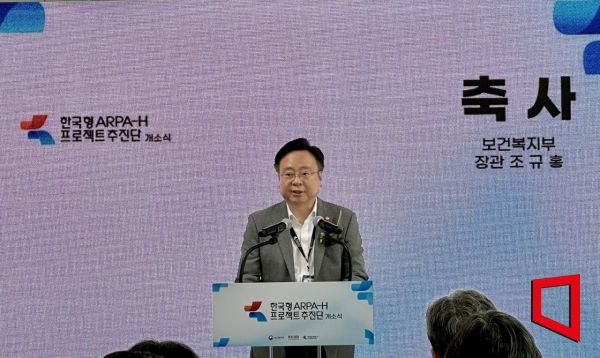 Minister of Health and Welfare Cho Kyu-hong is delivering a congratulatory speech at the opening ceremony of the Korean-style ARPA-H Project Promotion Team held on the afternoon of the 26th.
 [Photo by Lee Chun-hee]
Cho Kyu-hong, Minister of Health and Welfare, said, "The Korean-style ARPA-H is the first step for our bio industry to gain competitiveness amid intensifying global competition," adding, "We will significantly support research that brings innovative changes to public health and research that can become our core competitiveness in global competition, rather than research that ends up unused."
The core of the Korean-style ARPA-H is active yet flexible support for challenging innovative problems. To this end, it minimizes bureaucracy and introduces a system managed by project managers (PMs). PMs are responsible for the entire cycle from problem discovery, pre-planning, project selection, to management, overseeing projects in an integrated manner.
Unlike typical projects, the evaluation criteria abolish grading that distinguishes success or failure. Instead, qualitative indicators excluding success or failure are assessed, ensuring no disadvantages if the project is diligently conducted despite failure. Jung Eun-young, Director of the Health Industry Policy Bureau at the Ministry of Health and Welfare, explained, "Previously, budget cuts based on evaluations led to a tendency to focus only on 'safe' research. To overcome this, the Korean-style ARPA-H will have experts directly serve as PMs to overcome tasks centered on missions, ensuring no disadvantages even if projects fail."
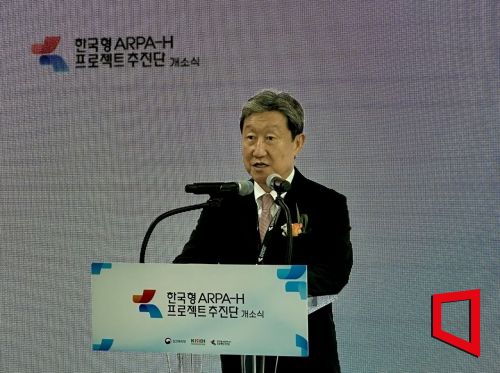 Cha Soon-do, President of the Korea Health Industry Development Institute, is delivering the opening address at the inauguration ceremony of the Korean ARPA-H Project Promotion Team held in Jung-gu, Seoul, on the afternoon of the 26th.
 [Photo by Lee Chun-hee]
At the opening ceremony, detailed tasks to be addressed by the Promotion Team were also revealed for the first time. In the health security field, the development of ultra-long-term vaccine stockpiling technology and the establishment of a decentralized vaccine production system were proposed. In the welfare and care field, the development of multimodal treatment technology for sarcopenia was presented. Seon-gyeong, head of the Promotion Team, stated, "We determined the priority of challenging problems through 3P analysis using projects, publications, and patents," and announced plans to derive a total of 10 projects within this year.
The ultra-long-term vaccine stockpiling technology development project aims to extend the current vaccine storage period of about three years to over ten years. While vaccine storage periods are limited, it is difficult to predict when and what infectious disease will require vaccines. This leads to a vicious cycle of producing stockpile vaccines only to discard them after expiration. Extending storage periods aims to solve this problem. Additionally, the decentralized vaccine production system project plans to develop and distribute small-scale, mobile vaccine production modules to produce and supply vaccines timely to regions in need.
The multimodal treatment technology development project for sarcopenia aims to develop technology that fundamentally treats sarcopenia occurring during aging. As society enters a super-aged phase, sarcopenia among the elderly has emerged as a major cause of shortened healthy lifespan and a social issue. This project plans to employ various technologies such as new biomarkers, therapeutics, and digital medical products to develop fundamental treatments that improve both quantitative and qualitative muscle functions beyond simple muscle mass increase.
© The Asia Business Daily(www.asiae.co.kr). All rights reserved.



















