"Next Generation Doctors Suffer from Reckless Policy Implementation"
"Immediate National Investigation Needed"
Medical school professors have urged a government investigation to uncover the truth behind the government's decision-making process for the policy to increase medical school admissions by 2,000 students.
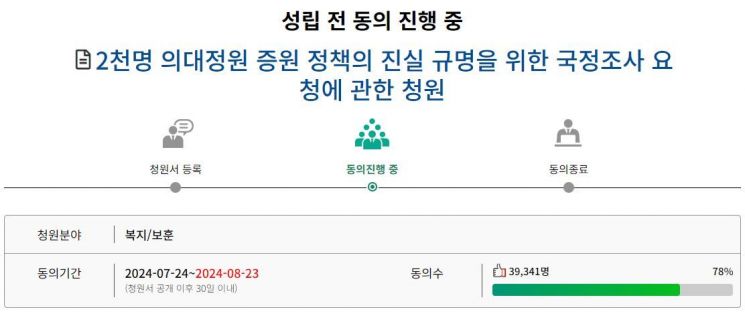
On the 24th, a petition titled "Request for a Government Investigation to Uncover the Truth Behind the Policy to Increase Medical School Admissions by 2,000 Students" was posted on the National Assembly's public petition board. The petitioner, Mr. Oh, stated, "The government, which is pushing an unprecedented ultra-short-term increase of 2,000 medical school admissions worldwide, is driving the medical field and medical education into collapse," and added, "It was revealed through a National Assembly hearing last June that the 2,000 increase was a hasty policy with no consultation, no basis, and no preparation."

He continued, "The ones suffering the most from this reckless policy are the public and the next generation of doctors," emphasizing, "An immediate government investigation is necessary to prevent further collapse and find solutions by uncovering the truth behind the decision and implementation process of the 2,000 increase policy that triggered this crisis." As of 3:30 PM on the 26th, the petition had garnered over 39,000 supporters. If a public petition reaches 50,000 supporters within 30 days of being posted on the website, it is referred to the relevant standing committee of the National Assembly.
They demanded that the government investigation clarify ▲ the decision-making process for increasing medical school admissions ▲ the allocation process of the increased admissions ▲ the scientific reality of the shortage of 15,000 doctors ▲ the judicial handling of residents ▲ the policy banning medical students from taking leaves of absence ▲ attempts to undermine the independence of the Korea Institute of Medical Education and Evaluation ▲ the preparation of educational conditions and securing related budgets following the increase in medical school admissions ▲ government measures regarding non-returning residents and medical students ▲ and government plans to establish a medical-government agreement body.
Earlier, the Emergency Committee of Medical School Professors from Seoul National University, Sungkyunkwan University, Yonsei University, Ulsan University, Catholic University, and Korea University also stated in a report that "at least 95.5% of fourth-year medical students have not taken the national medical licensing exam," warning that "without drastic measures, it will be difficult to avoid a situation where only a very small number of doctors graduate next year." According to a recent survey conducted by the Korean Medical School and Graduate Medical School Student Association (KMSA) targeting 3,015 fourth-year medical students nationwide, 95.5% (2,773) of the 2,903 respondents answered that they had not submitted the 'Consent Form for Personal Information Provision' required to take the national exam.
The Emergency Committee stated, "Although the recruitment of residents for the second half of the year is underway this week, even officials at the Ministry of Health and Welfare expect a very low return rate of resigning residents," and warned, "If the training system at university hospitals collapses even once, the worst-case scenario could occur where the number of residents applying to 'vital' clinical departments, which are already shrinking, drastically decreases and the training pipeline is severed." They added, "It is the government's responsibility to propose solutions to prevent the worst-case scenario where no new doctors or specialists are produced and there are no residents," emphasizing, "The government must recognize the harsh reality of the current medical situation and make a grand decision to establish a breakthrough through dialogue and agreement."
© The Asia Business Daily(www.asiae.co.kr). All rights reserved.
![Clutching a Stolen Dior Bag, Saying "I Hate Being Poor but Real"... The Grotesque Con of a "Human Knockoff" [Slate]](https://cwcontent.asiae.co.kr/asiaresize/183/2026021902243444107_1771435474.jpg)

















