Civil Servants' Salary Committee Decides 2.5~3.3% Increase This Year
Union Demands Fixed Amount System to Guarantee Living Expenses for Low Tenure
"Fixed Increase Beneficial for 56.5% of All Civil Servants"
Joint Government-Labor Research Group to Launch in September... Introduction Under Review
An organization to discuss a fixed amount wage increase will be established within the Civil Service Salary Committee, which adjusts the salary increase rate for public officials. The labor union side of the Salary Committee argues that a fixed amount wage increase is necessary to cover the living expenses of low-ranking public officials. Although this year the Salary Committee adopted a 'fixed rate system' that increases wages by a certain percentage rather than a fixed amount, attention is focused on whether a fixed amount increase plan will be decided at next year's Salary Committee as discussions between labor and government on fixed amount increases become more active.
According to the labor union delegation of the Salary Committee on the 26th, the union side requested a fixed amount increase of 8.1% (313,000 KRW) of the basic salary, which is the average wage of public officials, this year as well. However, the Salary Committee vote resulted in the adoption of a differential fixed rate increase plan of 2.5% for grade 5 and above and 3.3% for grade 6 and below. The government and experts have expressed reluctance, citing that there is no precedent for a fixed amount increase plan and that it could disrupt the wage system.
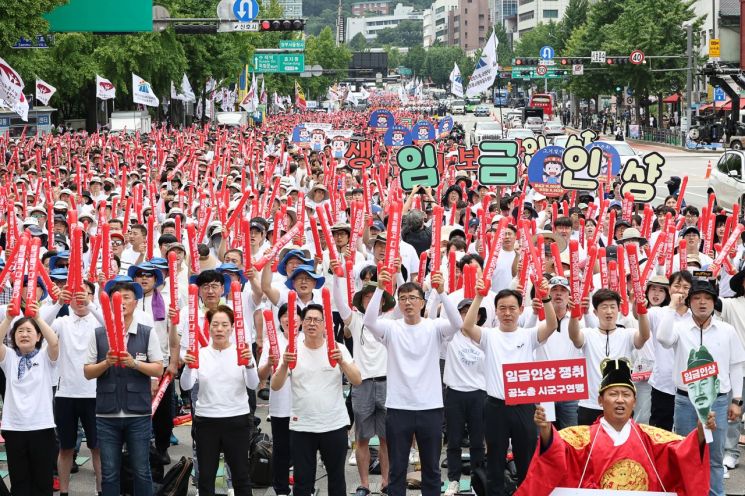
However, during this year's negotiation process, government and expert committee members who had been lukewarm toward the fixed amount wage increase method reportedly reached some consensus on the fixed amount increase method. Ahn Jeong-seop, Senior Vice Chairman of the Federation of Korean Government Employees' Unions, explained, "The government first proposed to us to form a consultative body to discuss promoting the fixed amount wage increase method for next year's public official wage increase," adding, "Internally, we accepted that plan and also accepted the government's differential increase plan by rank." Accordingly, the 'Joint Labor-Government Research Group,' which will begin operation in September, will include both the labor union and government sides to review the fixed amount application model and introduction scenarios.
The fixed amount wage increase means increasing the same amount of money equally from the lowest-ranking public officials to high-ranking officials regardless of their grade. Although higher-ranking officials receive less money compared to the fixed rate system, the advantage is that it can guarantee the living expenses of low-ranking public officials within a limited budget. The labor union argues that the wage level of low-ranking public officials is so low that it does not meet the minimum cost of living, and that the fixed amount increase is necessary because the outflow of low-ranking public officials is accelerating due to low wages. Last year, the public officials' wage level compared to the private sector was 83.1%, marking the lowest since 2000. For general positions excluding teachers and police officers, the wage level compared to the private sector is about 76.0%.
According to the labor union, 43.5% of all public officials, including general positions at grade 7 step 23, grade 6 step 17, and grade 5 step 11 and above, receive higher pay under the fixed rate increase than under the fixed amount increase. However, 56.5% of all public officials, who are lower-ranking and low-step employees, benefit relatively more from the fixed amount increase. When increasing the basic salary by 3.3%, which is the average monthly wage increase rate for public officials, the wage increase for a grade 9 step 1 public official is 123,800 KRW under the fixed amount increase and 62,200 KRW under the fixed rate increase, resulting in a difference of about 60,000 KRW.
However, even if the Salary Committee agrees on a fixed amount increase plan next year, the final decision depends on whether the Ministry of Economy and Finance implements the budget. Currently, the Salary Committee's decisions are only 'recommendations' without legal effect. Nine public official labor unions plan to create a single 'Salary Committee Act' bill that can elevate the Salary Committee to a legal organization like the Minimum Wage Commission and push for legislation in the second half of the year.
© The Asia Business Daily(www.asiae.co.kr). All rights reserved.
![Clutching a Stolen Dior Bag, Saying "I Hate Being Poor but Real"... The Grotesque Con of a "Human Knockoff" [Slate]](https://cwcontent.asiae.co.kr/asiaresize/183/2026021902243444107_1771435474.jpg)
















