UK Financial Times Highlights Korean Parents' Spending Habits
Teenagers Wearing Moncler Padding as School Uniform... Accustomed to Luxury Goods
"Birth Rate Continues to Decline, but Luxury Market Grows"
"South Korea's birth rate is steadily declining, but the luxury market for children continues to grow." On the 25th (local time), the British daily Financial Times (FT) highlighted the conspicuous consumption tendencies of Korean parents, with Lisa Hong, a beauty and fashion consultant at Euromonitor, pointing out this trend. She explained, "Many families have only one child, so they choose the highest-end items and lower the age at which children first consume luxury goods."
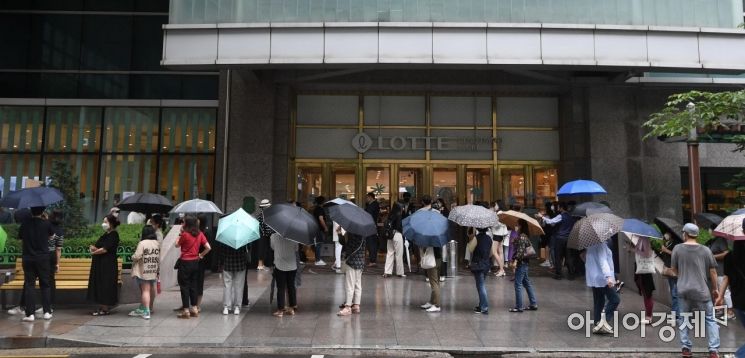 In front of a department store in Seoul, citizens hoping to purchase luxury goods are lined up in a long queue. This image is unrelated to the specific content of the article. Photo by Kim Hyun-min kimhyun81@
FT introduced cases where Korean parents buy expensive luxury products for children under the age of five. Kim, a 38-year-old woman living in Dongtan, Hwaseong, Gyeonggi Province, told FT, "I bought a 780,000 won silver necklace from Tiffany for my 4-year-old daughter and 380,000 won Golden Goose shoes for my 18-month-old daughter." In addition, Moncler jackets and shirts, Burberry dresses and pants, and Fendi shoes were also purchased for the children. Kim said, "I don't want my children to look shabby when they go to weddings, birthday parties, or music concerts," adding, "If they can comfortably go around in these clothes and shoes, the price doesn't matter."
Um, a businesswoman living in Jamsil, Seoul, also said, "I am worried because my 17-year-old daughter has recently become obsessed with luxury goods," and added, "I'm concerned whether my daughter, who has become too accustomed to luxury items, will be able to find a good job later to afford such extravagant consumption." Um's daughter recently received 800,000 won sneakers from a collaboration between Asics and Marc Jacobs as a birthday gift from her grandparents.
FT mentioned that, based on data from the World Bank (WB), South Korea has the lowest birth rate, diagnosing that "as Koreans become wealthier, they are spending money on luxury goods for their small number of offspring."
According to Euromonitor, South Korea is rapidly growing in the premium children's clothing market in terms of per capita expenditure. The average annual growth rate over the past five years exceeded 5%, ranking just after China and Turkey. A representative of a luxury brand's Korean branch told FT, "Korean society is highly competitive, and people want to stand out. Luxury goods are a good tool for this," claiming, "Moncler winter padding has become the uniform for teenagers." In fact, Shinsegae and Hyundai Department Store saw sales of premium children's brands increase by 15% and 27% respectively last year, while Lotte Department Store's sales of premium children's items rose by 25%.
The article also mentioned that luxury brands are recruiting K-pop stars as ambassadors to target people in their 20s and 30s. Advertisements featuring K-pop idols have imprinted luxury brands in the minds of young consumers. According to 2022 Morgan Stanley data, South Korea accounts for about 10% of the global sales of luxury brands such as Prada, Moncler, Bottega Veneta, and Burberry.
FT pointed out that this phenomenon could spoil children, stating, "Getting children accustomed to luxury goods cannot be seen as a purely positive phenomenon."
© The Asia Business Daily(www.asiae.co.kr). All rights reserved.
![Clutching a Stolen Dior Bag, Saying "I Hate Being Poor but Real"... The Grotesque Con of a "Human Knockoff" [Slate]](https://cwcontent.asiae.co.kr/asiaresize/183/2026021902243444107_1771435474.jpg)











