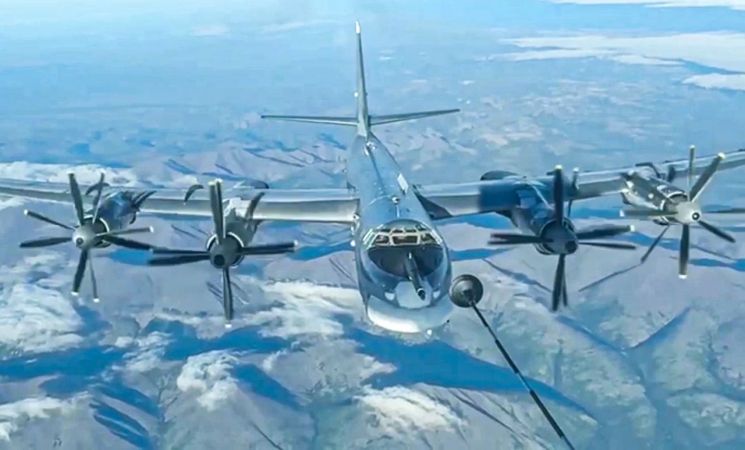
On the 24th (local time), the North American Aerospace Defense Command (NORAD) intercepted and responded to Chinese and Russian bombers flying near the U.S. state of Alaska.
According to major foreign media such as CNN, NORAD stated in a press release that it detected, tracked, and intercepted two Russian long-range strategic bombers TU-95 and two Chinese H-6 bombers that entered the Alaska Air Defense Identification Zone (ADIZ) that day.
The ADIZ is a concept different from national sovereign airspace; it is an arbitrary boundary set outside a country's airspace to identify and respond early to military aircraft approaching its sovereign airspace.
This is the first time Russian and Chinese aircraft have entered the ADIZ together. Previously, in May, four Russian aircraft entered the Alaska ADIZ but did not intrude into the airspace of the United States or Canada.
This is the first time a Chinese H-6 bomber has entered the Alaska ADIZ. This has led to analysis suggesting that China may be trying to expand its influence in the Arctic recently.
The U.S. Department of Defense evaluated that although China is not an Arctic nation, it is attempting to utilize Arctic resources and exert greater influence over the Arctic, and that the joint training of Chinese and Russian navies in the Arctic region over the past few years is part of this movement.
However, Chang Xiaogang, spokesperson for the Chinese Ministry of National Defense, said at a regular briefing, "According to the annual cooperation plan between the Chinese and Russian militaries, on the 25th, the two countries conducted a joint air strategic patrol in the relevant airspace of the Bering Sea," adding, "This action is not aimed at any third party, complies with international law and international practices, and has no relation to the current international and regional situation."
The Russian Ministry of Defense also explained in a statement that the Russian TU-95 and Chinese H-6 conducted a joint patrol for more than five hours over the Chukchi Sea and Bering Sea in the Arctic Ocean and the northern Pacific, with two fighters providing air cover, complying with international law during the patrol, and not violating the airspace of other countries.
© The Asia Business Daily(www.asiae.co.kr). All rights reserved.

















