This year, maritime border crimes such as stowaway and illegal entry, as well as visa-free departure violations, have significantly increased, prompting the Coast Guard to strengthen crackdowns.
According to the Korea Coast Guard on the 25th, as of this date this year, there have been a total of 8 cases involving 30 individuals violating border laws: 2 cases of stowaway and illegal entry involving 5 people, and 6 cases of visa-free departure violations involving 25 people.
This is similar to last year's total of 7 cases involving 35 people. After recording 8 cases with 34 people in 2020, border violation cases decreased to 1 case with 3 people in 2021 and 0 cases in 2022, but have recently been on the rise again.
With the number of foreigners entering Jeju under the visa-free program increasing eightfold compared to the previous year, the number of foreigners attempting unauthorized departure after entry is also rising, and the specialized organizations and brokers transporting and arranging these individuals are gradually becoming more organized.
On the 10th, the Jeju Coast Guard searched the cargo compartment of a refrigerated truck at the Jeju Port 6th pier checkpoint and apprehended one Vietnamese person hiding inside an icebox. He was caught by the Coast Guard while attempting to leave Jeju illegally after entering under the visa-free program. Earlier, in May, five Vietnamese individuals who had illegally left Jeju Island and five members of a domestic brokerage organization were also arrested.
 Vietnamese nationals who entered Jeju under the visa-free entry program and then unlawfully left were caught by the Coast Guard last May.
 [Photo by Korea Coast Guard]
Due to frequent attempts of stowaway for overseas escape by offenders infringing on the livelihood economy and visa-free departure violations, the Coast Guard plans to strengthen crackdowns on these individuals until the 31st of next month.
The Coast Guard has identified that in the West Sea region, which is geographically close to China, there is a high possibility of illegal entry using small boats, while in the South Sea region, economic offenders attempt stowaway to escape abroad or use it as a landing site for unauthorized departure of visa-free entrants.
Additionally, the East Sea is a region of concern for North Korean defectors landing and unauthorized landing of Russian yachts, and Jeju Island is reported to have many cases where foreigners entering under the visa-free program use professional brokers to depart to other regions.
Based on these regional characteristics, the Coast Guard will prepare tailored response measures, operate dedicated teams by regional headquarters, strengthen maritime patrols and stakeouts during weekends, holidays, and vulnerable times, and enhance cooperation with domestic and international related agencies.
In particular, to block unauthorized departure of visa-free entrants, the Coast Guard plans to expand surprise inspections on passenger ships on the Jeju route and thoroughly inspect suspicious vessels navigating maritime stowaway routes, as well as high-speed and small vessels moving through inland waters.
Gomin-gwan, Director of the Information and Foreign Affairs Bureau of the Coast Guard, urged, "If you discover vessels suspected of stowaway, illegal entry, or crimes related to Jeju visa-free entry, please report them to the nearest Coast Guard station."
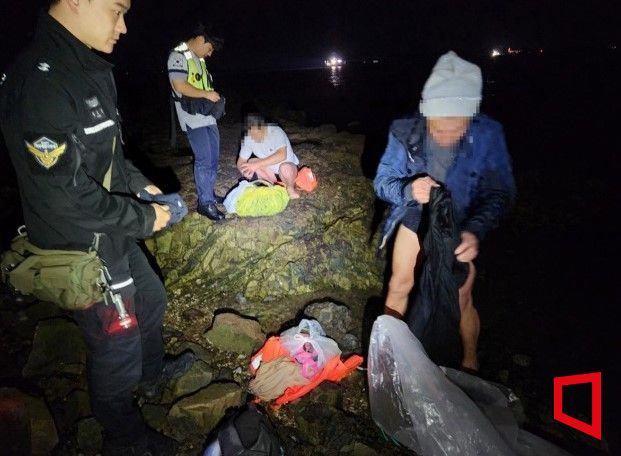 In October last year, 22 Chinese nationals were caught by the Coast Guard while attempting to enter illegally by boat off the coast of Boryeong, Chungnam.
 [Photo by Korea Coast Guard]
© The Asia Business Daily(www.asiae.co.kr). All rights reserved.


















