Timer resembling detonator found in debris of contaminated balloon
Experts say "Gas inside balloon also requires risk analysis"
Precautions needed such as removing flammable materials from rooftop and floor
A detonator attached to a 'filth balloon' dispersed by North Korea fell onto the rooftop of a building, causing a fire. Experts agree that while the danger of the balloon itself cannot be definitively concluded, caution is necessary as the balloon's detonator and gas could lead to an explosion.
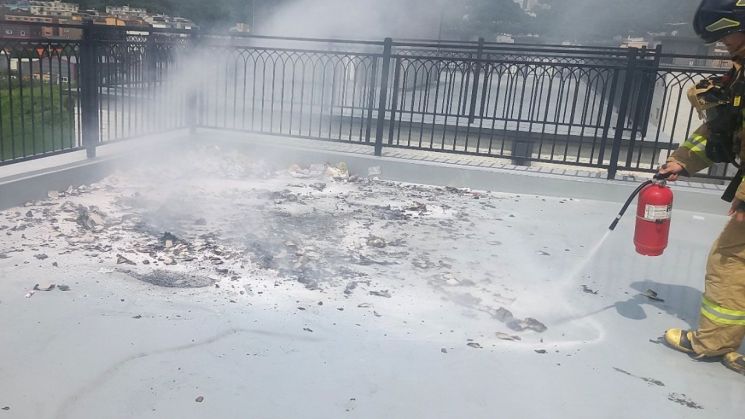 A North Korean waste balloon crashed onto the rooftop of a multi-family house in Goyang-si, Gyeonggi Province, causing a fire.
 [Photo by Gyeonggi Northern Fire and Disaster Headquarters]
According to fire authorities on the 26th, a fire broke out on the afternoon of the 24th at 2:35 PM on the rooftop of a multi-family house in Naeyu-dong, Deogyang-gu, Goyang-si, Gyeonggi Province, when a filth balloon sent by North Korea fell and burst. Fortunately, there were no casualties.
At the scene, a timer was found along with trash and product packaging. In this regard, the Joint Chiefs of Staff analyzed the cause of the fire as being due to a timer in the form of a detonator. A Joint Chiefs official explained in a briefing, "The timer attached to the balloon is designed to burst the balloon after a certain period, spreading the trash, and it is believed that this process led to the fire," adding, "Recently, the proportion of timers attached to balloons has been increasing."
An official from the Gyeonggi Northern Fire and Disaster Headquarters who responded to the scene said, "The reporter explained that there was no fire immediately after the filth balloon fell, but flames were seen three minutes later, prompting the report," and added, "The fire was limited to burning paper that scorched the floor, and since there were no flammable objects nearby, it did not lead to a major fire."
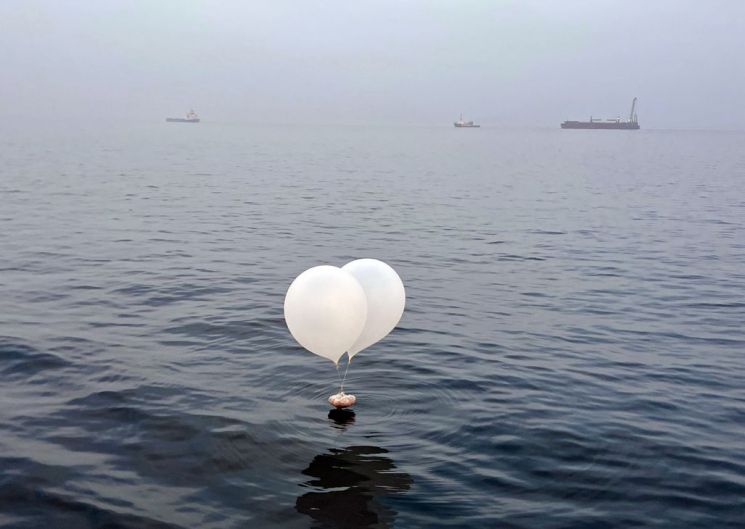
Experts warn that the risk of fire caused by the gas used to lift the filth balloons, along with the detonator, cannot be ignored. While it is difficult to definitively state that the filth balloon itself poses a fire hazard, the hydrogen or helium gases commonly used in buoyancy balloons could potentially lead to fire under certain conditions.
Professor Baek Seung-ju of the Department of Fire and Disaster Prevention at Open Cyber University said, "Helium is relatively safe, but hydrogen, which is comparatively cheaper, is very dangerous," adding, "In some cases, hydrogen can cause fires when it comes into contact with combustible materials such as paper inside the balloon and oxygen." He further noted, "We recently experienced lithium explosion accidents, but hydrogen is even more explosive, so caution is necessary."
Professor Gong Ha-seong of the Department of Fire and Disaster Prevention at Woosuk University also stated, "It is important to analyze what kind of gas is inside the filth balloon to assess the risk," and added, "Even if it is not hydrogen, static electricity from the balloon can ignite and cause flames at any time." In November last year, a fire broke out in India when a decorative balloon filled with hydrogen gas exploded during an event. It is reported that about 30 people near the balloon suffered burns in that incident.
Experts emphasize that to prepare for fire and explosion damage caused by filth balloons, flammable materials on rooftops and other areas should be removed in advance. Professor Baek explained, "This time, the balloon fell on concrete, but if it had fallen on a haystack or mountain, it could have led to a large fire, which is dangerous," and added, "The only way we can respond is to remove flammable materials from rooftops or floors." Professor Gong advised, "If you see a filth balloon coming down, you should stay as far away as possible," and "Also, fire extinguishers should be placed nearby so that fires can be immediately suppressed if they occur."
© The Asia Business Daily(www.asiae.co.kr). All rights reserved.


















