Pyeongtaek Plant 4 Construction Starts with Memory PH
Focused Strategy Targeting HBM Production
HBM3 Supply to Nvidia Begins Next Month
Attention on HBM3E Quality Test Results
Samsung Electronics is reportedly changing its expansion plan within the Pyeongtaek campus in Gyeonggi Province to increase production of the 4th generation High Bandwidth Memory (HBM3). Among the four phase processes (PH) of the Pyeongtaek Plant 4 currently under construction, the HBM line will be built before the foundry line. Attention is focused on whether Samsung will fully accelerate competition, as it has passed Nvidia's qual test (quality verification).
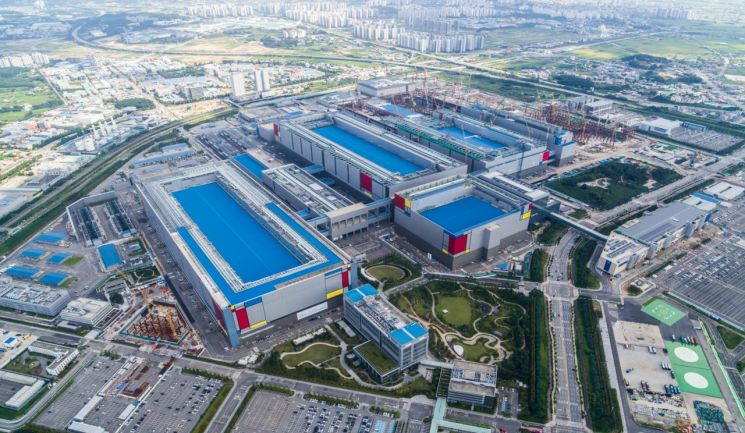
According to industry insiders on the 26th, Samsung Electronics recently revised its construction plan to prioritize building PH3, which produces memory such as DRAM, among the four PHs of Plant 4 at the Pyeongtaek campus. Samsung originally planned to prioritize PH2 and PH4 to strengthen its foundry competitiveness, but after passing the HBM3 test recently, it completely changed the construction direction. It is reported that the DRAM produced here is likely to be used to make HBM. The timing is also interpreted as a measure to meet the situation where HBM3 must be delivered to Nvidia next month. HBM is a device that stacks multiple layers of DRAM to widen the bandwidth of the data passageway and maximize processing speed, requiring a large amount of DRAM to manufacture. An industry insider explained in a phone call with Asia Economy, "The order of PH construction in the factory can always change according to the situation at the time."
In the industry, there is growing support for the forecast that Samsung Electronics will continue to increase and strengthen its DRAM production lines. This is based on the analysis that Samsung will soon expand its influence in the HBM market. In particular, the supply of the 5th generation HBM3E 12-layer product, which is undergoing qual testing, is also expected to be decided soon. Among Taiwanese semiconductor companies familiar with Nvidia's internal news, there are many rumors that Samsung's HBM3E has passed Nvidia's qual test and will be announced as early as the end of this month or at the latest early next month. Considering the next-generation HBM4 currently under development with mass production targeted for next year, Samsung Electronics has no choice but to expand the scale of DRAM production. Samsung is currently producing DRAM at four lines in the Hwaseong plant and others.
In addition to expanding DRAM production lines, Samsung Electronics is expected to make various efforts to strengthen its competitiveness in the HBM market in the second half of this year. Earlier this month, through an organizational restructuring of the Device Solutions (DS) division, Samsung gathered the HBM development teams that were operating within the memory business unit to form a dedicated team for HBM development. The HBM development team has been focusing on next-generation HBM research and development (R&D). Attention is focused on whether the HBM competition landscape will change as Samsung puts more effort into it. From Samsung's perspective, proving superior technology compared to SK Hynix, which has secured the market-leading position, is essential for success. Experts believe that the competition will ultimately be decided by Nvidia's choice. It is analyzed that the fortunes will be divided depending on whose HBM products Nvidia uses in its upcoming high-performance products. According to recent foreign media such as Taiwan's United Daily News, Nvidia has increased orders for its next-generation AI accelerator graphics processing unit (GPU) 'Blackwell' by 25% compared to the original plan, requiring more HBM supply than before. This suggests that competition between Samsung Electronics and SK Hynix, which are expanding their HBM market share, is likely to intensify.
© The Asia Business Daily(www.asiae.co.kr). All rights reserved.
![Clutching a Stolen Dior Bag, Saying "I Hate Being Poor but Real"... The Grotesque Con of a "Human Knockoff" [Slate]](https://cwcontent.asiae.co.kr/asiaresize/183/2026021902243444107_1771435474.jpg)
















