Don't Stop at 'Information Failure'... Need to Improve Counterintelligence System
Spy Charges Unchanged for 70 Years... Can't Investigate Without North Korea
Must Introduce Foreign Agent Registration Act to Block 'Influence Operations'
Criticism is mounting over the exposure of the National Intelligence Service's intelligence activities due to the so-called 'Sumi Terry' incident. The United States makes no exceptions for allies when it comes to protecting national interests. This incident has sparked calls for South Korea to use it as a lesson to not only improve 'intelligence failures' but also to address shortcomings in its counterintelligence system.
'Sumi Terry' Incident: The Core Issue is the Foreign Agents Registration Act
 The U.S. Attorney's Office for the Southern District of New York indicted Sumi Terry, a senior fellow at the Council on Foreign Relations (CFR), on June 16 (local time) for violating the Foreign Agents Registration Act (FARA). The background involves scenes of contact between a National Intelligence Service agent and Terry, as detailed in the prosecution's indictment.
On the 16th (local time), the U.S. Southern District of New York indicted Sumi Terry, a senior fellow at the Council on Foreign Relations (CFR), for violating the Foreign Agents Registration Act (FARA). She was charged with working for South Korea without notifying the government. Terry is a North Korea expert who worked as an analyst at the Central Intelligence Agency (CIA) from 2001 to 2008. After resigning from the CIA, she served as director for Korea, Japan, and Oceania at the White House National Security Council (NSC) until 2010. According to the 31-page indictment, U.S. prosecutors believe Terry acted as an agent for the South Korean government for at least ten years starting from 2013 after leaving public office. The indictment also notes that her initial resignation from the CIA was due to issues arising from contact with the National Intelligence Service (NIS).
The controversy in South Korea centers on the lax movements of the NIS handler mentioned in the indictment. The handler gave Terry expensive luxury bags and clothing as gifts, allowing her to receive tax-free benefits due to her diplomatic status. After a closed-door meeting at the U.S. State Department in June 2022, Terry was driven in a vehicle with diplomatic license plates and received meeting details. This violated the basic principles of covert, indirect, and untraceable intelligence activities. However, since Terry is a 'scholar' and a 'civilian,' contact with her is closer to typical public diplomacy rather than espionage. This suggests it is difficult to view her as a spy. So on what grounds did the U.S. monitor even conversations inside the car?
The Foreign Agents Registration Act (FARA) requires individuals or organizations engaging in activities that could influence U.S. policy or public opinion on behalf of foreign entities to register with the Department of Justice. While it does not restrict activities, it mandates regular reporting of activities related to the foreign principal. Enacted in 1938 to block Nazi propaganda before World War II, the law had become largely dormant, with fewer than ten prosecutions from the 1960s until recently. It was revived when the special counsel investigating the Trump campaign's 'Russia scandal' from 2017 to 2019 indicted several associates of the then-president for FARA violations. The surge in violations cited in Terry's indictment from 2019 onward is seen in this context.
No Law to Investigate Even When Foreign Spies Run Rampant
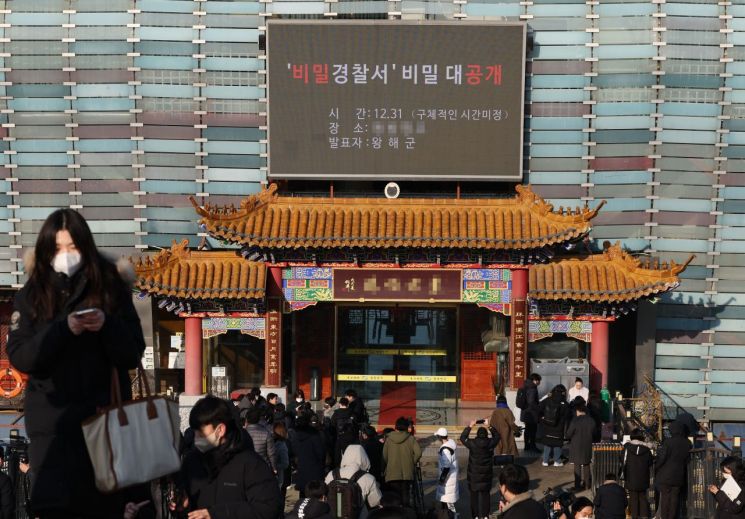 A phrase announcing a press conference to clarify the Chinese restaurant Dongbangmyeongju in Seoul, identified as a domestic base of the Chinese secret police in December 2022, is displayed. [Image source=Yonhap News]
What if this happened in South Korea? Even if someone writes articles or influences public opinion for specific countries like the U.S., Japan, or China, they cannot be punished. Investigations are difficult. Unlike the U.S., which blocks influence even from allies, South Korea lacks adequate legal grounds for counterintelligence.
An intelligence official who has worked in counterintelligence said, "Unless clear crimes such as defense industry corruption or technology leaks under domestic law are committed, there is no way to block agents working for foreign governments regardless of their actions. There is even less basis to prevent political influence or interference."
A prime example is the 'Chinese Secret Police Station' incident that shook the world at the end of 2022. The Chinese government allegedly operated illegal police agencies overseas to collect information and suppress dissidents. In South Korea, a Chinese restaurant by the Han River was identified as a base. While other countries arrested those involved as spies, South Korea prosecuted the restaurant's actual owner, Wang Haijun, for violating food sanitation laws. The secret police allegations could not be investigated due to lack of legal grounds. At the end of last month, the police added embezzlement charges, which is all that has been forwarded.
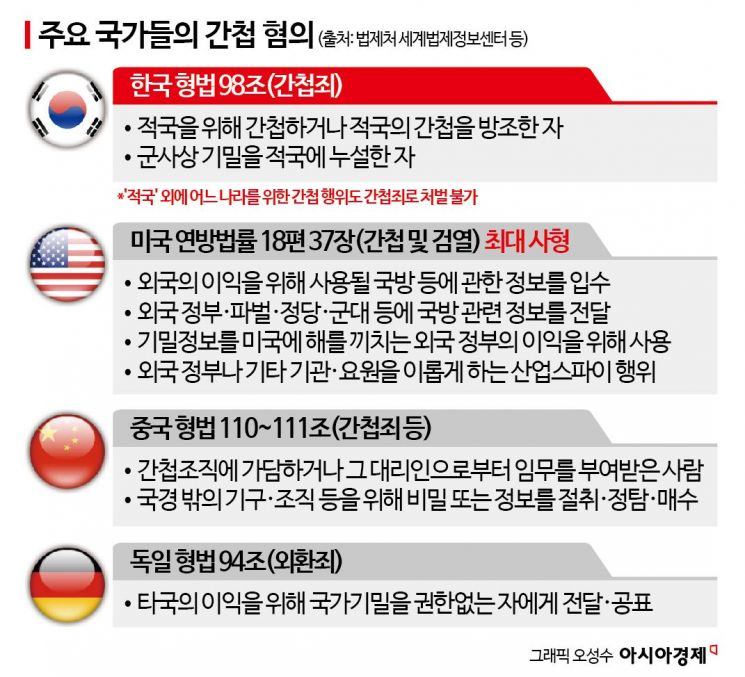
The problem lies in the absence of a FARA-like system and the fact that the espionage crime is limited to 'enemy states.' Article 98, Paragraph 1 of the Criminal Act states, "Anyone who spies for an enemy state or aids an enemy state's spy shall be punished by death, life imprisonment, or imprisonment for at least seven years." This provision specifying 'enemy state' has remained unchanged since the law was enacted in 1953. The concept of enemy state applies only to North Korea. This means there is no way to stop espionage activities for foreign countries other than North Korea. In fact, a naval lieutenant from the Republic of Korea's Defense Security Command who leaked information about a naval destroyer to China in 2015 was not charged with espionage.
Counterintelligence Targets: The International Trend is 'Foreign' Not 'Enemy State'
It is necessary to revisit the concept of counterintelligence. The NIS explains its work by stating, "Counterintelligence targets no longer refer solely to North Korea." Due to the nature of a divided nation, most people associate counterintelligence with detecting North Korean spies, but this is a narrow concept called 'internal security counterintelligence.' Counterintelligence refers to all activities aimed at monitoring and blocking intelligence activities by 'foreign' entities that threaten national security.
Activities by defense industry lobbyists and spies aiming to leak industrial secrets are increasing, and North Korea has shifted its offensive tactics to 'influence operations' that interfere with public opinion. Meanwhile, the NIS has transferred internal security investigative authority to the police and no longer has legal grounds to initiate 'investigations.' Currently, it only supports investigative authorities with information collected at the 'inquiry' level. In the era of information warfare, counterintelligence is effectively hamstrung.
Major countries have already enacted laws similar to the U.S. FARA. Australia enforces the Foreign Influence Transparency Scheme (FITS), requiring registration as a foreign agent when acting on behalf of foreign governments. Interfering in domestic affairs is subject to criminal penalties. The definition of 'influence activities' broadly includes funding activities that affect policy processes. The United Kingdom has the Foreign Influence Registration Scheme (FIRS), allowing the Home Secretary to designate specific foreign entities for registration if deemed necessary for security and national interest.
The scope of espionage charges is also expanding from 'enemy state' to 'foreign' with stronger responses. According to Title 18, Chapter 37 of the U.S. Code, espionage charges apply to those who obtain information to be used for foreign interests or deliver defense-related information to foreign governments, factions, or parties, with penalties up to death. Article 110 of the Chinese Criminal Law punishes those who join espionage organizations or receive missions with life imprisonment or at least ten years. The same penalties apply to theft, reconnaissance, or bribery of information for organizations outside the border.
South Korea has a concept similar to FARA. Under the Inter-Korean Exchange and Cooperation Act, individuals traveling to North Korea or contacting North Korean residents must report in advance to the Ministry of Unification. However, like the current espionage law, this focuses solely on North Korea. This shows that the existing counterintelligence system is trapped in a narrow perspective that only considers the Korean Peninsula situation without reflecting contemporary changes.
"Korean Version of Foreign Agents Registration Act... Expanding the Espionage Concept"
Consequently, voices are emerging in South Korea calling for the introduction of a 'Foreign Agents Registration Act.' The idea is to shift the counterintelligence concept from North Korea to foreign countries. This would allow legal oversight of orders and financial operations directed by foreign governments to their agents and enable detailed monitoring of activities by arms brokers or industrial spies. In June last year, Choi Jae-hyung, then a member of the People Power Party, proposed such a 'Korean version of the Foreign Agents Registration Act,' but it was shelved in the Legislation and Judiciary Committee and eventually discarded.
In the same vein, revising espionage charges is also an urgent task. Although political consensus has formed since the early 2000s, bills have repeatedly failed due to political conflicts. In the 22nd National Assembly, both ruling and opposition parties have proposed amendments to the Criminal Act. On the 21st of last month, ten members including Joo Ho-young of the People Power Party submitted a bill, and on the 4th of this month, twelve members including Jang Kyung-tae of the Democratic Party submitted another. While there are detailed differences, the core is the same: to expand the application of espionage charges in the Criminal Act from 'enemy state' to 'foreign' in line with the ambiguous concept of enemy state in the current era and changes in international affairs.
An expert from a government-funded research institute, speaking anonymously, said, "If a Foreign Agents Registration Act is enacted, influence operations can be monitored in advance and punished if they harm national interests. Currently, there is no shield to protect sovereignty from foreign government interference in domestic affairs." He warned, "If this incident ends with blaming a particular administration, the NIS will only deteriorate while being hamstrung."
Nam Seong-wook, director of the Korea University Institute for Unification and Convergence Studies and a former NIS official, said, "It is necessary to normalize the selection process for NIS dispatched agents, which has fluctuated with each regime change," and urged, "It is urgent to study and analyze the direction of the U.S. FARA application, which has changed since 2019." He added, "Taking this incident as an opportunity, we should also consider introducing a Korean version of the Foreign Agents Registration Act to protect national interests and security."
© The Asia Business Daily(www.asiae.co.kr). All rights reserved.
![Clutching a Stolen Dior Bag, Saying "I Hate Being Poor but Real"... The Grotesque Con of a "Human Knockoff" [Slate]](https://cwcontent.asiae.co.kr/asiaresize/183/2026021902243444107_1771435474.jpg)


















