"The Speaker of the National Assembly Is Not Just a Simple Moderator"
Speaker of the National Assembly Woo Won-sik pointed out that the ruling government party is responsible for the paralysis of the political situation after rejecting the mediation proposal related to the Broadcasting Act, and announced his intention to handle the agenda items, including the Broadcasting Act, submitted to the plenary session the following day.
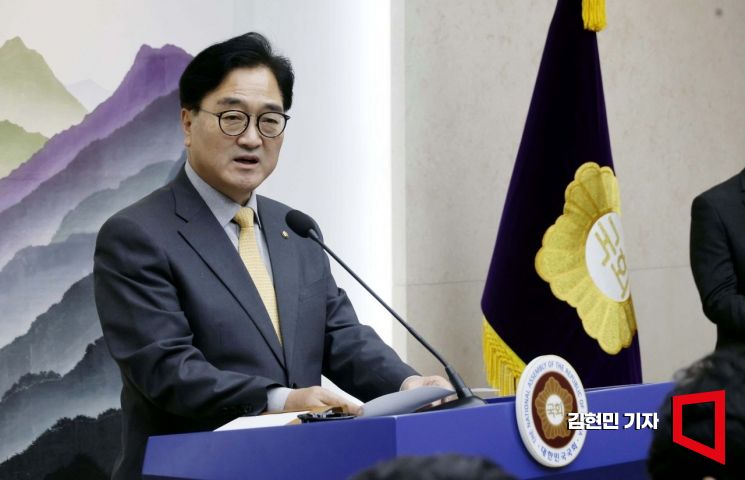 Woo Won-shik, Speaker of the National Assembly, is holding an emergency press conference on the 24th at the National Assembly regarding the mediation proposal for the Broadcasting Act and other current parliamentary issues. Photo by Hyunmin Kim kimhyun81@
On the 24th, Speaker Woo held a press conference at the National Assembly in Yeouido, Seoul, stating, "The vicious cycle of extreme conflict surrounding the legislation of the four broadcasting laws (Broadcasting Act, Broadcasting Culture Promotion Act, Korea Educational Broadcasting System Act, and the Act on the Establishment of the Korea Communications Commission) and the appointment of executives of public broadcasters has repeated again," adding, "It is truly regrettable and I apologize to the people."
He criticized the ruling government party for irresponsibility in rejecting the mediation proposal. Speaker Woo said, "The ruling party repeatedly emphasized dialogue and compromise in the operation of the National Assembly, but when the Speaker, after much deliberation, presented a mediation proposal, they rejected it," adding, "This is inconsistent." Furthermore, he pointed out, "The extreme dysfunction of the Korea Communications Commission has continued for over a year, but regarding the Speaker’s mediation proposal, the ruling party shifted responsibility to the government citing personnel authority, and the government shifted responsibility back to the ruling party citing bipartisan agreement," and said, "It can only be seen as neglecting and abetting the conflict."
Speaker Woo stated that if the confrontation between the ruling and opposition parties continues, he plans to sequentially process the bills, including the Broadcasting Act, that come up in the plenary session. It is expected that not only the four broadcasting laws but also the re-vote on the special investigation law for Corporal Chae will be conducted in the plenary session the next day. Speaker Woo said, "We have no choice but to sequentially process the bills submitted to the plenary session starting tomorrow," and added, "The Speaker of the National Assembly has the duty to create a National Assembly that reflects the public sentiment that formed the 22nd National Assembly." Regarding the 'third-party special investigation' proposed by Han Dong-hoon, the new leader of the People Power Party, he said, "That is separate from what each party is discussing," and plans to prioritize re-voting on the special investigation law for Corporal Chae, which was led by the opposition parties.
Speaker Woo also expressed his intention to actively intervene if the deadlock continues. He said, "The Speaker of the National Assembly is not just a simple moderator," and added, "If there are bills that benefit the people but conflicts between the ruling and opposition parties continue, it is natural for the Speaker to guide the process in a direction that serves the people."
© The Asia Business Daily(www.asiae.co.kr). All rights reserved.
![Clutching a Stolen Dior Bag, Saying "I Hate Being Poor but Real"... The Grotesque Con of a "Human Knockoff" [Slate]](https://cwcontent.asiae.co.kr/asiaresize/183/2026021902243444107_1771435474.jpg)
















