The National Assembly's Legislation and Judiciary Committee decided on the 24th to determine whether to refer the bills for the 'Han Dong-hoon Special Prosecutor Act' and the 'Kim Geon-hee Special Prosecutor Act' to a subcommittee after going through hearings and other procedures. Additionally, the Yellow Envelope Act and the Special Act on Livelihood Recovery Support Funds were deferred for a vote.
The Legislation and Judiciary Committee held a plenary meeting that day and made these decisions regarding the bills under discussion. Initially, the bill to provide a 250,000 won livelihood recovery support fund, a general election pledge of former Democratic Party leader Lee Jae-myung, and the Yellow Envelope Act were expected to be passed solely by the opposition party, but they were held in the plenary session. Previously, these two bills were passed solely by the opposition in the relevant standing committees, the National Assembly's Administration and Security Committee and the Environment and Labor Committee.
The ruling and opposition members of the Legislation and Judiciary Committee engaged in fierce disputes from the start over the handling of the related bills. Democratic Party lawmaker Lee Geon-tae pointed out regarding the Yellow Envelope Act, "In our country, employers tend to exploit subcontracting structures," and added, "We need to comprehensively consider the status and role within labor unions and the circumstances of participation in industrial actions." On the other hand, People Power Party lawmaker Jang Dong-hyuk countered, "If the law unilaterally stipulates that compensation must be paid by differentiating the scope of responsibility for each case, it effectively places all the burden of proof on the employers who suffered damages."
The major bills, the 'Han Dong-hoon Special Prosecutor Act' and the 'Kim Geon-hee Special Prosecutor Act,' will first proceed with hearings and public hearings. Jeong Cheong-rae, chair of the National Assembly's Legislation and Judiciary Committee from the Democratic Party, stated, "Since these two bills are enactment bills, according to Article 58 of the National Assembly Act, public hearings or hearings must be held," and added, "After being held in the plenary session, they will be referred to the subcommittee following the public hearings or hearings."
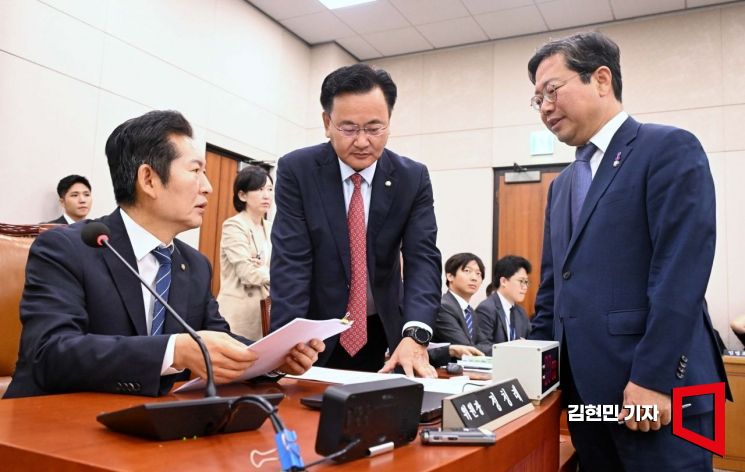 Jeong Cheong-rae, Chairman of the National Assembly Judiciary Committee, is talking with Yoo Sang-beom and Kim Seung-won, the ruling and opposition party secretaries, at the plenary meeting of the Legislation and Judiciary Committee held at the National Assembly on the 24th. Photo by Kim Hyun-min kimhyun81@
Before the meeting, the People Power Party argued that the agenda's submission was invalid due to the lack of consultation procedures among the parliamentary negotiation groups, but this was not accepted. People Power Party lawmaker Song Seok-jun, during a procedural speech, said, "The first bill raises suspicions about actions that were properly carried out as a prosecutor and as Minister of Justice," and questioned, "Is it appropriate to conduct a special prosecutor investigation on matters that could be clarified during a confirmation hearing as if they were major national incidents?" He also protested to Chair Jeong, saying, "The second bill concerns matters currently under investigation and is not subject to a special prosecutor."
Another lawmaker from the same party, Park Jun-tae, expressed strong regret, saying, "The Legislation and Judiciary Committee always claims that people's livelihoods are difficult, yet again has submitted a politically charged special prosecutor bill. They only talk about impeachment special prosecutors," and raised his voice, "The new party leader (Han Dong-hoon) was elected at the party convention; is this how you congratulate him?"
In response, Chair Jeong drew a line, stating, "Whether it is the Han Dong-hoon Special Prosecutor Act or the Kim Geon-hee Special Prosecutor Act, we can first submit them and decide on the handling process through intense debate." The ruling party plans to initiate unlimited debate (filibuster) if contentious bills such as the livelihood recovery support fund bill are brought to the plenary session.
Meanwhile, the petition opposing the proposal to impeach President Yoon Seok-youl, which was also on the agenda, was held in the plenary session. This was due to the ruling party not having decided on holding hearings. Although the ruling party has bought some time regarding contentious bills, it is expected that the agenda will inevitably be submitted as the 'continued review' effectively continues.
© The Asia Business Daily(www.asiae.co.kr). All rights reserved.
![Clutching a Stolen Dior Bag, Saying "I Hate Being Poor but Real"... The Grotesque Con of a "Human Knockoff" [Slate]](https://cwcontent.asiae.co.kr/asiaresize/183/2026021902243444107_1771435474.jpg)
















